Italiano in pratica
by Alessio · teacher of Italian for foreigners, ITALS master’s in teaching Italian abroad (Ca’ Foscari University, Venice) and a master’s in teaching Italian as a second language (Giustino Fortunato University, Benevento)
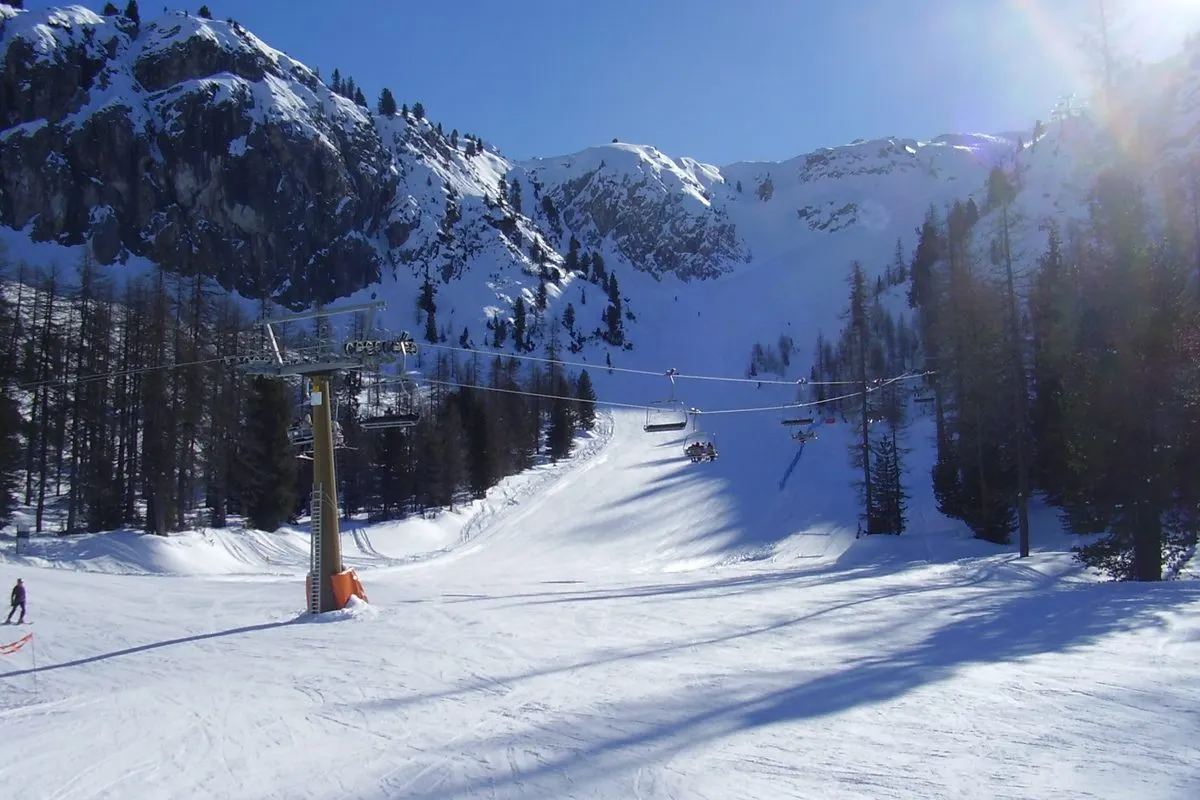
On Italian slopes two rules apply to visitors too: a helmet is compulsory for under-18s, and every skier needs third-party insurance, which you can buy together with the skipass. Slopes are marked blu (easy), rossa (intermediate) and nera (difficult).
The Dolomites, the Aosta Valley, the Alps above Turin: Italian ski resorts are full of foreign visitors, and English goes a long way. But the rental shop, the ticket office and the hut at lunchtime run on Italian, and the signs on the slopes always do.
Here's how to buy the pass, rent the gear, read the slopes and order lunch at the rifugio, with closed questions for every doubt.
| Italian | English |
|---|---|
| Un giornaliero, per favore. | A one-day pass, please. |
| L'assicurazione è compresa? | Is insurance included?answer: sì or no |
| Vorrei noleggiare sci e scarponi. | I'd like to rent skis and boots. |
| Porto il quarantadue. | I take a 42.boot size |
| Questa pista è facile? | Is this slope easy?answer: sì or no |
| La seggiovia è aperta? | Is the chairlift open?answer: sì or no |
| Vorrei una lezione privata. | I'd like a private lesson. |
| C'è posto al rifugio? | Is there room at the hut?answer: sì or no |
Read the Italian out loud once before you need it. The questions marked sì or no get a one-word answer you can understand.
At the ticket office, la biglietteria, or online. Ask for un giornaliero, a one-day pass, mezza giornata, half a day, or un plurigiornaliero for several days. Every skier must have third-party insurance: it's usually offered with the pass for a few euros a day.
Children, juniors and seniors often pay less: c'è una riduzione per bambini? Keep the pass in a pocket of its own: gates read it without contact.
| You say | English |
|---|---|
| Un giornaliero, per favore. | A one-day pass, please. |
| L'assicurazione è compresa? | Is insurance included?sì or no |
| C'è una riduzione per bambini? | Is there a discount for children?sì or no |
| Vale anche per l'altra valle? | Is it valid in the other valley too?sì or no |
| You hear | English |
|---|---|
| Con l'assicurazione? | With insurance?sì or no |
| Mi serve una foto. | I need a photo.for multi-day passes, sometimes |
| La cauzione per la tessera è di cinque euro. | The card deposit is five euros. |
Say what you need, sci, scarponi e bastoncini, skis, boots and poles, or una tavola for a snowboard, then your size, height and level. The questions are always the same three: che numero porta?, quanto è alto?, che livello?
Rent a helmet, un casco, too: compulsory for under-18s on Italian slopes, and sensible for everyone.
| You say | English |
|---|---|
| Vorrei noleggiare sci e scarponi. | I'd like to rent skis and boots. |
| Porto il quarantadue. | I take a 42. |
| Sono principiante. | I'm a beginner.intermedio, esperto |
| Gli scarponi sono stretti. | The boots are tight. |
| Anche il casco, per favore. | A helmet too, please. |
| You hear | English |
|---|---|
| Che numero porta? | What's your shoe size? |
| Quanto è alto? | How tall are you? |
| Che livello? | What level? |
| Li riporta entro le cinque. | Bring them back by five. |

Slopes are piste: blu for beginners, rossa intermediate, nera difficult. Lifts: seggiovia (chairlift), cabinovia (gondola), funivia (cable car), skilift (drag lift) and, for beginners, tapis roulant (magic carpet).
Pista chiusa means the slope is closed: don't go. Off-piste, fuoripista, carries avalanche risk, pericolo valanghe, and is never patrolled.
| You say | English |
|---|---|
| Questa pista è facile? | Is this slope easy?sì or no |
| La seggiovia è aperta? | Is the chairlift open?sì or no |
| Da qui si arriva al paese? | Can you get back to the village from here?sì or no |
| pista blu · rossa · nera | easy · intermediate · difficult slope |
| You hear | English |
|---|---|
| Pista chiusa. | Slope closed.don't go |
| Prenda la rossa e poi la blu. | Take the red and then the blue. |
| Pericolo valanghe. | Avalanche danger.off-piste: stay away |

In the  amo Italian app you practise inside real-life pathways: il bar, il ristorante, i trasporti, la casa and more, with listening, dialogues and the grammar explained in English. This page gives you the phrases; the app trains your ear.
Half the A1 course free, no sign-up
★★★★★(22)by Alessio, teacher since 2018
Downloadamo Italian for iPhone ↗︎Search for amo Italian
At the ski school, la scuola di sci: a private lesson, lezione privata, or a group course, corso collettivo. Say your level and ask a closed question: il maestro parla inglese?
Children's courses usually run in the morning and fill up fast in the holidays: book early.
| You say | English |
|---|---|
| Vorrei una lezione privata. | I'd like a private lesson. |
| Il maestro parla inglese? | Does the instructor speak English?sì or no |
| Ci sono corsi per bambini? | Are there courses for children?sì or no |
| You hear | English |
|---|---|
| Un'ora o due? | One hour or two?a choice of two |
| Il ritrovo è davanti alla scuola. | The meeting point is in front of the school. |

A rifugio is a mountain hut with a restaurant, ideal for lunch on the slopes: ask c'è posto? and order the local dish. On the slopes, skiing under the influence of alcohol is forbidden, and the skier below you has right of way.
If there's an accident, stop, help, and call the slope rescue number on your skipass or 112.
| You say | English |
|---|---|
| C'è posto al rifugio? | Is there room at the hut?sì or no |
| Cosa c'è di tipico? | What's the local speciality? |
| Un tè caldo, per favore. | A hot tea, please. |
| C'è stato un incidente sulla pista. | There's been an accident on the slope. |
| You hear | English |
|---|---|
| Il piatto del giorno è polenta e spezzatino. | Today's dish is polenta and stew. |
| Si paga alla cassa. | You pay at the till. |
For many Italian families skiing means the settimana bianca, the white week: a week in the mountains, often in the same resort every year, at Christmas, in the February school holidays or around Carnival. Those weeks and the weekends are busy; mid-week in January or March the same slopes can be almost empty. In 2026 Italy hosted the Winter Olympics in Milan and Cortina, which brought new lifts and a lot of foreign attention to its resorts.

The scale is large. The Dolomites, a UNESCO World Heritage Site since 2009, are covered by the Dolomiti Superski pass: one ticket for twelve ski areas and about 1,200 km of slopes. In South Tyrol you will notice that the mountains are bilingual: German is spoken as much as Italian, place names come in both languages, Bolzano and Bozen, and in some valleys there is a third language, Ladin. A buongiorno works everywhere; a Grüß Gott will win you a smile.
Lunch is the other difference. Where a North American resort sells a quick burger at the base, Italians stop at a rifugio for a proper meal: polenta, canederli, a glass of wine, an hour in the sun on the terrace. The law adds a few rules visitors follow too, all from a 2021 decree: a helmet for under-18s, third-party insurance for every skier, and no skiing under the influence of alcohol.
Read next: Why are Italian town centres closed to cars? · How does healthcare work in Italy, and what does it mean for visitors?
Italians rarely answer with a bare sì or no. These are the forms you will actually hear, so you know which way the answer went.
| You hear | English | It means |
|---|---|---|
| Sì, certo. | Yes, of course. | yes |
| Certo! | Sure! | yes |
| Come no! | Of course! (literally: how not?) | yes |
| Volentieri. | Gladly. | yes |
| Va bene. | Fine, OK. | yes |
| Prego. | Go ahead / please do. | yes |
| No, mi dispiace. | No, I'm sorry. | no |
| Purtroppo no. | Unfortunately not. | no |
| Non c'è. | There isn't any. | no |
| È finito. | It's sold out / all gone. | no |
| Non si può. | That's not allowed. | no |
| Non ancora. | Not yet. | no |
Six real replies. Tap Yes or No for each one.
The grammar behind them
This guide as two printable pages, in English: the phrases to say, the yes/no questions and what you will hear.
All 43 phrase PDFs · €9Already included in the full course · €39 a year.
Or keep the eight phrases as an image, to save on your phone or pin:
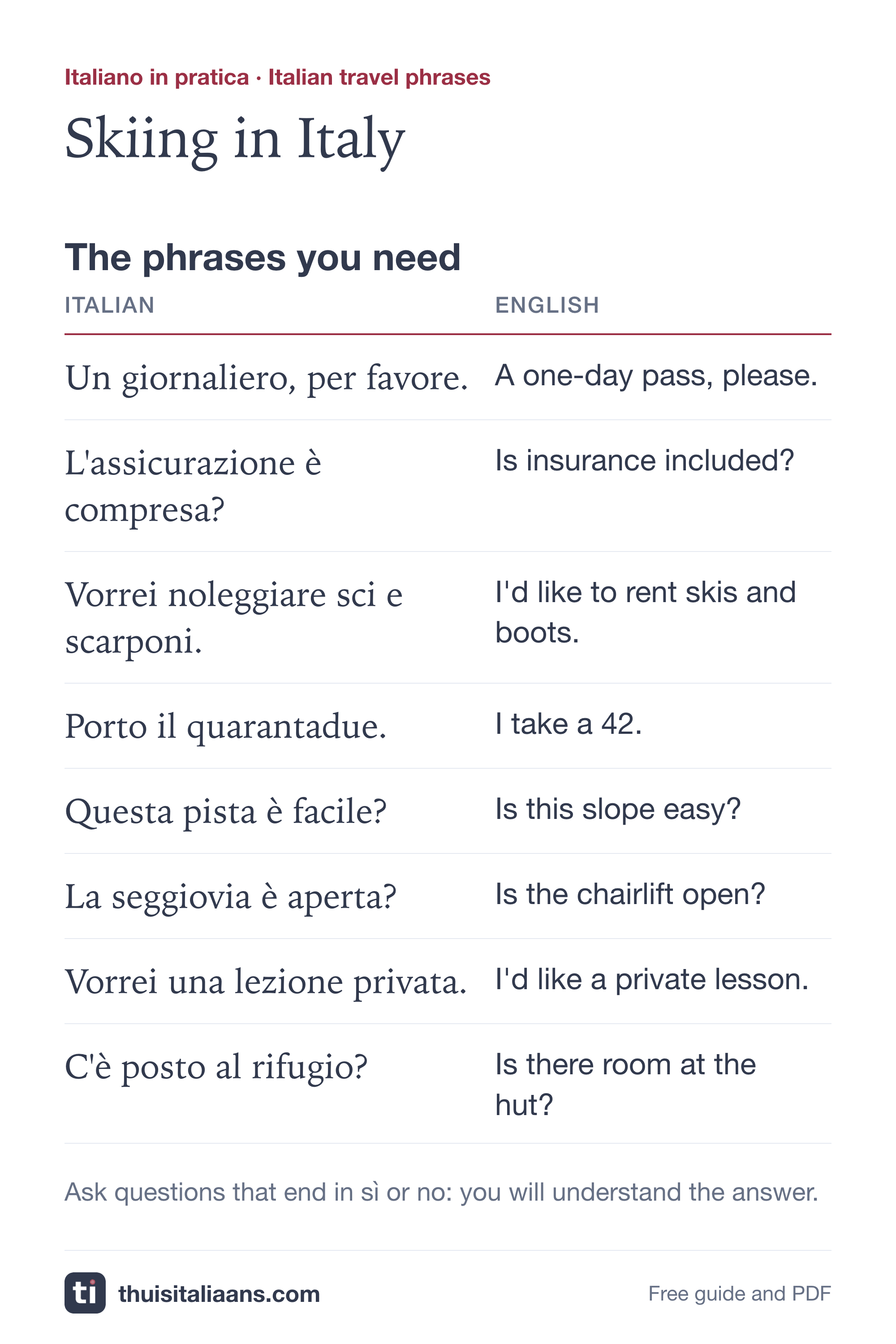 Italian phrases: Skiing in Italy
For under-18s, yes, on alpine slopes. It's strongly recommended for adults too.
Yes: every skier on Italian slopes must have third-party liability insurance. It's usually sold with the skipass.
Blue is easy, red intermediate and black difficult.
A mountain hut with a restaurant, often on the slopes, where skiers stop for lunch.