Italiano in pratica
by Alessio · teacher of Italian for foreigners, ITALS master’s in teaching Italian abroad (Ca’ Foscari University, Venice) and a master’s in teaching Italian as a second language (Giustino Fortunato University, Benevento)
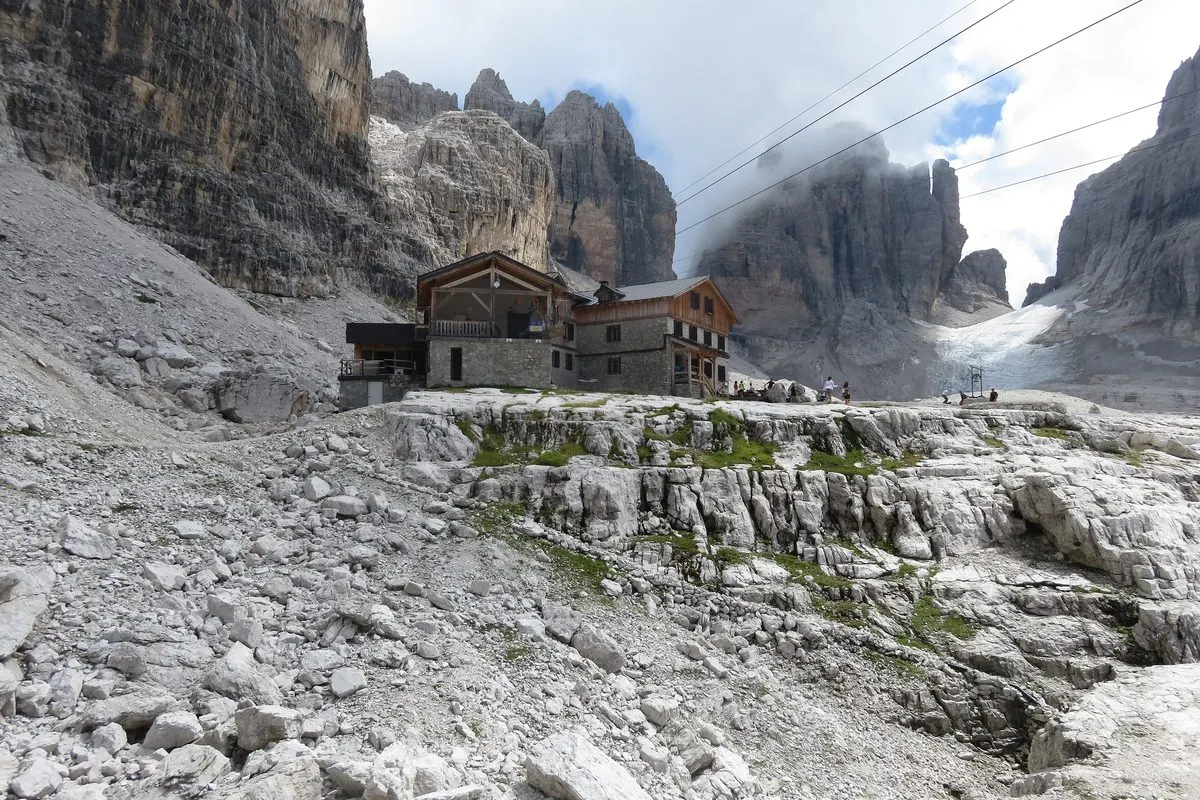
A rifugio is a mountain hut with beds and a kitchen, often reachable only on foot. In huts of the Italian Alpine Club (CAI) a sleeping-bag liner is required, boots stay outside the rooms, and a booking is usually held only until 6 pm: call if you'll be late.
You arrive after six hours of walking, the sun is going down behind the Dolomites, and the warden is laying out bowls of soup for forty people. The rifugio is the heart of Italian mountain life, and it has its own customs.
Here is how to book, what to bring, how dinner works, how to read the trail signs, and the closed questions that matter when the weather turns.
| Italian | English |
|---|---|
| Avete posto per stanotte? | Do you have room for tonight?answer: sì or no |
| Abbiamo prenotato a nome Miller. | We booked under the name Miller. |
| La mezza pensione è compresa? | Is half board included?answer: sì or no |
| Avete il sacco lenzuolo? | Do you have a sleeping-bag liner?answer: sì or no |
| Questo è il sentiero per il rifugio? | Is this the path to the hut?answer: sì or no |
| Quanto ci vuole a piedi? | How long does it take on foot? |
| Domani il tempo tiene? | Will the weather hold tomorrow?answer: sì or no |
| Il sentiero è difficile? | Is the path difficult?answer: sì or no |
Read the Italian out loud once before you need it. The questions marked sì or no get a one-word answer you can understand.
Book by phone, email or the hut's website; in summer the popular huts fill weeks ahead. A booking counts only when the warden, il gestore, confirms it, and in CAI huts it's usually held until 6 pm on the day: if you'll arrive later, call, or your beds may be given away.
Some huts ask for a deposit. Phone signal can be poor on the trail, so warn them before you set off if you're running late.
| You say | English |
|---|---|
| Avete posto per stanotte? | Do you have room for tonight?sì or no |
| Abbiamo prenotato a nome Miller. | We booked under the name Miller. |
| Arriviamo dopo le sei, va bene? | We'll arrive after six, is that OK?sì or no |
| Serve una caparra? | Do you need a deposit?sì or no |
| You hear | English |
|---|---|
| Siamo al completo. | We're full.no |
| Mi chiami se tardate. | Call me if you're late. |
| Vi tengo i posti fino alle sei. | I'll keep the beds until six. |
A sleeping-bag liner, il sacco lenzuolo: in CAI huts it's compulsory, because blankets can't be washed every day at altitude; if you forget it, most huts sell or rent one. Also bring hut slippers or light shoes, a head torch and cash, because not every hut takes cards.
Boots stay in the boot room, il locale scarponi, and you walk inside in slippers. Dormitories are shared, and lights go out early: most people start walking at dawn.
| You say | English |
|---|---|
| Avete il sacco lenzuolo? | Do you have a sleeping-bag liner?sì or no |
| Dove si lasciano gli scarponi? | Where do you leave boots? |
| Si può pagare con la carta? | Can you pay by card?sì or no |
| C'è la doccia calda? | Is there a hot shower?sì or no |
| You hear | English |
|---|---|
| Gli scarponi restano fuori. | Boots stay outside. |
| Il sacco lenzuolo è obbligatorio. | A sleeping-bag liner is compulsory. |
| La doccia è a gettone. | The shower takes a token.pay for hot water |
Most huts offer half board, mezza pensione: dinner, bed and breakfast at one price, with drinks extra. Dinner is served at a set time, often around seven, at shared tables; say when you book if you have dietary needs.
Day walkers can stop for lunch without sleeping there: polenta, soups and cakes are mountain classics. Water may be sold in bottles, because it all comes up by cable or helicopter.
| You say | English |
|---|---|
| La mezza pensione è compresa? | Is half board included?sì or no |
| A che ora si cena? | What time is dinner? |
| Avete qualcosa senza carne? | Do you have anything without meat?sì or no |
| Possiamo riempire le borracce? | Can we fill our water bottles?sì or no |
| You hear | English |
|---|---|
| Le bevande sono a parte. | Drinks are extra. |
| La cena è alle sette. | Dinner is at seven. |
| L'acqua qui non è potabile. | The water here isn't drinkable.no |


In the  amo Italian app you practise inside real-life pathways: il bar, il ristorante, i trasporti, la casa and more, with listening, dialogues and the grammar explained in English. This page gives you the phrases; the app trains your ear.
Half the A1 course free, no sign-up
★★★★★(22)by Alessio, teacher since 2018
Downloadamo Italian for iPhone ↗︎Search for amo Italian
Paths are marked with red and white stripes painted on rocks and trees, and a number. Signposts give destinations and walking times in hours, not distances. The CAI grades paths as T (tourist), E (hiking), EE (for expert hikers) and EEA (with protected sections, via ferrata equipment needed).
Ask locals in closed questions, and trust the times on the signs more than your map app: they include the climb.
| You say | English |
|---|---|
| Questo è il sentiero per il rifugio? | Is this the path to the hut?sì or no |
| Quanto ci vuole a piedi? | How long does it take on foot? |
| Il sentiero è difficile? | Is the path difficult?sì or no |
| È segnato bene? | Is it well marked?sì or no |
| You hear | English |
|---|---|
| Segua i segni bianchi e rossi. | Follow the white and red marks. |
| Due ore e mezza. | Two and a half hours. |
| È per escursionisti esperti. | It's for experienced hikers.think twice |

In the Alps summer storms often build in the afternoon, so start early and ask the warden about the forecast: they know the mountain better than any app. In an emergency call 112; in some regions the mountain rescue service has its own direct number, written in the hut.
Tell the warden which way you're going the next morning. If the weather turns, staying an extra night is always an option.
| You say | English |
|---|---|
| Domani il tempo tiene? | Will the weather hold tomorrow?sì or no |
| Si può passare dal passo? | Can you get over the pass?sì or no |
| C'è neve sul sentiero? | Is there snow on the path?sì or no |
| Ci siamo persi. | We're lost. |
| You hear | English |
|---|---|
| Nel pomeriggio arrivano i temporali. | Storms are coming in the afternoon. |
| Partite presto. | Set off early. |
| Oggi non conviene. | Today it's not a good idea.no |
The Alps and the Apennines are dotted with huts, many of them owned by the Italian Alpine Club, CAI, and run in summer by a warden and their family. A rifugio is a shelter before it is a business: it exists so that walkers and climbers can eat, sleep and wait out bad weather high up, far from roads. Everything up there arrives on someone's back, by cable or by helicopter, which explains the simple food, the bottled water and the shared dormitories.

Hut rules follow from that. In CAI huts a sleeping-bag liner is compulsory, because blankets can't be washed every day at altitude. Boots stay in the boot room. A booking is valid only once the warden confirms it, and unless agreed otherwise it is held until six in the evening of the day of arrival: after that, the beds may go to someone else. Many huts offer half board, dinner, bed and breakfast, with drinks paid separately.
The paths have their own language too. Trails are marked with red and white stripes and a number, signposts give times rather than distances, and the CAI scale grades each route from T, an easy tourist path, to E for hiking, EE for experienced hikers and EEA for routes with fixed cables that need via ferrata equipment. The warden's advice on the weather is worth more than any app: summer storms in the Alps tend to build in the afternoon.
Read next: How is skiing in Italy different from skiing elsewhere? · Why do Italians take the waters?
Italians rarely answer with a bare sì or no. These are the forms you will actually hear, so you know which way the answer went.
| You hear | English | It means |
|---|---|---|
| Sì, certo. | Yes, of course. | yes |
| Certo! | Sure! | yes |
| Come no! | Of course! (literally: how not?) | yes |
| Volentieri. | Gladly. | yes |
| Va bene. | Fine, OK. | yes |
| Prego. | Go ahead / please do. | yes |
| No, mi dispiace. | No, I'm sorry. | no |
| Purtroppo no. | Unfortunately not. | no |
| Non c'è. | There isn't any. | no |
| È finito. | It's sold out / all gone. | no |
| Non si può. | That's not allowed. | no |
| Non ancora. | Not yet. | no |
Six real replies. Tap Yes or No for each one.
The grammar behind them
This guide as two printable pages, in English: the phrases to say, the yes/no questions and what you will hear.
All 43 phrase PDFs · €9Already included in the full course · €39 a year.
Or keep the eight phrases as an image, to save on your phone or pin:
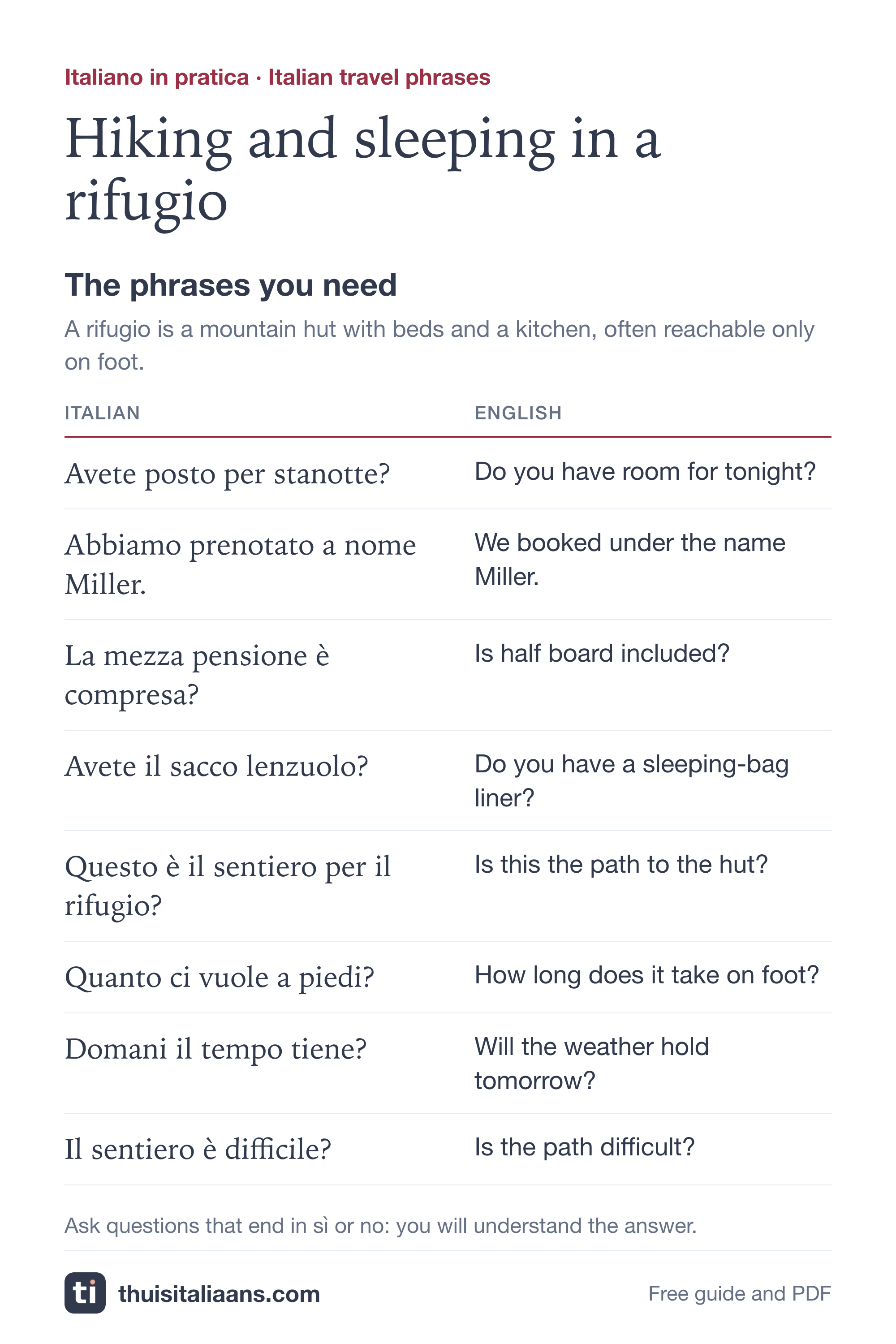 Italian phrases: Hiking and sleeping in a rifugio
A mountain hut with beds and meals, often reachable only on foot. Many belong to the Italian Alpine Club (CAI).
In CAI huts a sleeping-bag liner is compulsory; blankets are provided. Most huts sell or rent liners if you forget.
In CAI huts usually until 6 pm on the day of arrival. Call if you'll be late.
«Mezza pensione»: dinner, bed and breakfast at one price. Drinks are usually extra.
T is tourist, E hiking, EE for expert hikers and EEA a path with protected sections that need via ferrata equipment.