

Grammar · A1
Adjectives and agreement
by Alessio · teacher of Italian as a foreign language, ITALS master’s

Italian adjectives are loyal: they follow the noun in gender and number, always. Un vestito rosso, una giacca rossa, due scarpe rosse. The rule is one: change the ending together with the noun.
- 5min reading
- 15min exercises
- A1level
What you learn
- in -o (4 forme), in -e (2 forme)
- When to use adjectives and agreement
- The two families of adjectives
- Vocabulary: i vestiti e la moda
Italian and English side by side
In English the adjective sits before the noun and never changes: a red car, red cars. In Italian it normally comes after and agrees in gender and number: una macchina rossa, due macchine rosse. A handful of common adjectives can go before, and when they do the meaning often shifts: un vecchio amico is a friend of long standing, un amico vecchio is an elderly one.
Take this page with you
This chapter’s sheet as a free printable PDF (tables in Italian): rules, typical mistakes and the quiz with answers. A teacher’s tip: grammar sticks by reviewing it often, not by studying it once.


The words on this page
Drag each Italian word onto its definition, or tap a word first, then its box.
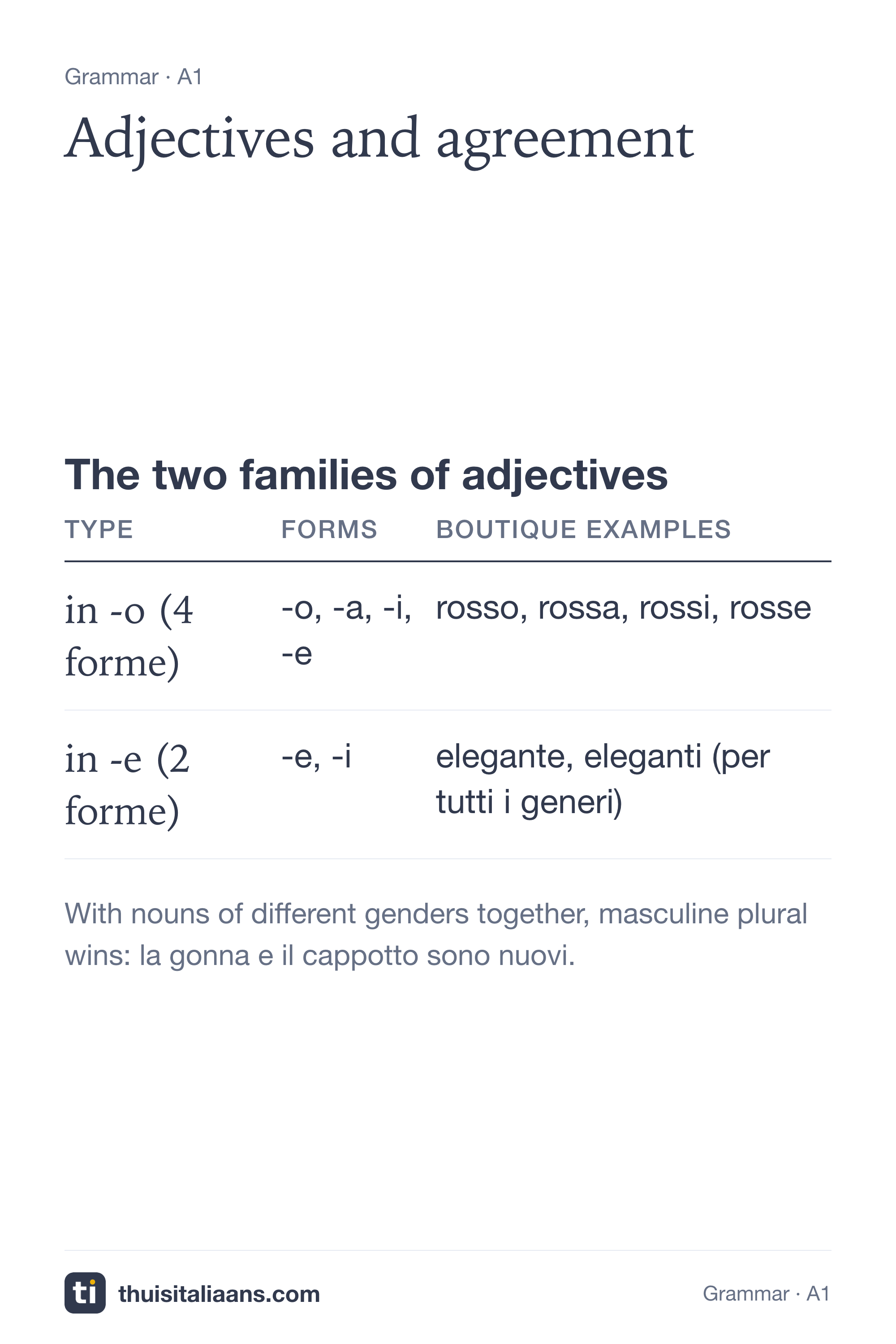
The two families of adjectives
| Type | Forms | Boutique examples |
|---|---|---|
| in -o (4 forme) | -o, -a, -i, -e | rosso, rossa, rossi, rosse |
| in -e (2 forme) | -e, -i | elegante, eleganti (per tutti i generi) |
Adjectives usually follow the noun: una borsa nera, un cappotto lungo. A few short, very common ones can precede it: bello, brutto, grande, piccolo, nuovo, vecchio.
| Colours | Behaviour |
|---|---|
| rosso, nero, bianco, giallo | si accordano normalmente |
| blu, rosa, viola, beige | invariabili: le scarpe blu, i pantaloni rosa |
The most common mistakes
una giacca rosso→ una giacca rossa (feminine: -a)le scarpe eleganti e neri→ le scarpe eleganti e nere (feminine plural agreement)i pantaloni blues→ i pantaloni blu (blu is invariable)
Did you know?
Read and understand
This chapter’s grammar. Example: a sale sign.
Saldi di fine stagione
Via Rizzoli 8 · Bologna
Camicia bianca, cotone leggero29
Scarpe nere italiane89
Giacca lunga e calda129
Sciarpe colorate, lana morbida19
Borse piccole in pelle vera59
Ultima settimana: prezzi piccoli, scelta grande.
Questions
Quanto costano le sciarpe?
Perché «scarpe nere» e non «scarpe nero»?
Completa: «una borsa ___» (rosso).

Exercises
Five exercises in order of difficulty. The last ones bring back what you have already seen.
01 Accordo semplice
Complete the ending of the adjective.
- un ragazzo alt
- una ragazza alt
- due libri nuov
- due case bell
- la pizza calda? No, fredd
- i giorni lungh
02 Gli aggettivi in -e
These have one single form in the singular. Complete.
- un esercizio facil
- una domanda facil
- due esercizi facil
- due domande facil
- un ragazzo gentil
- due ragazze gentil
03 Colori e invariabili
Careful: blu, rosa, viola, arancione do not change (or barely do).
- due maglie ross
- due maglie blu →
- tre fiori ros
- due macchine ner
- due sciarpe viola →
- due porte verd
04 Maschile e femminile insieme
When the group is mixed, the adjective goes to the masculine plural. Complete.
- Marco e Luca sono italian
- Anna e Sara sono italian
- Marco e Anna sono italian
- Il libro e la penna sono nuov
- La madre e le figlie sono stanc
- Il padre e le figlie sono stanc
05 Descrivi la stanza
Complete with article, noun and adjective, all in agreement. Example: (tavolo / grande) → il tavolo grande.
Review articoli · genere e numero
- (finestra / aperto) →
- (libri / vecchio) →
- (sedie / comodo) →
- (zaino / nero) →
- (amiche / simpatico) →
- (alberghi / caro) →
These five are a taste. There are over seven hundred on the site, free and with no sign-up. All the exercises →

Every topic, a world
In the  amo Italian app, grammar is practised inside thematic pathways with field-specific vocabulary: il bar, i trasporti, il calcio, la moda, la burocrazia and seventeen more. Choose your world and the grammar comes along by itself, explained in your language too.
Half the path free, no sign-up
★★★★★(11)by Alessio, teacher since 2018
Downloadamo Italian for iPhone ↗︎Search for amo Italian

Read and understand
This chapter’s grammar. Example: a shop's email.
Nuovi arrivi di primavera
daBottega Rizzoli <info@bottegarizzoli.it>
aclienti@bottegarizzoli.it
datagio 14 mar, 08:30
Buongiorno,
sono arrivati i capi nuovi: camicie bianche e azzurre, maglie morbide, giacche corte.
La lana è italiana e i colori sono caldi. Le taglie piccole finiscono presto.
Vi aspettiamo in una bottega piccola ma piena di cose belle.
A presto,
Elena
Questions
Quali taglie finiscono presto?
Perché «maglie morbide» e non «maglie morbidi»?
Completa: «i colori ___» (vivace).
Want another text on this topic? A rental ad · Gelato flavours
One more go
Make the adjective agree:
- Ho comprato una camicia .
- Queste scarpe sono troppo .
- Cerco un cappotto .
- Le borse sono in vetrina.
- Il vestito e la giacca sono .
Frequently asked questions
Why doesn’t viola change: due maglie viola?
A few colour adjectives are invariable because they were born as nouns: viola (the flower), rosa (the rose), blu. So: una sciarpa viola, due sciarpe viola, i pantaloni blu. All the other colours agree normally: rosse, gialli, verdi.
Does the adjective go before or after the noun?
After, as a default: un vestito elegante, una giacca nuova. Some very common adjectives also sit comfortably before (una bella giornata, un buon caffè), and at higher levels position even changes meaning: that story is in the chapter on adjective position.
Why is it molto belle and not molte belle?
Because there molto is an adverb (“very”) and adverbs never agree: le scarpe sono molto belle. It agrees only when it means “many” and sits before a noun: molte scarpe, molti amici. The test: if you can replace it with “very”, it stays molto.
 The two families of adjectives