Italiano in pratica
by Alessio · teacher of Italian for foreigners, ITALS master’s in teaching Italian abroad (Ca’ Foscari University, Venice) and a master’s in teaching Italian as a second language (Giustino Fortunato University, Benevento)
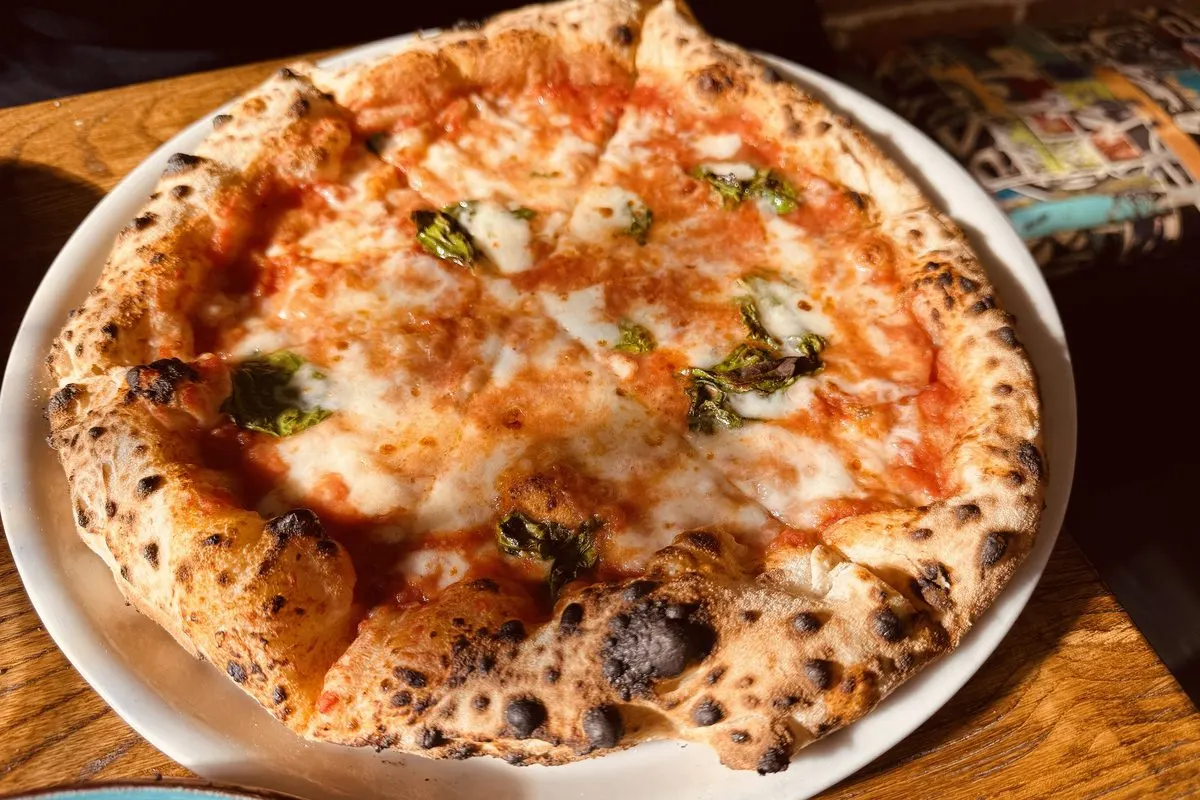
In a pizzeria everyone orders a whole pizza of their own, and eats it with a knife and fork, or folded, both fine. Careful with one word: peperoni are bell peppers. The spicy salami is salame piccante, and the pizza with it is a diavola.
Pizza is the one Italian meal everybody thinks they already know how to order, and the one that surprises people most: the pizza is round and whole, one each, and the menu has names instead of descriptions.
Here are the names, the changes you can ask for, and the other way of eating pizza, by the slice and by weight. With closed questions for every doubt.
| Italian | English |
|---|---|
| Una margherita, per favore. | A margherita, please. |
| Per me una diavola. | A diavola for me.with spicy salami |
| È piccante? | Is it spicy?answer: sì or no |
| Si può fare senza mozzarella? | Can you make it without mozzarella?answer: sì or no |
| Avete l'impasto senza glutine? | Do you have gluten-free dough?answer: sì or no |
| Una birra media, per favore. | A medium beer, please. |
| È da portare via. | It's to take away. |
| Un pezzo così, per favore. | A piece this big, please.pizza al taglio: show with your hands |
Read the Italian out loud once before you need it. The questions marked sì or no get a one-word answer you can understand.
Each person orders a whole round pizza, and it arrives uncut: cut it yourself with knife and fork, or fold it. Sharing one pizza between two is unusual in a sit-down pizzeria. Many pizzerias open only in the evening.
The classic drink with pizza is beer or a soft drink. A wood-fired oven, forno a legna, is often written on the sign: it's a point of pride.
| You say | English |
|---|---|
| Una margherita, per favore. | A margherita, please. |
| Possiamo dividere una pizza? | Can we share a pizza?sometimes sì |
| Me la può tagliare? | Could you cut it for me?sì: for children, ask |
| You hear | English |
|---|---|
| Cosa vi porto? | What can I bring you? |
| Da bere? | To drink? |
| Media o piccola? | Medium or small?about the beer |
A margherita is tomato, mozzarella and basil; a marinara is tomato, garlic and oregano, with no cheese at all. A diavola has spicy salami, a capricciosa ham, mushrooms and artichokes, a quattro formaggi four cheeses. Pizza bianca means no tomato.
The trap: peperoni are bell peppers. If you want what is called «pepperoni» abroad, ask for salame piccante, or simply order a diavola.
| You say | English |
|---|---|
| margherita · marinara | tomato and mozzarella · tomato and garlic, no cheese |
| diavola | with spicy salami |
| capricciosa | ham, mushrooms, artichokes, olivestoppings vary a little |
| quattro formaggi · quattro stagioni | four cheeses · four seasons, four toppings in quarters |
| peperoni | bell peppersnot salami |
| bianca · rossa | without tomato · with tomato |

Use senza, without, and con, with, as a yes/no question: si può fare senza mozzarella? Extra toppings are aggiunte and cost a little more, usually listed at the bottom of the menu.
Gluten-free dough, impasto senza glutine, is offered by a growing number of pizzerias, often prepared separately. Ask, and if you're coeliac say so: sono celiaco.
| You say | English |
|---|---|
| Si può fare senza mozzarella? | Can you make it without mozzarella?sì or no |
| Con la bufala, per favore. | With buffalo mozzarella, please.often an extra |
| Posso aggiungere i funghi? | Can I add mushrooms?sì or no |
| Avete l'impasto senza glutine? | Do you have gluten-free dough?sì or no |
| È piccante? | Is it spicy?sì or no |
| You hear | English |
|---|---|
| L'aggiunta costa un euro. | The extra costs a euro. |
| Senza glutine non facciamo. | We don't do gluten-free.no |

In the  amo Italian app you practise inside real-life pathways: il bar, il ristorante, i trasporti, la casa and more, with listening, dialogues and the grammar explained in English. This page gives you the phrases; the app trains your ear.
Half the A1 course free, no sign-up
★★★★★(22)by Alessio, teacher since 2018
Downloadamo Italian for iPhone ↗︎Search for amo Italian
Pizza al taglio is pizza by the slice, baked in large trays and sold by weight, typical of Rome: point, show the size with your hands, and it's weighed and warmed up. Da asporto means takeaway, a whole pizza in a box.
At the counter you'll hear la scaldo?, shall I heat it up? and così va bene?, is this much OK? Both are yes/no questions.
| You say | English |
|---|---|
| Un pezzo così, per favore. | A piece this big, please.show with your hands |
| Un po' di più. | A bit more. |
| È da portare via. | It's to take away. |
| Quanto devo aspettare? | How long do I have to wait? |
| You hear | English |
|---|---|
| Così va bene? | Is this much OK?sì or no |
| La scaldo? | Shall I heat it up?sì or no |
| Qui o da portare via? | Eat in or take away?a choice of two |
| Pronta tra un quarto d'ora. | Ready in a quarter of an hour. |

Often yes: coperto, the cover charge, appears in pizzerias too, usually a euro or two per person, and it must be on the menu. Ask for the bill as in any restaurant: il conto, per favore.
In busy pizzerias you may pay at the till, la cassa, on the way out: ask si paga alla cassa?
| You say | English |
|---|---|
| Il conto, per favore. | The bill, please. |
| Si paga alla cassa? | Do you pay at the till?sì or no |
| Possiamo pagare separatamente? | Can we pay separately?sì or no |
| You hear | English |
|---|---|
| Insieme o separati? | Together or separately?a choice of two |
| Il coperto è compreso. | The cover charge is included. |
Pizza in Italy is a meal for one, not a dish to share. Each person orders a round pizza, it arrives uncut, and you eat it with knife and fork or fold the slices in your hand. A Neapolitan pizza is soft and slightly wet in the centre, with a puffy rim, the cornicione, and it is meant to be eaten within minutes of leaving the oven. In 2017 UNESCO added the art of the Neapolitan pizzaiuolo to its list of intangible cultural heritage: a craft still learned in the pizzeria itself, by watching the master at the oven.

Pizza is also, mostly, an evening food. A wood-fired oven takes time to reach its heat, so many pizzerias open only for dinner. At lunch Italians eat pizza in other forms: pizza al taglio, by the slice and by weight, in Rome, or a folded pizza from a stall in Naples. Styles change from city to city: Roman pizza is thin and crisp, Neapolitan pizza thick at the edge and soft in the middle, and both sides are convinced they are right.
What is missing from the menu surprises visitors more than what is on it. There is no chicken, no barbecue sauce, no garlic bread and, in most places, no pineapple. Pineapple on pizza is a running joke in Italy, and the Hawaiian pizza was in fact invented in Canada, in the 1960s. Italians are relaxed about plenty of things at table, but toppings are not one of them: the simpler the pizza, the better the pizzeria is assumed to be.
Read next: Why does nobody bring you the bill in an Italian restaurant? · How do Italians drink wine, and how is it different from home?
Italians rarely answer with a bare sì or no. These are the forms you will actually hear, so you know which way the answer went.
| You hear | English | It means |
|---|---|---|
| Sì, certo. | Yes, of course. | yes |
| Certo! | Sure! | yes |
| Come no! | Of course! (literally: how not?) | yes |
| Volentieri. | Gladly. | yes |
| Va bene. | Fine, OK. | yes |
| Prego. | Go ahead / please do. | yes |
| No, mi dispiace. | No, I'm sorry. | no |
| Purtroppo no. | Unfortunately not. | no |
| Non c'è. | There isn't any. | no |
| È finito. | It's sold out / all gone. | no |
| Non si può. | That's not allowed. | no |
| Non ancora. | Not yet. | no |
Six real replies. Tap Yes or No for each one.
The grammar behind them
This guide as two printable pages, in English: the phrases to say, the yes/no questions and what you will hear.
All 43 phrase PDFs · €9Already included in the full course · €39 a year.
Or keep the eight phrases as an image, to save on your phone or pin:
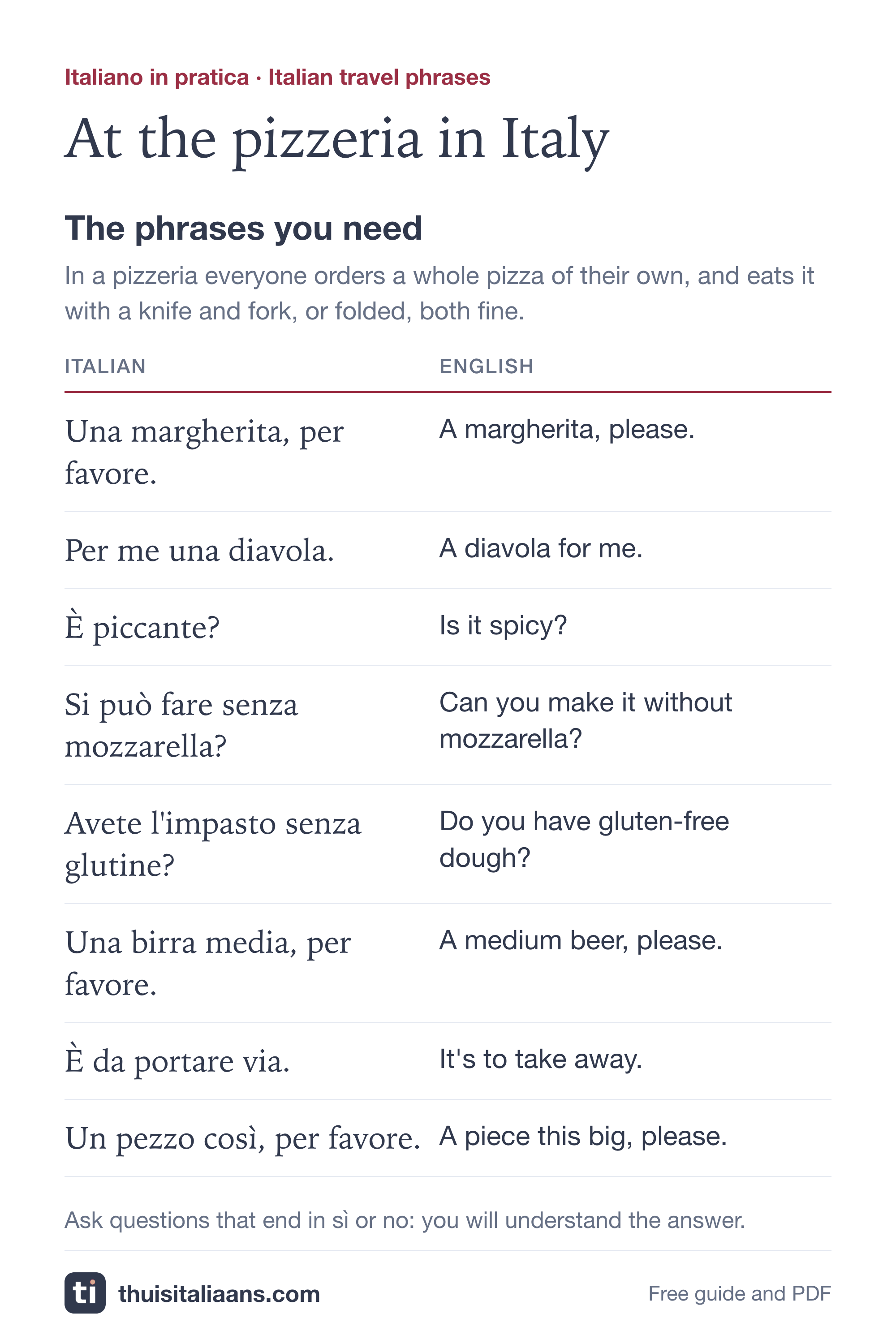 Italian phrases: At the pizzeria in Italy
Not usually in a sit-down pizzeria: each person orders a whole pizza. Sharing is more common with pizza al taglio, sold by the slice.
Bell peppers. The spicy salami called «pepperoni» abroad is «salame piccante» in Italy, and the pizza with it is usually a «diavola».
Tomato, garlic, oregano and olive oil, with no cheese. It has nothing to do with seafood.
Pizza by the slice, baked in trays and sold by weight, typical of Rome.
Yes. In a pizzeria many people use a knife and fork for the centre and their hands for the crust; folding a slice is normal too.