Italiano in pratica
by Alessio · teacher of Italian for foreigners, ITALS master’s in teaching Italian abroad (Ca’ Foscari University, Venice) and a master’s in teaching Italian as a second language (Giustino Fortunato University, Benevento)
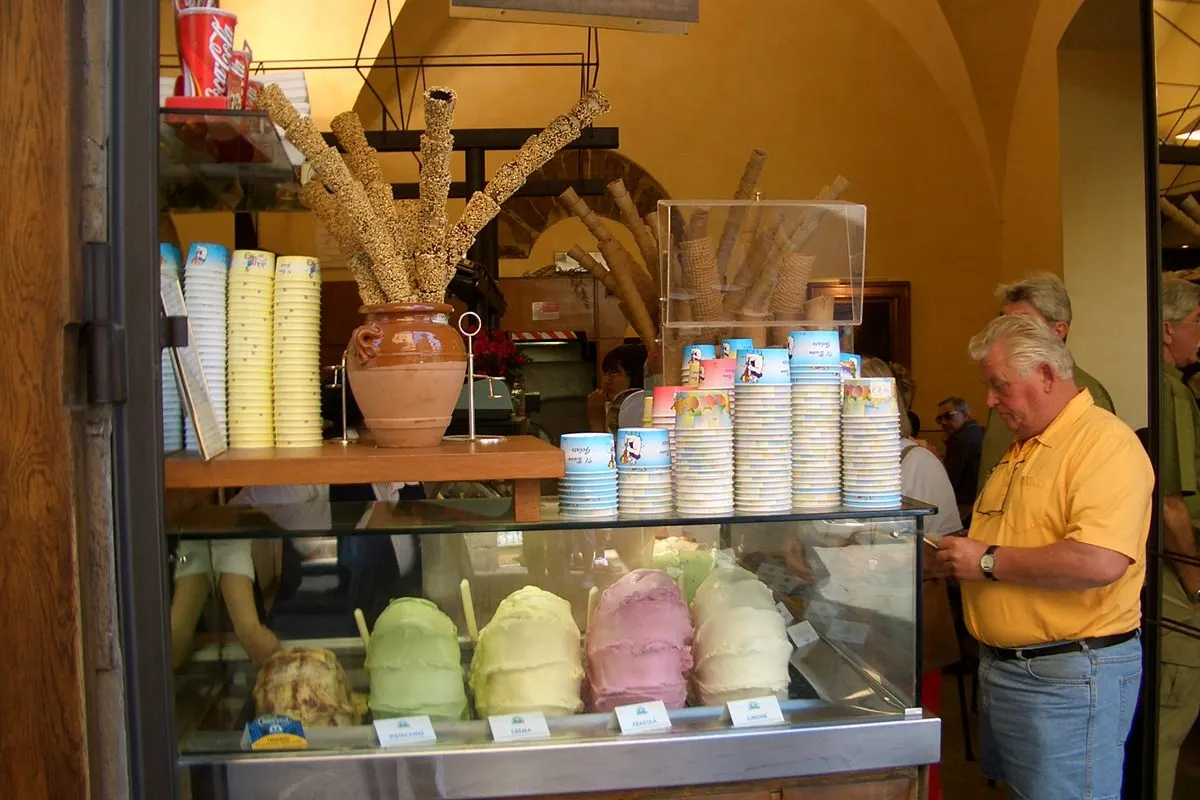
You choose the size first, cono (cone) or coppetta (cup), then the flavours: the size decides how many you can have. In busy gelaterie you pay at the till first and order with the receipt. Asking for a taste is normal: posso assaggiare?
There's a queue, a glass counter with twenty colours, and someone behind it already asking you something. It takes ten seconds and it always goes in the same order: size, flavours, extras. Know the order and you will never be caught out.
And when you want to know something about a flavour, ask it as a yes/no question. È senza latte? gets you a sì or a no; «what's in it?» gets you a list.
| Italian | English |
|---|---|
| Una coppetta piccola, per favore. | A small cup, please. |
| Un cono da due gusti. | A cone with two flavours. |
| Pistacchio e cioccolato. | Pistachio and chocolate. |
| Posso assaggiare? | Can I taste it?answer: sì |
| Si paga prima? | Do I pay first?answer: sì or no |
| Posso fare tre gusti? | Can I have three flavours?answer: sì or no |
| È senza latte? | Is it dairy-free?answer: sì or no |
| Con la panna, grazie. | With whipped cream, thanks. |
Read the Italian out loud once before you need it. The questions marked sì or no get a one-word answer you can understand.
Size first, then flavours. Say un cono or una coppetta and the size, piccola, media or grande, or simply the price on the board. Each size allows a set number of flavours, usually two for a small and three for a medium.
In busy gelaterie you pay at the till first, la cassa, and hand the receipt over the counter. Where there's no till, you order and pay afterwards. When in doubt, ask: si paga prima?
| You say | English |
|---|---|
| Un cono piccolo, per favore. | A small cone, please. |
| Una coppetta da tre euro. | A three-euro cup.naming the price works everywhere |
| Si paga prima? | Do I pay first?sì: go to the till |
| Posso fare tre gusti? | Can I have three flavours?sì or no |
| You hear | English |
|---|---|
| Cono o coppetta? | Cone or cup?a choice of two |
| Che misura? | What size?piccola, media, grande |
| Quanti gusti? | How many flavours?say a number |
| Ha lo scontrino? | Do you have the receipt?show it |

Yes. Asking for a taste, un assaggio, is completely normal, and you'll get it on a little spoon. One or two tastes is fine; ten is pushing it when there's a queue.
Point and ask a closed question: posso assaggiare questo?
| You say | English |
|---|---|
| Posso assaggiare? | Can I taste it?sì |
| Posso assaggiare il pistacchio? | Can I taste the pistachio?sì |
| Questo è il fiordilatte? | Is this the fiordilatte?sì or no: the plain milk flavour |
| You hear | English |
|---|---|
| Certo, ecco. | Of course, here you are.yes |
| Le piace? | Do you like it?sì or no |
Fiordilatte is plain milk and cream, stracciatella is fiordilatte with chocolate shavings, nocciola is hazelnut, bacio is chocolate and hazelnut, and crema is egg custard, not cream. Fruit flavours are usually sorbetti, made without milk.
Pistachio from a good gelateria is a muted greenish brown, not bright green. Vivid colours and gelato piled high above the tub usually mean colourings and whipped-in air. Some of the best artisan shops keep their gelato in covered metal tubs, pozzetti, so you can't see it at all.
| You say | English |
|---|---|
| fiordilatte | milk and cream |
| stracciatella | milk with chocolate shavings |
| crema | egg custardnot «cream» |
| nocciola · bacio | hazelnut · chocolate and hazelnut |
| limone · fragola · frutti di bosco | lemon · strawberry · mixed berriesusually sorbets, dairy-free |
| la panna | whipped creamon top, often free |

In the  amo Italian app you practise inside real-life pathways: il bar, il ristorante, i trasporti, la casa and more, with listening, dialogues and the grammar explained in English. This page gives you the phrases; the app trains your ear.
Half the A1 course free, no sign-up
★★★★★(22)by Alessio, teacher since 2018
Downloadamo Italian for iPhone ↗︎Search for amo Italian
One ingredient at a time, as a yes/no question: è senza latte?, ci sono nocciole?, avete coni senza glutine? Many gelaterie keep a book or a sign listing the allergens in each flavour, and you can ask to see it.
Fruit sorbets are usually dairy-free, but not always: some are made with milk. If an allergy is serious, also ask for a clean scoop, una paletta pulita.
| You say | English |
|---|---|
| È senza latte? | Is it dairy-free?sì or no |
| È vegano? | Is it vegan?sì or no |
| Ci sono nocciole? | Are there hazelnuts in it?sì or no |
| Avete coni senza glutine? | Do you have gluten-free cones?sì or no |
| Sono allergico alla frutta secca. | I'm allergic to nuts.allergica for a woman |
| Può usare una paletta pulita? | Could you use a clean scoop?sì |
| You hear | English |
|---|---|
| Sì, è un sorbetto. | Yes, it's a sorbet.dairy-free |
| No, c'è il latte. | No, there's milk in it.no |
| C'è il libro degli allergeni. | There's the allergen book.ask to see it |

After the flavours, usually one or two short questions: whether you want whipped cream, panna?, and whether that's everything. Answer in two words: sì, grazie or no, grazie.
In Sicily, and more and more elsewhere, you may be offered your gelato in a soft brioche bun: nella brioche? In summer, there, a brioche with gelato or with a granita is breakfast.
| You say | English |
|---|---|
| Sì, con la panna. | Yes, with cream. |
| No, grazie, va bene così. | No, thanks, that's fine. |
| You hear | English |
|---|---|
| Panna? | Whipped cream?sì or no |
| Va bene così? | Is that everything?sì or no |
| Nella brioche? | In a brioche?sì or no |
| Il prossimo! | Next! |
Gelato is not simply the Italian word for ice cream. It is usually made with more milk and less cream, so it has less fat, and it is churned more slowly, so less air is beaten into it. The result is denser, and it is served a few degrees warmer than ice cream from a supermarket freezer. That is why gelato feels soft and silky and the flavour reaches you at once, while very cold, rich ice cream numbs the tongue first. Near Bologna there is even a gelato university, run by the machine maker Carpigiani, where people from all over the world come to learn the trade.

The way it is served differs too. Instead of round scoops, gelato is pressed into the cone or cup with a flat spatula, la paletta, and two or three small flavours share the space. Many Italians pair fruit with fruit and creams with creams, lemon with strawberry, hazelnut with chocolate, although nobody will stop you mixing them. A sign saying produzione propria means it is made on the premises, and it is worth looking for.
Above all, gelato is a social habit rather than a dessert. Italians eat it in the late afternoon or after dinner, walking with friends along the main street during the evening passeggiata, which makes it the great exception to the rule that you don't eat while walking. In small towns many gelaterie close for the winter and reopen in spring, and the first cone of the year is a small event.
Read next: Why do Italians drink their coffee standing up? · Why do Italians go out so late, and drink so little?
Italians rarely answer with a bare sì or no. These are the forms you will actually hear, so you know which way the answer went.
| You hear | English | It means |
|---|---|---|
| Sì, certo. | Yes, of course. | yes |
| Certo! | Sure! | yes |
| Come no! | Of course! (literally: how not?) | yes |
| Volentieri. | Gladly. | yes |
| Va bene. | Fine, OK. | yes |
| Prego. | Go ahead / please do. | yes |
| No, mi dispiace. | No, I'm sorry. | no |
| Purtroppo no. | Unfortunately not. | no |
| Non c'è. | There isn't any. | no |
| È finito. | It's sold out / all gone. | no |
| Non si può. | That's not allowed. | no |
| Non ancora. | Not yet. | no |
Six real replies. Tap Yes or No for each one.
The grammar behind them
All the phrases from this page on two printable pages, the yes/no questions included. Print it, or keep it on your phone for when you are there.
Or keep the eight phrases as an image, to save on your phone or pin:
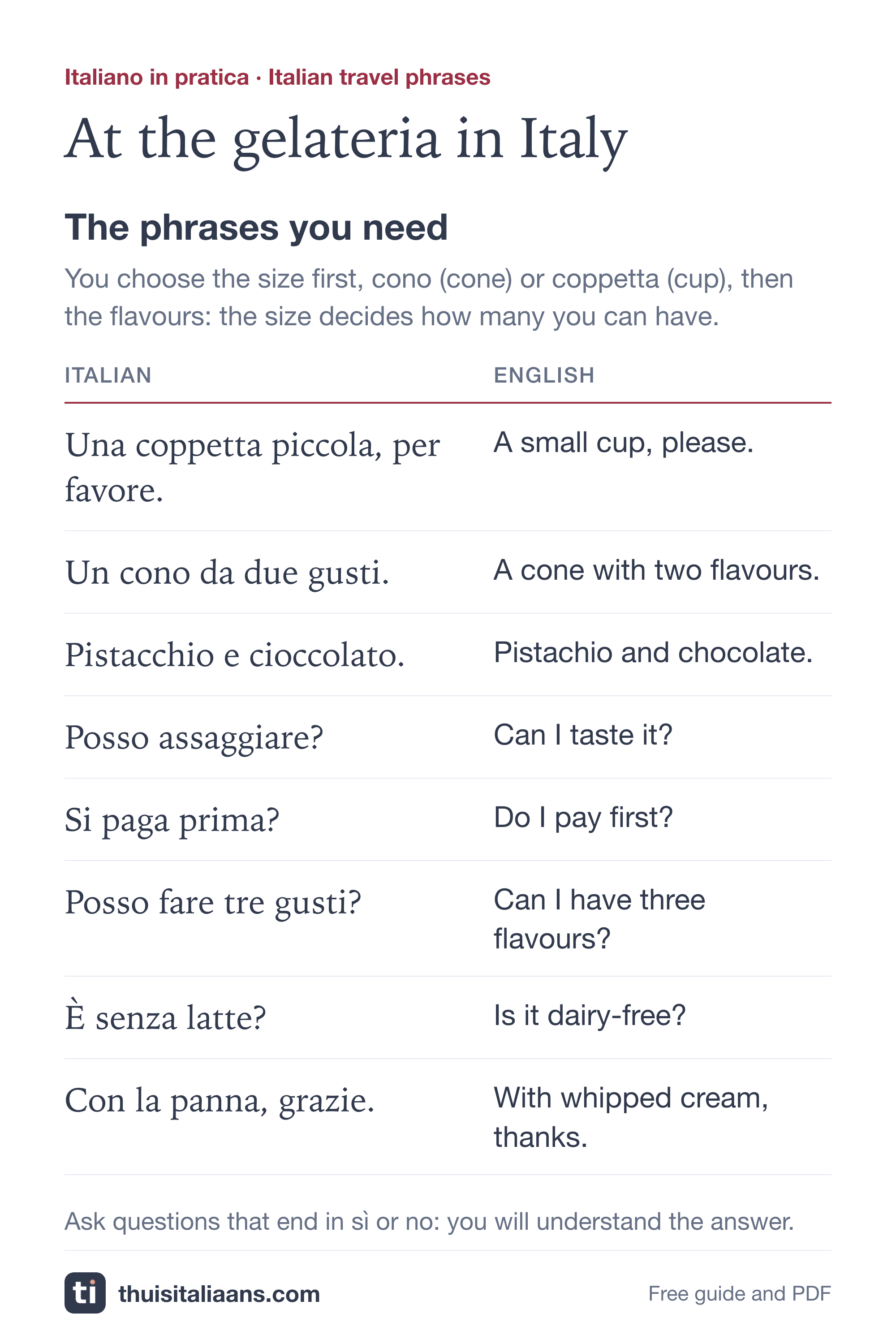 Italian phrases: At the gelateria in Italy
Both happen. In busy gelaterie you pay at the till first and show the receipt; in smaller ones you order and pay afterwards. Ask «Si paga prima?» if you're not sure.
Usually yes: a small cone or cup allows two flavours, a medium three. Ask «Posso fare due gusti?».
Gelato is made with milk; sorbetto is made with fruit, sugar and water, usually without milk. Ask «È senza latte?» to be sure.
Yes, «Posso assaggiare?» is a normal question. One or two tastes is fine, especially when there's a queue.
It is an egg-custard flavour, not cream. Whipped cream is «la panna».