Italiano in pratica
by Alessio · teacher of Italian for foreigners, ITALS master’s in teaching Italian abroad (Ca’ Foscari University, Venice) and a master’s in teaching Italian as a second language (Giustino Fortunato University, Benevento)
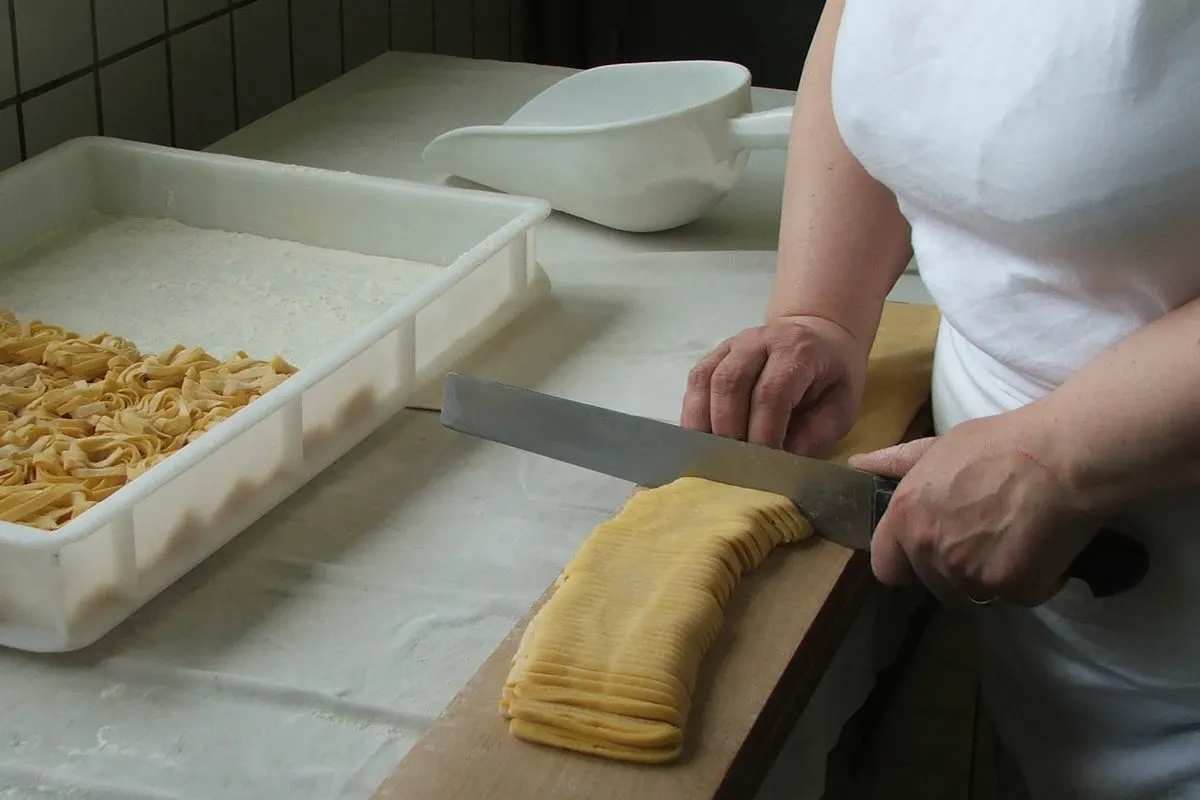
Most cooking classes for visitors follow the same order: ingredients, dough, rolling, shaping, then you eat what you made. In Bologna the teacher is often a sfoglina, a woman who rolls fresh pasta by hand with a long rolling pin, il mattarello, and the city's tagliatella even has an official width: 8 mm once cooked.
Flour on the board, a well in the middle, two eggs cracked inside, and a woman who has rolled pasta for forty years watching your hands with a patient smile. A cooking class is the most Italian afternoon you can spend indoors.
The teacher will speak English, but the kitchen speaks Italian. Here are the words you'll hear, the verbs of the recipe, and the closed questions that save your dough.
| Italian | English |
|---|---|
| Va bene così? | Is this right?answer: sì or no |
| È troppo duro? | Is it too hard?answer: sì or no |
| Devo aggiungere farina? | Do I need to add flour?answer: sì or no |
| Lo stendo ancora? | Shall I roll it out more?answer: sì or no |
| Me lo fa vedere di nuovo? | Can you show me again?answer: sì or no |
| Posso fare una foto? | Can I take a photo?answer: sì or no |
| Mi dà la ricetta? | Will you give me the recipe?answer: sì or no |
| Si può fare anche senza uova? | Can it be made without eggs too?answer: sì or no |
Read the Italian out loud once before you need it. The questions marked sì or no get a one-word answer you can understand.
Most classes follow the same steps: the teacher shows the ingredients, you make a dough, knead it and let it rest, roll it out, cut or shape it, and finally sit down to eat what you made, often with wine. Some start with a market visit or end with tiramisù.
Classes are held in family kitchens, trattorias, farms or cooking schools. Check what's included, how many people are in the group, and whether it's hands-on or a demonstration.
| You say | English |
|---|---|
| È tutto incluso? | Is everything included?sì or no |
| Quante persone siamo? | How many of us are there? |
| Cuciniamo noi? | Do we do the cooking?sì or no |
| You hear | English |
|---|---|
| Lavatevi le mani. | Wash your hands. |
| Prima facciamo la sfoglia. | First we make the pasta sheet. |
| Alla fine mangiamo insieme. | At the end we eat together. |
The basic ones: la farina, flour; le uova, eggs; l'impasto, the dough; la spianatoia, the wooden board; il mattarello, the long rolling pin; la sfoglia, the thin sheet of pasta. The sfoglina is the woman who rolls it by hand, a respected craft in Emilia-Romagna.
Classic proportion in Emilia: one egg for every hundred grams of flour. In the south many shapes, like orecchiette, are made with durum wheat semolina and water, without eggs.
| You say | English |
|---|---|
| Quante uova ci vogliono? | How many eggs does it take? |
| È farina di grano duro? | Is it durum wheat flour?sì or no |
| Si può fare anche senza uova? | Can it be made without eggs too?sì or no |
| You hear | English |
|---|---|
| Un uovo per ogni etto di farina. | One egg for every hundred grams of flour. |
| Fate la fontana. | Make a well.the flour with a hole in the middle |

The recipe is a chain of imperatives: impastate, knead; lasciate riposare, let it rest; stendete, roll out; tagliate, cut; chiudete, close (the ravioli); buttate la pasta, put the pasta into the boiling water; scolate, drain.
The teacher may switch between tu and voi: impasta to you, impastate to the group. The meaning is the same.
| You say | English |
|---|---|
| Lo stendo ancora? | Shall I roll it out more?sì or no |
| Quanto deve riposare? | How long does it need to rest? |
| Lo taglio adesso? | Shall I cut it now?sì or no |
| You hear | English |
|---|---|
| Impastate per dieci minuti. | Knead for ten minutes. |
| Lasciate riposare mezz'ora. | Let it rest for half an hour. |
| Più sottile! | Thinner!keep rolling |

In the  amo Italian app you practise inside real-life pathways: il bar, il ristorante, i trasporti, la casa and more, with listening, dialogues and the grammar explained in English. This page gives you the phrases; the app trains your ear.
Half the A1 course free, no sign-up
★★★★★(22)by Alessio, teacher since 2018
Downloadamo Italian for iPhone ↗︎Search for amo Italian
With closed questions about texture: è troppo duro?, too hard; è troppo morbido?, too soft; è appiccicoso?, sticky. The teacher will touch it and tell you to add flour, un po' di farina, or a drop of water, un goccio d'acqua.
The right dough is smooth and elastic and springs back when you press it. If it tears when you roll it, it needs more kneading or more rest.
| You say | English |
|---|---|
| Va bene così? | Is this right?sì or no |
| È troppo duro? | Is it too hard?sì or no |
| Devo aggiungere farina? | Do I need to add flour?sì or no |
| Me lo fa vedere di nuovo? | Can you show me again?sì or no |
| You hear | English |
|---|---|
| Perfetto, così va bene. | Perfect, that's right.yes |
| Ancora un po'. | A little more.keep going |
| Un goccio d'acqua. | A drop of water. |

In 1972 the Bologna delegation of the Accademia Italiana della Cucina registered the recipe and size of the tagliatella at the city's Chamber of Commerce: 8 millimetres wide once cooked. A golden sample is kept in Palazzo della Mercanzia, the Chamber's seat.
Families in Bologna still cut them their own way, but the story says a lot about how seriously food is taken here. Ask your teacher what width she cuts: everyone has an opinion.
| You say | English |
|---|---|
| Le tagliatelle si tagliano a mano? | Are tagliatelle cut by hand?sì or no |
| Mi dà la ricetta? | Will you give me the recipe?sì or no |
| Posso fare una foto? | Can I take a photo?sì or no |
| You hear | English |
|---|---|
| Otto millimetri, da cotte. | Eight millimetres, once cooked. |
| Le arrotolate e tagliate. | Roll them up and cut. |
In most countries a recipe is a matter of taste. In Italy it can be a matter of record. On 16 April 1972 the Bologna delegation of the Accademia Italiana della Cucina registered the authentic recipe and size of the tagliatella at the city's Chamber of Commerce: eight millimetres wide once cooked, roughly six and a half to seven when raw. A golden sample of the measure is kept in a case at Palazzo della Mercanzia, the medieval building that houses the Chamber.

The same Chamber has received other «official» recipes over the years, including the ragù alla bolognese, updated in 2023. Nobody is fined for cutting their pasta wider, and Bolognese families still argue about their grandmothers' versions. The deposits are a way of saying what the classic form is, and of protecting a food culture from imitations sold under its name.
That seriousness is exactly what a cooking class shows you. The sfoglina, the woman who rolls egg pasta by hand with a long mattarello, learned by watching for years, and she can tell by touch whether the dough has rested enough. In the south the craft is different but just as precise: orecchiette and cavatelli are made with durum wheat semolina and water, shaped one by one with a knife or a thumb.
Read next: Why does nobody bring you the bill in an Italian restaurant? · What is a sagra really celebrating?
Italians rarely answer with a bare sì or no. These are the forms you will actually hear, so you know which way the answer went.
| You hear | English | It means |
|---|---|---|
| Sì, certo. | Yes, of course. | yes |
| Certo! | Sure! | yes |
| Come no! | Of course! (literally: how not?) | yes |
| Volentieri. | Gladly. | yes |
| Va bene. | Fine, OK. | yes |
| Prego. | Go ahead / please do. | yes |
| No, mi dispiace. | No, I'm sorry. | no |
| Purtroppo no. | Unfortunately not. | no |
| Non c'è. | There isn't any. | no |
| È finito. | It's sold out / all gone. | no |
| Non si può. | That's not allowed. | no |
| Non ancora. | Not yet. | no |
Six real replies. Tap Yes or No for each one.
The grammar behind them
This guide as two printable pages, in English: the phrases to say, the yes/no questions and what you will hear.
All 43 phrase PDFs · €9Already included in the full course · €39 a year.
Or keep the eight phrases as an image, to save on your phone or pin:
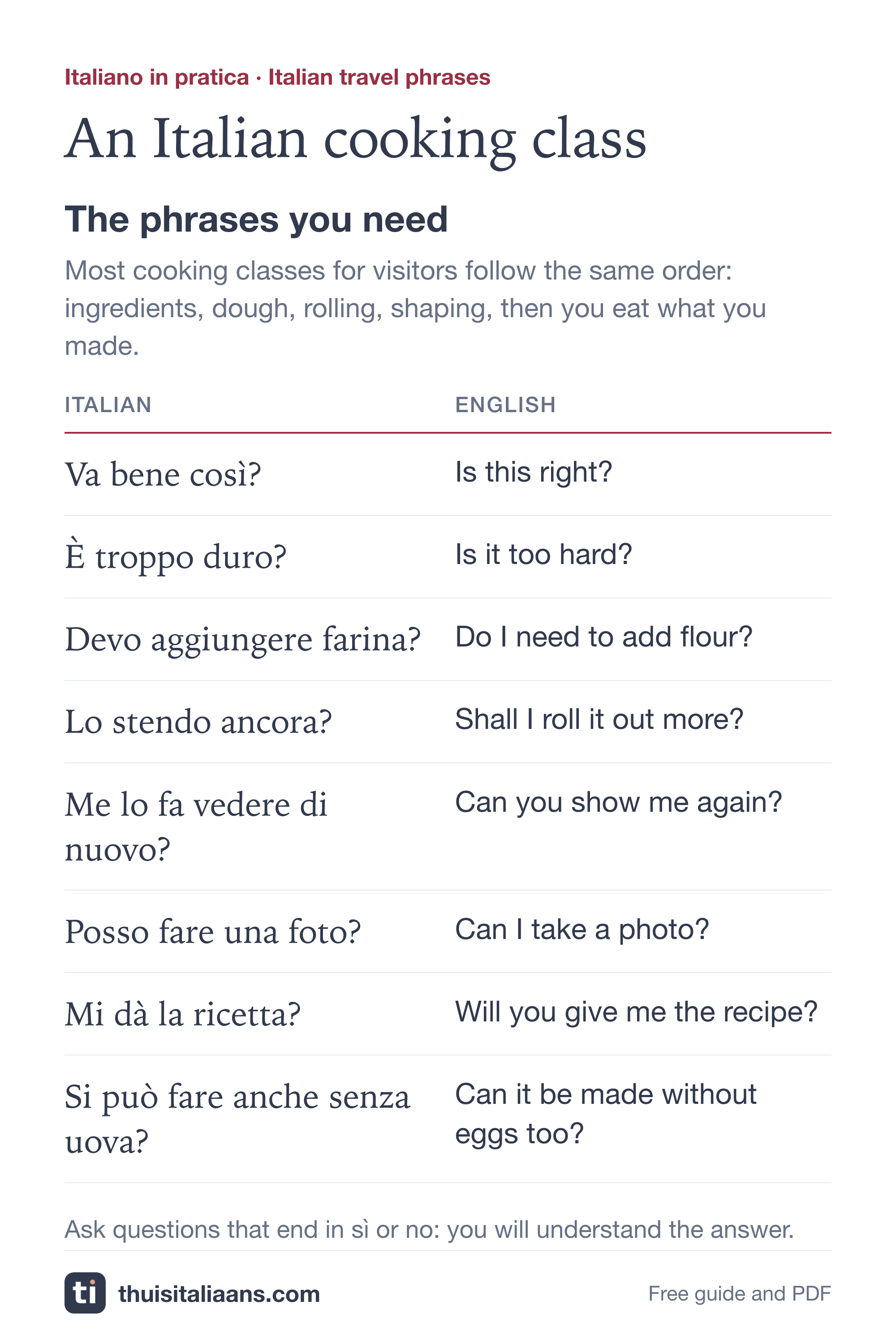 Italian phrases: An Italian cooking class
Usually you make a dough, knead it, roll it out, shape fresh pasta and then eat it together. Some classes add a market visit, a sauce or tiramisù.
A woman who rolls fresh egg pasta by hand with a long rolling pin, a traditional craft in Bologna and Emilia-Romagna.
«Il mattarello». The thin sheet of pasta is «la sfoglia», the wooden board «la spianatoia».
8 mm once cooked, according to the recipe registered at Bologna's Chamber of Commerce in 1972.
The classic Emilian proportion is one egg for every hundred grams of flour.