Italiano in pratica
by Alessio · teacher of Italian for foreigners, ITALS master’s in teaching Italian abroad (Ca’ Foscari University, Venice) and a master’s in teaching Italian as a second language (Giustino Fortunato University, Benevento)
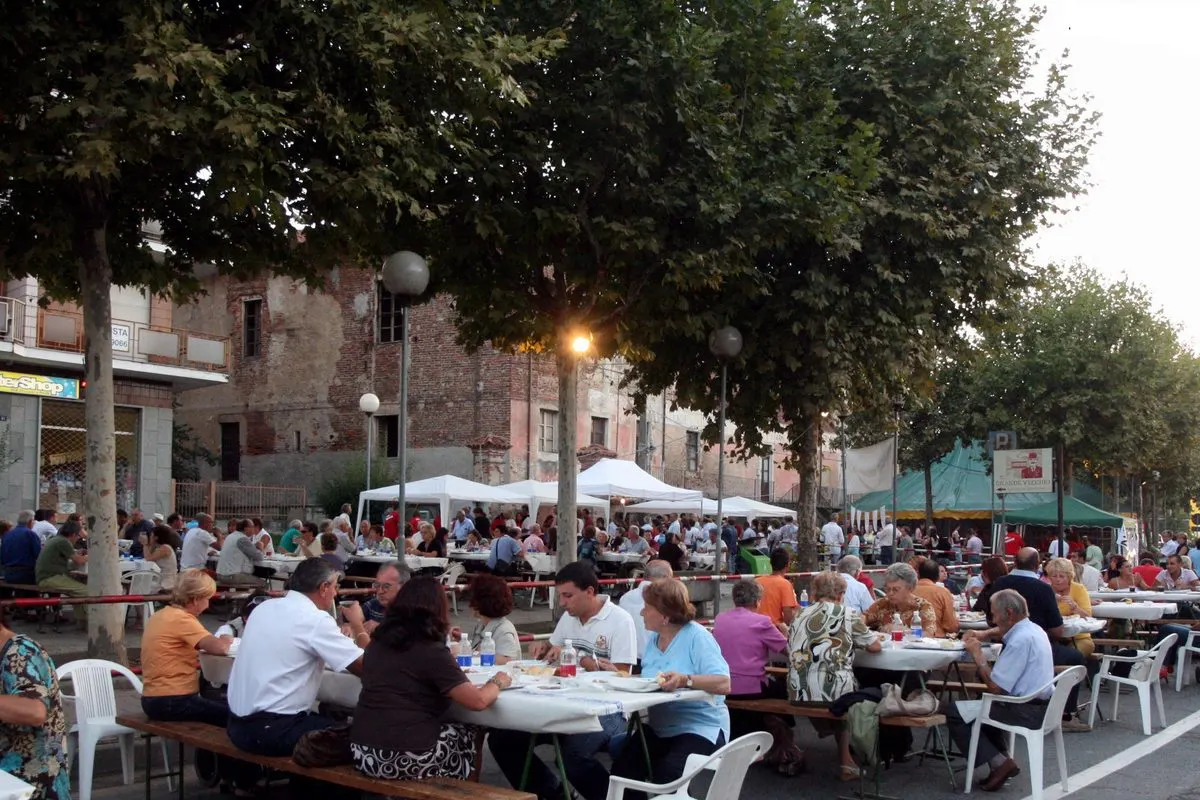
A sagra is a village festival built around one local food: truffles, chestnuts, fried fish, wine, a pasta shape. Volunteers, often from the Pro Loco, cook at long outdoor tables for a few days a year. You usually order and pay first at the cash desk, then collect your food with the receipt.
On summer and autumn evenings, hand-painted signs appear on the roundabouts: Sagra del cinghiale, Sagra della castagna. Follow one and you'll find a village square full of trestle tables, a band, and grandmothers frying in a tent.
Here is what a sagra is, how the strange ordering system works, when and where to find one, and the questions to ask in the queue.
| Italian | English |
|---|---|
| Dove si ordina? | Where do you order? |
| Si paga prima? | Do you pay first?answer: sì or no |
| Due porzioni di tortelli, per favore. | Two portions of tortelli, please. |
| Questo posto è libero? | Is this seat free?answer: sì or no |
| C'è ancora il cinghiale? | Is there still wild boar?answer: sì or no |
| Il vino è della zona? | Is the wine local?answer: sì or no |
| Dove si ritira? | Where do you collect it? |
| Fino a quando dura la sagra? | Until when does the festival run? |
Read the Italian out loud once before you need it. The questions marked sì or no get a one-word answer you can understand.
A sagra is a local festival dedicated to a food or product, usually lasting a few days, organised by volunteers. The word comes from Latin sacrum, sacred: originally a religious feast. Many today are run by the village's Pro Loco, an association that promotes the area, and the money raised often goes to local causes.
Some sagre are centuries old and tied to a patron saint or a harvest; others were invented a few decades ago to bring visitors. To mark authentic ones, the national union of Pro Loco (UNPLI) has awarded a «Sagra di qualità» label since 2019.
| You say | English |
|---|---|
| Che sagra è? | What festival is it? |
| È la sagra di cosa? | What's the festival of? |
| È tutto fatto in casa? | Is everything homemade?sì or no |
| You hear | English |
|---|---|
| È la sagra del tortello. | It's the tortello festival. |
| Cucinano i volontari. | Volunteers do the cooking. |
Usually you queue at the cash desk, la cassa, order from the board, pay, and get a receipt or tokens. Then you take the receipt to the kitchen counter or wait for your number to be called, and find a seat at the long tables.
Prices are low and portions generous. Drinks may be a separate queue. Cash is still common, though more and more sagre take cards.
| You say | English |
|---|---|
| Dove si ordina? | Where do you order? |
| Si paga prima? | Do you pay first?sì or no |
| Due porzioni di tortelli, per favore. | Two portions of tortelli, please. |
| Dove si ritira? | Where do you collect it? |
| Accettate la carta? | Do you take cards?sì or no |
| You hear | English |
|---|---|
| Prima si paga alla cassa. | First you pay at the cash desk. |
| Numero quarantadue! | Number forty-two!your order is ready |
| Il bere si prende di là. | Drinks are over there. |
At long shared tables, tavolate: ask if a seat is free and sit down next to strangers. Clear your own plate at the end if you see bins for it, and expect to be offered a taste of someone's wine.
After dinner there's often music and a dance floor, il liscio for the older generation, a band for the younger. Children run everywhere: it's a family evening.
| You say | English |
|---|---|
| Questo posto è libero? | Is this seat free?sì or no |
| Possiamo sederci qui? | Can we sit here?sì or no |
| Dove si buttano i piatti? | Where do the plates go? |
| You hear | English |
|---|---|
| Prego, accomodatevi. | Please, sit down.yes |
| È occupato. | It's taken.no |


In the  amo Italian app you practise inside real-life pathways: il bar, il ristorante, i trasporti, la casa and more, with listening, dialogues and the grammar explained in English. This page gives you the phrases; the app trains your ear.
Half the A1 course free, no sign-up
★★★★★(22)by Alessio, teacher since 2018
Downloadamo Italian for iPhone ↗︎Search for amo Italian
Mostly from late spring to autumn, following the season of the product: fish and summer vegetables in July and August, mushrooms, chestnuts, new wine and truffles in October and November. Look for hand-made signs on roads and roundabouts, posters in bars, and the town's or Pro Loco's website.
Italy has thousands every year. Small ones are often the best: ask in the bar or at your agriturismo which sagra is on this weekend.
| You say | English |
|---|---|
| C'è una sagra questo fine settimana? | Is there a sagra this weekend?sì or no |
| Fino a quando dura la sagra? | Until when does the festival run? |
| È lontano da qui? | Is it far from here?sì or no |
| You hear | English |
|---|---|
| Fino a domenica sera. | Until Sunday evening. |
| Andate presto, finisce tutto. | Go early, everything runs out. |

Ask in closed questions what's left and what's in it: food at a sagra runs out, especially the star dish. C'è ancora?, is there still some, is the key question after nine in the evening.
If you have allergies, ask at the cash desk, not at the kitchen: they know the menu and the volunteers are busy.
| You say | English |
|---|---|
| C'è ancora il cinghiale? | Is there still wild boar?sì or no |
| Il vino è della zona? | Is the wine local?sì or no |
| C'è glutine? | Does it contain gluten?sì or no |
| You hear | English |
|---|---|
| Il cinghiale è finito. | The wild boar has run out.no |
| Sì, è delle cantine qui intorno. | Yes, it's from the wineries around here. |
Food festivals exist everywhere, but the Italian sagra has a particular shape. The word comes from Latin sacrum, sacred, and originally meant a religious feast held near a church, often ending in a shared meal. Many sagre still fall on the day of the village's patron saint, or mark a harvest. Others are recent, created by local associations to bring visitors and money to small places that are losing their young people.

Most are organised by the Pro Loco, a volunteer association, its name Latin for «in favour of the place». For a few days a year, residents set up kitchens and tables, cook, serve and wash up, and the takings fund the village: a nursery, a sports pitch, the next festival. That's why a sagra feels more like a family evening than a restaurant, and why the queue at the cash desk is staffed by somebody's aunt.
Because thousands of sagre are held every year, quality varies. Since 2019 the national union of Pro Loco, UNPLI, has awarded a «Sagra di qualità» label to events running for more than five years that respect standards of local products, tradition, safety and sustainability; the awards are presented at the Italian Senate. A label helps, but the old rule also works: follow the hand-painted sign to the smallest village, and go early, before the star dish runs out.
Read next: Why does Italy stop in August? · What makes an agriturismo different from a country hotel?
Italians rarely answer with a bare sì or no. These are the forms you will actually hear, so you know which way the answer went.
| You hear | English | It means |
|---|---|---|
| Sì, certo. | Yes, of course. | yes |
| Certo! | Sure! | yes |
| Come no! | Of course! (literally: how not?) | yes |
| Volentieri. | Gladly. | yes |
| Va bene. | Fine, OK. | yes |
| Prego. | Go ahead / please do. | yes |
| No, mi dispiace. | No, I'm sorry. | no |
| Purtroppo no. | Unfortunately not. | no |
| Non c'è. | There isn't any. | no |
| È finito. | It's sold out / all gone. | no |
| Non si può. | That's not allowed. | no |
| Non ancora. | Not yet. | no |
Six real replies. Tap Yes or No for each one.
The grammar behind them
This guide as two printable pages, in English: the phrases to say, the yes/no questions and what you will hear.
All 43 phrase PDFs · €9Already included in the full course · €39 a year.
Or keep the eight phrases as an image, to save on your phone or pin:
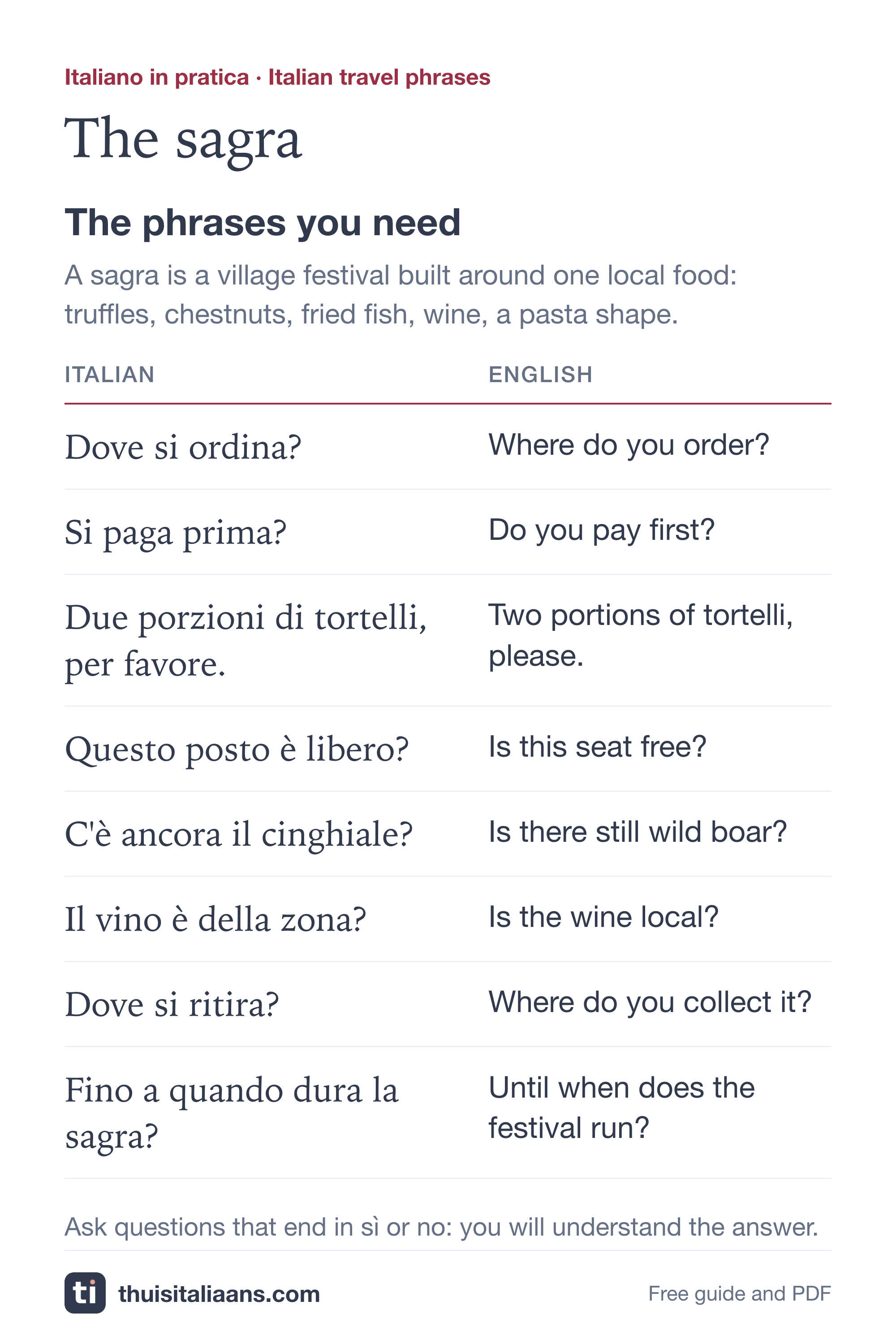 Italian phrases: The sagra
A village festival dedicated to a local food or product, run by volunteers for a few days a year, often by the local Pro Loco.
Usually you order and pay at the cash desk first, get a receipt or number, then collect your food at the kitchen counter.
Mostly from late spring to autumn, following the season of the product: chestnuts, mushrooms and truffles in autumn, fish and vegetables in summer.
From Latin «sacrum», sacred: originally it meant a religious feast.
A label awarded since 2019 by UNPLI, the national union of Pro Loco, to established festivals that promote genuine local products.