

Grammar · A1
Gender and number of nouns
by Alessio · teacher of Italian as a foreign language, ITALS master’s

In Italian every noun has a gender, even il tavolo and la sedia. It is not logic, it is grammar: but the endings help almost every time, and the important exceptions can be counted on your fingers.
- 5min reading
- 17min exercises
- A1level
What you learn
- -o, -a, -e
- How it works: gender and number of nouns
- The exceptions you meet right away
- Vocabulary: gli oggetti di casa
Italian and English side by side
English nouns have no gender: a table is an it. In Italian every noun is masculine or feminine, and the ending usually tells you which (-o masculine, -a feminine), with a large group in -e that you have to learn one by one. Plurals change the vowel instead of adding -s: libro → libri, casa → case. Getting the gender wrong is not fatal, but it drags the article and the adjective along with it.
Take this page with you
This chapter’s sheet as a free printable PDF (tables in Italian): rules, typical mistakes and the quiz with answers. A teacher’s tip: grammar sticks by reviewing it often, not by studying it once.


The words on this page
Drag each Italian word onto its definition, or tap a word first, then its box.
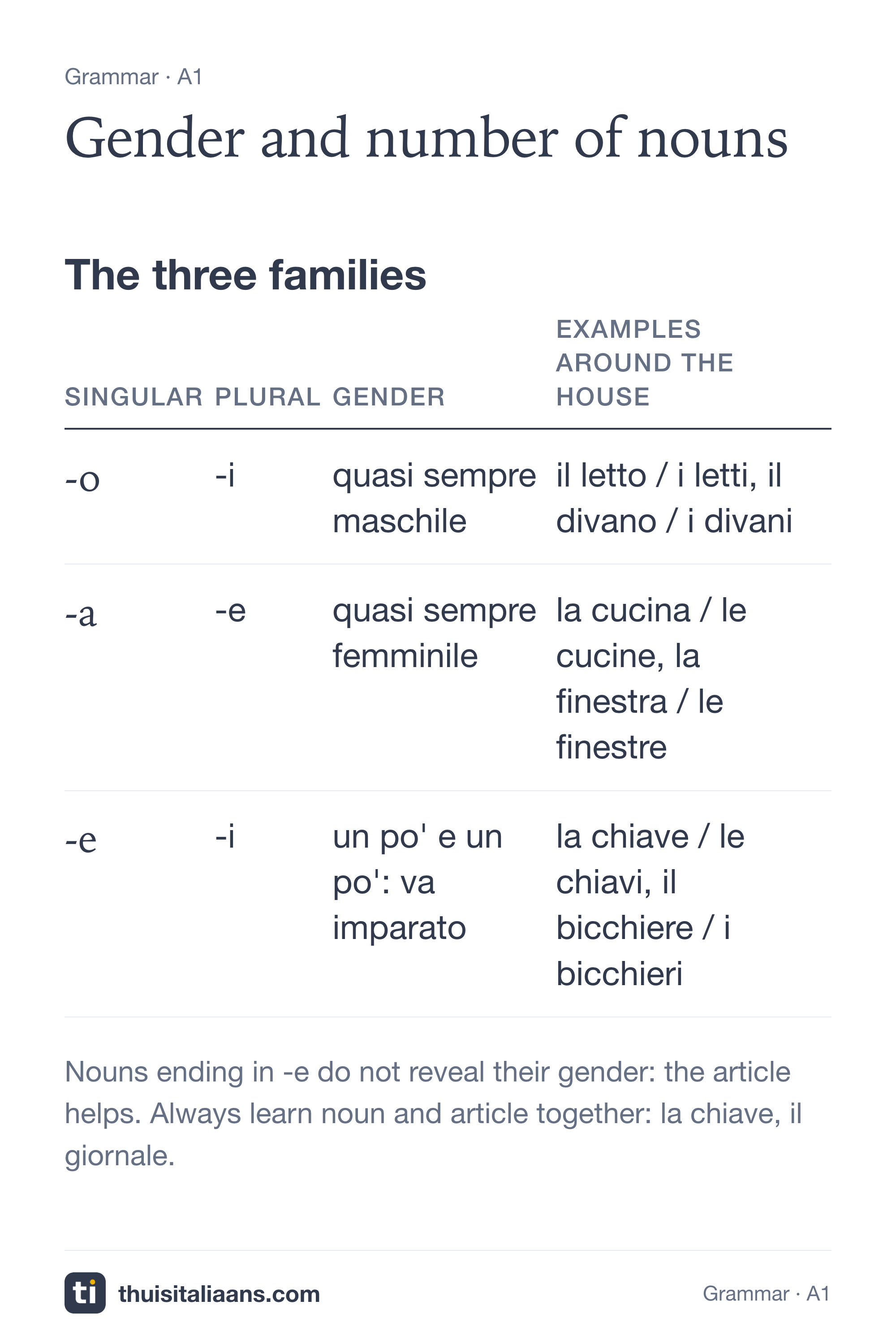
The three families
| Singular | Plural | Gender | Examples around the house |
|---|---|---|---|
| -o | -i | quasi sempre maschile | il letto / i letti, il divano / i divani |
| -a | -e | quasi sempre femminile | la cucina / le cucine, la finestra / le finestre |
| -e | -i | un po' e un po': va imparato | la chiave / le chiavi, il bicchiere / i bicchieri |
The exceptions you meet right away
| Type | Examples |
|---|---|
| Maschili in -a | il problema, il programma, il pigiama |
| Femminili in -o | la mano / le mani, la radio, la foto |
| Accentati e stranieri: invariabili | la città / le città, il caffè / i caffè, il bar / i bar |
| In -ca / -ga: plurale con h | l’amica / le amiche, la bottega / le botteghe |
The most common mistakes
la problema→ il problema (masculine in -a, from Greek)i mani→ le mani (la mano is feminine)le citte→ le città (stressed-final nouns never change)due caffi→ due caffè (invariable)
Did you know?
Read and understand
This chapter’s grammar. Example: a grocery receipt.
CASA E DINTORNI
Via Garibaldi 12 · Bologna
14/03/26 10:42SCONTRINO N. 0148
2 sedie di legno58,00
1 lampada da tavolo24,50
4 bicchieri9,60
1 specchio grande39,00
3 asciugamani18,00
2 foto in cornice12,00
TOTALE EUR161,10
GRAZIE E ARRIVEDERCI
Questions
Quanti bicchieri compra?
Perché «foto» non cambia al plurale?
Il plurale di «specchio» è…

Exercises
Five exercises in order of difficulty. The last ones bring back what you have already seen.
01 Maschile o femminile?
Write M or F. Look at the final vowel.
- libro →
- finestra →
- problema →
- chiave →
- giornale →
- città →
- cinema →
- mano →
02 Uno diventa due
Write the plural.
- il tavolo →
- la sedia →
- il fiore →
- la notte →
- il bicchiere →
- la stazione →
03 Quelli che non cambiano
Put into the plural. Some words do not change: only the article does.
- la città →
- il bar →
- il film →
- la foto →
- il caffè →
- l’università →
- lo sport →
04 -co, -go, -ca, -ga
Plural. Remember that ch and gh keep the sound hard.
- l’amico →
- l’amica →
- il gioco →
- l’albergo →
- il medico →
- la banca →
- il lago →
05 Nella valigia
Complete with article and noun in the plural, as in the example: una camicia → le camicie.
Review articoli
- un libro →
- uno zaino →
- un’amica →
- una chiave →
- un ombrello →
- uno spazzolino →
- un paio di occhiali →
These five are a taste. There are over seven hundred on the site, free and with no sign-up. All the exercises →

Every topic, a world
In the  amo Italian app, grammar is practised inside thematic pathways with field-specific vocabulary: il bar, i trasporti, il calcio, la moda, la burocrazia and seventeen more. Choose your world and the grammar comes along by itself, explained in your language too.
Half the path free, no sign-up
★★★★★(11)by Alessio, teacher since 2018
Downloadamo Italian for iPhone ↗︎Search for amo Italian

Read and understand
This chapter’s grammar. Example: a rental ad.
Stanze e posti letto
Affittasi camera
Camera luminosa con due finestre e un balcone.
Ci sono il letto, la scrivania, le mensole e un armadio grande.
In cucina: quattro sedie, due tavoli, i bicchieri e le pentole.
Il bagno ha lo specchio e gli asciugamani puliti.
Scrivere a stanze@centro.it
Questions
Quante finestre ha la camera?
«Gli asciugamani» è il plurale di…
Il plurale di «l'armadio» è…
Want another text on this topic? A shopping receipt · The shopping list
One more go
Choose the right form:
- In salotto ci sono due comodi.
- Ho perso di casa.
- C’è un con la lavatrice.
- Mi lavo prima di cucinare.
- In questa via ci sono tre storici.
Frequently asked questions
Is there any way to guess the gender of nouns in -e?
The suffix often helps: nouns in -zione and -sione are feminine (la stazione, la decisione), nouns in -ore are masculine (il colore, il fiore). It is not a guarantee for every noun in -e, but these two families alone cover hundreds of words.
Why is the plural of camicia camicie, but arancia becomes arance?
The spelling rule: -cia and -gia keep the i in the plural when a vowel comes before (camicia → camicie, valigia → valigie), and drop it after a consonant (arancia → arance, spiaggia → spiagge). The i is also kept when it is stressed: farmacia → farmacie.
Which nouns never change in the plural?
Nouns with a final accent (la città → le città, il caffè → i caffè), shortened nouns (la foto, il cinema, la bici) and most loanwords (il film → i film, lo sport → gli sport). Only the article tells you the number: il film, i film.
 The three families