Italiano in pratica
by Alessio · teacher of Italian for foreigners, ITALS master’s in teaching Italian abroad (Ca’ Foscari University, Venice) and a master’s in teaching Italian as a second language (Giustino Fortunato University, Benevento)
Start with scusi, then ask a question that ends in sì or no: è da questa parte?, is it this way? È lontano?, is it far? The answers come with gestures: a destra is right, a sinistra left, sempre dritto straight on.
Your phone has died, or the map has you walking in circles round the same fountain. Italians are generous with directions: they stop, point, and sometimes walk you there. The problem is the reply, which comes fast and with a list of turns.
So ask the kind of question whose answer you can follow. «Where is the museum?» gets you a speech; «is the museum this way?» gets you a sì or a no and a pointing hand. Then check each step with another yes/no question.
| Italian | English |
|---|---|
| Scusi, posso chiederle un'informazione? | Excuse me, can I ask you something?answer: sì |
| Il Duomo è da questa parte? | Is the cathedral this way?answer: sì or no |
| È lontano? | Is it far?answer: sì or no |
| Ci si arriva a piedi? | Can you get there on foot?answer: sì or no |
| Devo girare a destra? | Do I turn right?answer: sì or no |
| Sempre dritto? | Straight on?answer: sì or no |
| C'è una farmacia qui vicino? | Is there a pharmacy near here?answer: sì or no |
| Grazie, gentilissimo! | Thanks, you're very kind!gentilissima to a woman |
Read the Italian out loud once before you need it. The questions marked sì or no get a one-word answer you can understand.
With scusi and a smile, then one closed question: scusi, la stazione è da questa parte? Excuse me, is the station this way? Shopkeepers, bar staff and people waiting at a bus stop are your best bet.
A plain «where is...?», dov'è...?, is fine too, as long as you're ready to follow up with yes/no checks.
| You say | English |
|---|---|
| Scusi, posso chiederle un'informazione? | Excuse me, can I ask you something?sì |
| Scusi, dov'è la stazione? | Excuse me, where is the station?an open question: expect directions |
| La stazione è da questa parte? | Is the station this way?sì or no |
| Sto cercando questo indirizzo. | I'm looking for this address.show your phone |
| You hear | English |
|---|---|
| Sì, sempre dritto. | Yes, straight on.yes |
| No, è dall'altra parte. | No, it's the other way.no |
| Non sono di qui. | I'm not from here.ask someone else |
A destra is right, a sinistra left, sempre dritto straight on. Add la prima or la seconda, the first or the second street, and in fondo, at the end.
Directions in Italian come in the polite imperative: giri, turn, vada, go, attraversi, cross, prenda, take. You only need to recognise them, not to say them.
| You say | English |
|---|---|
| a destra · a sinistra | on the right · on the left |
| sempre dritto | straight onalso: sempre diritto |
| la prima a destra | the first street on the right |
| in fondo alla strada | at the end of the street |
| all'incrocio · al semaforo | at the crossroads · at the traffic lights |
| davanti a · dietro · accanto a | opposite · behind · next to |
| You hear | English |
|---|---|
| Giri a sinistra. | Turn left. |
| Vada sempre dritto. | Keep going straight on. |
| Attraversi la piazza. | Cross the square. |
| Prenda la seconda a destra. | Take the second on the right. |

Repeat each step back as a question: a destra, poi la prima a sinistra? The answer is sì or a correction. Two checks are enough to keep you from walking the wrong way for ten minutes.
If the explanation is long, ask for the first step only and ask again after that. Poi chiedo di nuovo, then I'll ask again, makes people smile and keeps it short.
| You say | English |
|---|---|
| A destra e poi sempre dritto? | Right and then straight on?sì or no |
| Dopo il semaforo? | After the traffic lights?sì or no |
| Questa strada? | This street?pointing; sì or no |
| Me lo può far vedere sulla mappa? | Could you show me on the map?sì |
| You hear | English |
|---|---|
| Esatto. | Exactly.yes |
| No, a sinistra. | No, left.a correction |
| Ha sbagliato strada. | You've taken the wrong road.no |

In the  amo Italian app you practise inside real-life pathways: il bar, il ristorante, i trasporti, la casa and more, with listening, dialogues and the grammar explained in English. This page gives you the phrases; the app trains your ear.
Half the A1 course free, no sign-up
★★★★★(22)by Alessio, teacher since 2018
Downloadamo Italian for iPhone ↗︎Search for amo Italian
Anything from two minutes to a twenty-minute walk. Ask the closed question that matters to you: ci si arriva a piedi?, can you walk there?, or è più di dieci minuti?, is it more than ten minutes?
Answers come in minutes on foot, a piedi, or by car, in macchina. A due passi, two steps away, means very close.
| You say | English |
|---|---|
| È lontano? | Is it far?sì or no |
| Ci si arriva a piedi? | Can you get there on foot?sì or no |
| È più di dieci minuti? | Is it more than ten minutes?sì or no |
| Devo prendere l'autobus? | Do I need to take the bus?sì or no |
| You hear | English |
|---|---|
| È a due passi. | It's just round the corner.very close |
| Cinque minuti a piedi. | Five minutes on foot. |
| È un po' lontano. | It's a bit far.take a bus or a taxi |

Use c'è... qui vicino?, is there a... near here?, for anything you need: a pharmacy, a cash machine, a supermarket, a toilet. The answer is yes or no first, then the way.
A cash machine is un bancomat, a supermarket un supermercato, and the old town il centro storico.
| You say | English |
|---|---|
| C'è una farmacia qui vicino? | Is there a pharmacy near here?sì or no |
| C'è un bancomat qui vicino? | Is there a cash machine near here?sì or no |
| C'è un supermercato aperto? | Is there a supermarket open?sì or no |
| Il centro storico è da questa parte? | Is the old town this way?sì or no |
| You hear | English |
|---|---|
| Sì, proprio lì. | Yes, right there. |
| Ce n'è uno in piazza. | There's one in the square. |
| A quest'ora è tutto chiuso. | At this time everything's closed.no |
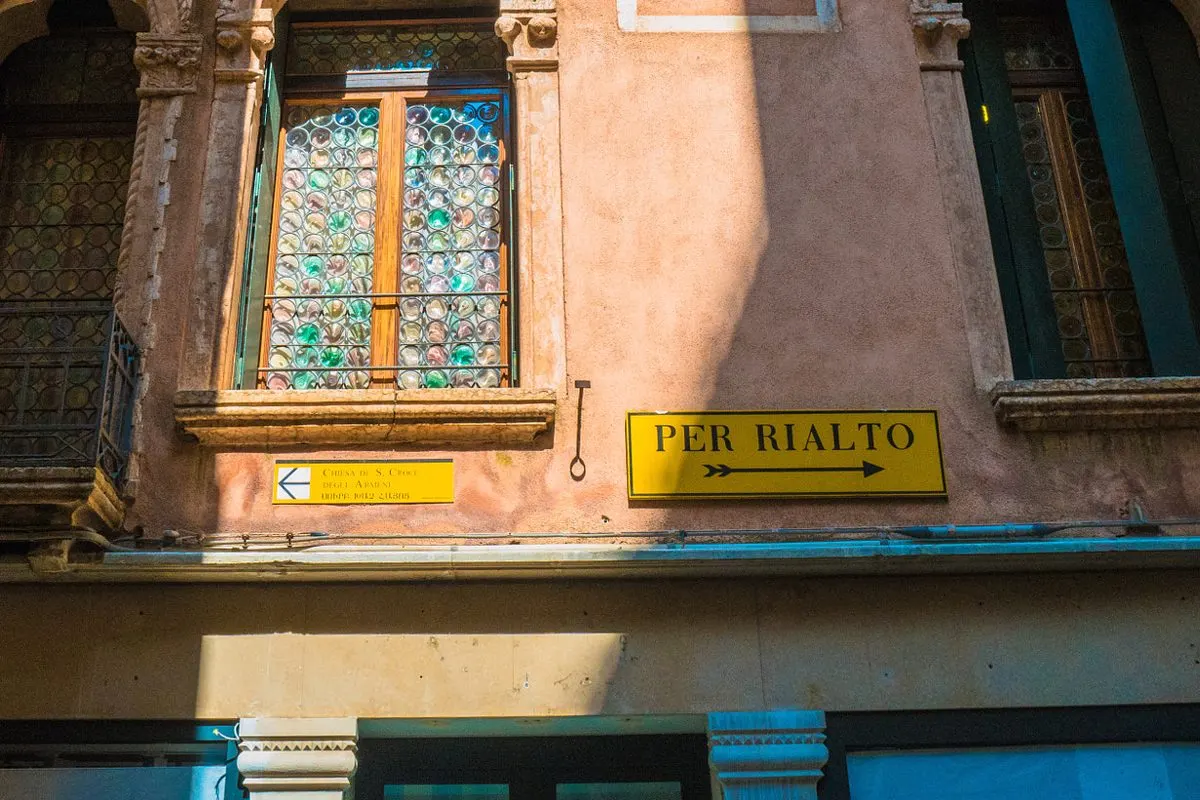
In a city laid out on a grid you can say «three blocks north, then left on Fifth Avenue». Italian historic centres grew over two thousand years without a plan: streets bend, change name every few hundred metres and open into squares you can't see until you are in them. So Italians give directions the way the town is lived: past the church, left at the bar on the corner, straight on as far as the pharmacy. Listen for the landmarks rather than the street names, and repeat them back.

Even house numbers can mislead you. In the historic centre of Florence homes and businesses are numbered separately: black numbers for residences and offices, red ones, written with an r, for shops and restaurants. So number 10 and number 10r on the same street can be a long way apart. Venice does without street addresses altogether: buildings are numbered by district, sestiere, into the thousands, which is why Venetians give directions by bridges, churches and squares.
What you can count on is help. Italians stop, point and quite often walk you to the corner to show you, and the answer to «is it far?» comes in minutes on foot rather than in kilometres. Five minutes, cinque minuti, is a flexible unit: it can mean two minutes or fifteen. That is exactly why a second yes/no question halfway there is never wasted.
Read next: Why can't you buy a ticket on the bus, or hail a taxi? · Why are Italian town centres closed to cars?
Italians rarely answer with a bare sì or no. These are the forms you will actually hear, so you know which way the answer went.
| You hear | English | It means |
|---|---|---|
| Sì, certo. | Yes, of course. | yes |
| Certo! | Sure! | yes |
| Come no! | Of course! (literally: how not?) | yes |
| Volentieri. | Gladly. | yes |
| Va bene. | Fine, OK. | yes |
| Prego. | Go ahead / please do. | yes |
| No, mi dispiace. | No, I'm sorry. | no |
| Purtroppo no. | Unfortunately not. | no |
| Non c'è. | There isn't any. | no |
| È finito. | It's sold out / all gone. | no |
| Non si può. | That's not allowed. | no |
| Non ancora. | Not yet. | no |
Six real replies. Tap Yes or No for each one.
The grammar behind them
This guide as two printable pages, in English: the phrases to say, the yes/no questions and what you will hear.
All 43 phrase PDFs · €9Already included in the full course · €39 a year.
Or keep the eight phrases as an image, to save on your phone or pin:
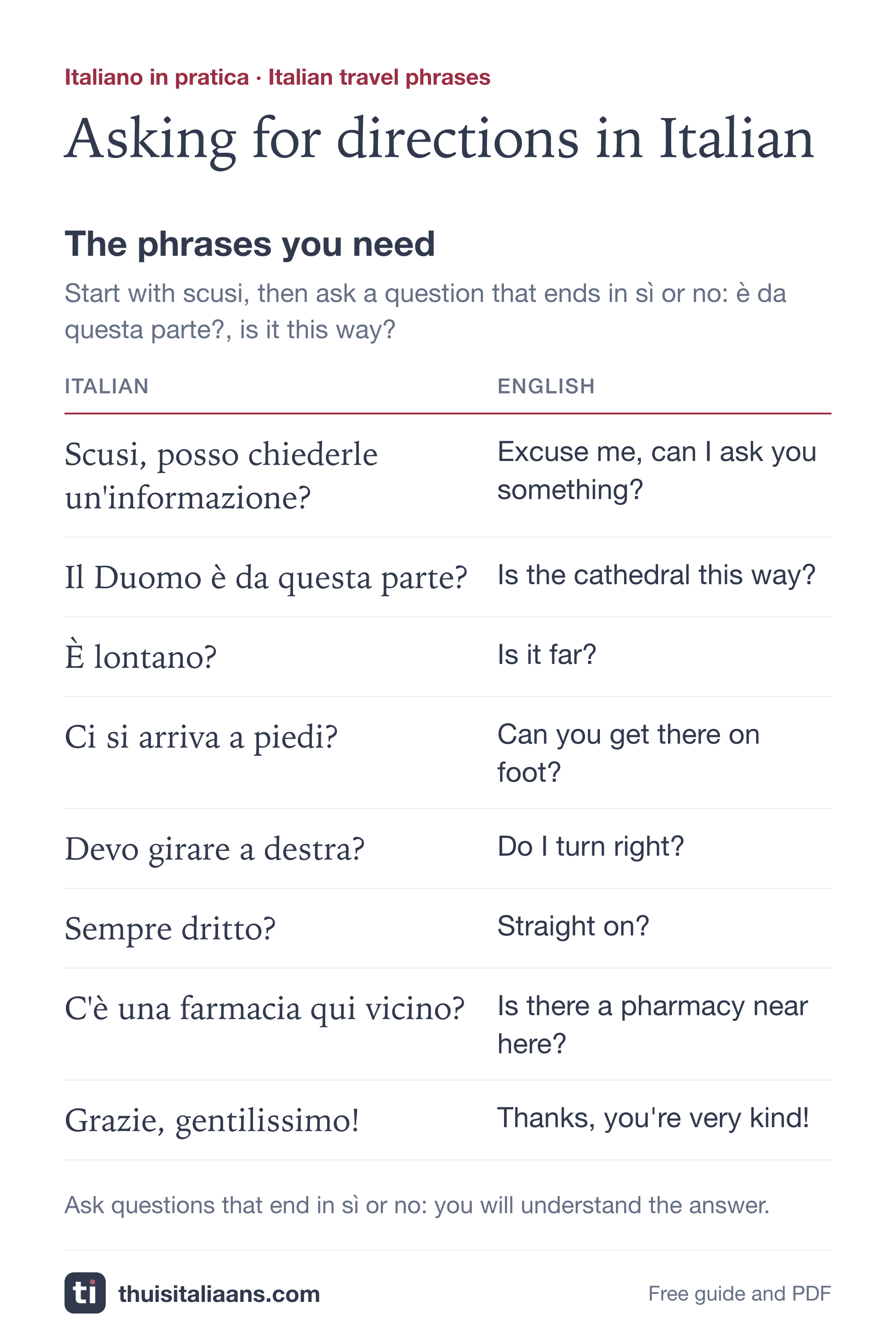 Italian phrases: Asking for directions in Italian
Start with «Scusi» and ask a yes/no question: «La stazione è da questa parte?», is the station this way? The answer is sì or no, often with a gesture.
Straight on. «A destra» is right and «a sinistra» is left.
Literally «two steps away»: very close, a minute or two on foot.
«È lontano?». To ask whether you can walk there: «Ci si arriva a piedi?»