Italiano in pratica
by Alessio · teacher of Italian for foreigners, ITALS master’s in teaching Italian abroad (Ca’ Foscari University, Venice) and a master’s in teaching Italian as a second language (Giustino Fortunato University, Benevento)
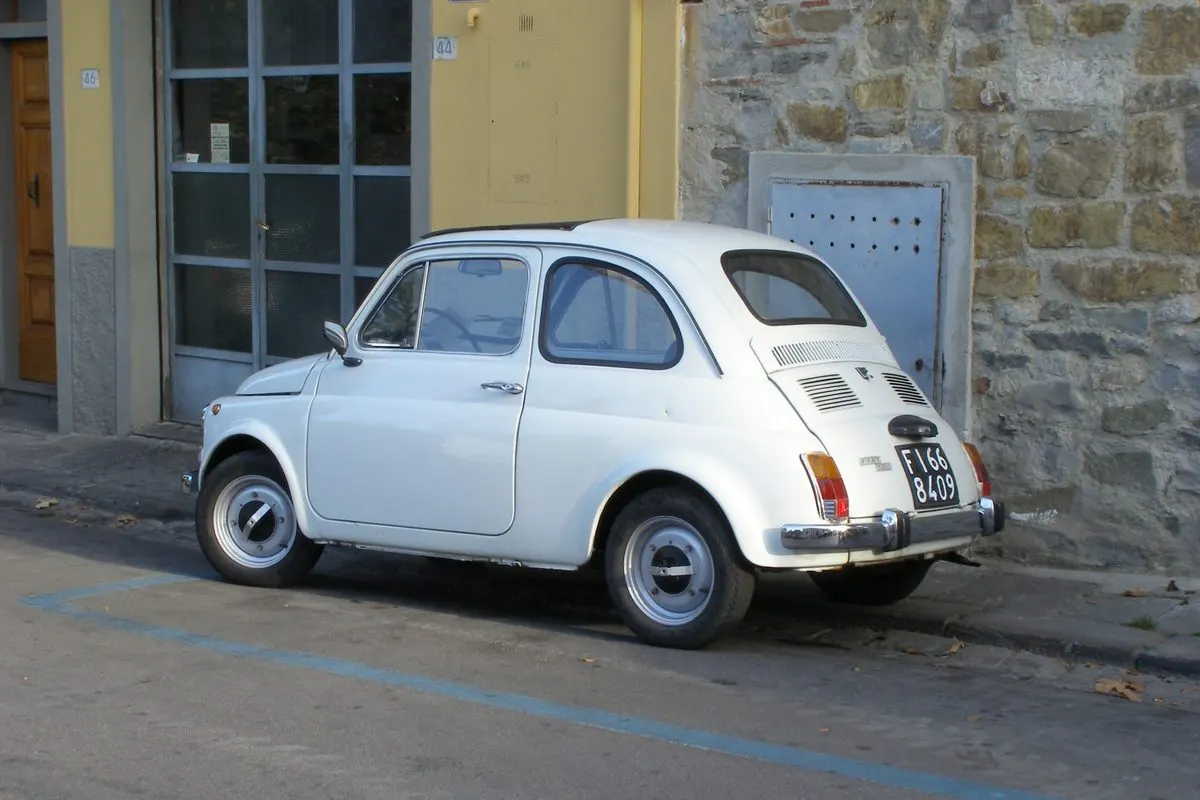
Before you drive into a historic centre, check for a ZTL, a limited traffic zone: cameras fine you if you have no permit. Blue lines mean paid parking, white lines are usually free, yellow lines are for residents or permit holders. At the pump, gasolio is diesel.
A car is the best way to see the Tuscan hills and the worst way to see Florence. Most of the trouble comes from three things: zones you can't drive into, parking lines in three colours, and a pump where the word for diesel isn't diesel.
Here they are in the order you meet them, from the rental desk to the petrol station, with a closed question for every doubt.
| Italian | English |
|---|---|
| Ho una prenotazione a nome Smith. | I have a booking under the name Smith. |
| L'assicurazione è inclusa? | Is insurance included?answer: sì or no |
| Devo riportarla con il pieno? | Do I have to bring it back full?answer: sì or no |
| Qui c'è la ZTL? | Is there a limited traffic zone here?answer: sì or no |
| Si può parcheggiare qui? | Can I park here?answer: sì or no |
| Il parcheggio è a pagamento? | Is parking paid?answer: sì or no |
| Questo è gasolio? | Is this diesel?answer: sì or no |
| Il pieno, per favore. | Fill it up, please. |
Read the Italian out loud once before you need it. The questions marked sì or no get a one-word answer you can understand.
Your driving licence, an ID document and a credit card in the driver's name for the deposit. If your licence was issued outside the EU, you are generally also required to carry an International Driving Permit.
Before you drive off, walk round the car with the agent and photograph every scratch. Then ask the questions that cost money later: fuel, insurance, and where you return it.
| You say | English |
|---|---|
| Ho una prenotazione a nome Smith. | I have a booking under the name Smith. |
| L'assicurazione è inclusa? | Is insurance included?sì or no |
| C'è una franchigia? | Is there an excess?sì: then ask how much |
| Devo riportarla con il pieno? | Do I have to bring it back full?sì or no |
| Posso lasciarla all'aeroporto? | Can I drop it off at the airport?sì or no |
| You hear | English |
|---|---|
| Patente e carta di credito, per favore. | Licence and credit card, please. |
| Il deposito è di cinquecento euro. | The deposit is five hundred euros. |
| Pieno-pieno. | Full to full.bring it back with a full tank |
A ZTL, zona a traffico limitato, is an area, usually the historic centre, where only permit holders may drive during set hours. The entrance has a sign and a camera: drive through when it says varco attivo and the fine reaches your rental company, which passes it on to you, often months later.
Varco attivo means the zone is active; varco non attivo means you may drive in. If your hotel is inside a ZTL, ask them before you arrive: they can often register your number plate.
| You say | English |
|---|---|
| Qui c'è la ZTL? | Is there a limited traffic zone here?sì or no |
| Il mio albergo è nella ZTL? | Is my hotel in the limited traffic zone?sì or no |
| Potete registrare la mia targa? | Can you register my number plate?ask the hotel; sì or no |
| You hear | English |
|---|---|
| Varco attivo. | Gate active.don't drive in |
| Varco non attivo. | Gate not active.you may drive in |
| Deve lasciare la macchina fuori. | You have to leave the car outside. |
Blue lines, strisce blu, mean paid parking: pay at the meter, il parchimetro, or in an app, and leave the ticket on the dashboard. White lines are usually free, sometimes with a time limit. Yellow lines are for residents, disabled badge holders or loading.
In some towns you pay with a scratch card, il grattino, sold at the tabaccheria: you scratch off the date and time and leave it behind the windscreen. Where there's a time limit you may need a parking disc, il disco orario, set to your arrival time.
| You say | English |
|---|---|
| Si può parcheggiare qui? | Can I park here?sì or no |
| Il parcheggio è a pagamento? | Is parking paid?sì or no |
| Il parchimetro accetta la carta? | Does the meter take cards?sì or no |
| Si paga con il grattino? | Do you pay with a scratch card?sì or no |
| La domenica è gratis? | Is it free on Sundays?sì or no |
| You hear | English |
|---|---|
| Solo residenti. | Residents only.no |
| Ci vuole il disco orario. | You need a parking disc. |
| Rimozione forzata. | Vehicles will be towed.on signs: don't park |

In the  amo Italian app you practise inside real-life pathways: il bar, il ristorante, i trasporti, la casa and more, with listening, dialogues and the grammar explained in English. This page gives you the phrases; the app trains your ear.
Half the A1 course free, no sign-up
★★★★★(22)by Alessio, teacher since 2018
Downloadamo Italian for iPhone ↗︎Search for amo Italian
Gasolio is diesel and benzina is petrol. Most stations have two kinds of pump: fai da te, self-service, and servito, where an attendant fills up for you at a higher price per litre.
Outside opening hours the automatic machine, il self, takes cards and notes but often gives no change: non dà resto. Choose an amount you actually want to put in.
| You say | English |
|---|---|
| Questo è gasolio? | Is this diesel?sì or no |
| Il pieno, per favore. | Fill it up, please. |
| Venti euro di benzina. | Twenty euros of petrol. |
| Posso pagare con la carta? | Can I pay by card?sì or no |
| Qui è servito? | Is it attended here?sì or no: an attendant fills up |
| You hear | English |
|---|---|
| Il pieno? | Fill it up?sì or no |
| Fai da te o servito? | Self-service or attended?a choice of two |
| Non dà resto. | No change given.on the machine |

Most Italian motorways have tolls. Take a ticket at the entrance and pay at the exit, il casello: lanes with a white sign take cash and cards, blue ones marked Carte take cards only, and yellow Telepass lanes are for drivers with a transponder.
Never drive into a yellow Telepass lane without the device. If it happens by mistake, stop and press the help button, assistenza, at the barrier.
| You say | English |
|---|---|
| Si paga qui? | Do you pay here?sì or no |
| Questa corsia accetta contanti? | Does this lane take cash?sì or no |
| Ho perso il biglietto. | I've lost the ticket. |
| You hear | English |
|---|---|
| Inserire il biglietto. | Insert the ticket.on the machine |
| Solo Telepass. | Telepass only.don't use this lane |

A helmet, il casco, is compulsory on every scooter and moped in Italy, for the rider and the passenger. Ask whether helmets are included before you sign; for bikes, ask whether there's a lock, un lucchetto.
Bike and e-scooter sharing works through apps in most big cities. To rent a moped you need a driving licence that covers it.
| You say | English |
|---|---|
| Il casco è incluso? | Is the helmet included?sì or no |
| Ci sono due caschi? | Are there two helmets?sì or no |
| C'è il lucchetto? | Is there a lock?sì or no |
| You hear | English |
|---|---|
| Il casco è obbligatorio. | A helmet is compulsory. |
| Va riportato entro le sette. | It must be back by seven. |
Most Italian historic centres were built long before cars, with streets the width of a cart and squares meant for markets. Limited traffic zones, ZTL, protect them: residents, taxis, buses and deliveries may drive in at set hours, and every other car is filmed at the entrance. Florence, Rome, Pisa, Siena, Bologna and many smaller towns have one. Navigation apps don't always know the rules, so a route that looks perfect on the phone can bring a fine weeks after you get home.

Italian driving has its own style rather than no style. The horn is used to say «I'm here» more often than to insult; on motorways the left lane is for overtaking only, and the limit is 130 km/h, 110 in the rain. Outside built-up areas dipped headlights must be on in daytime too. Speed is checked by fixed cameras and, on many motorways, by systems that calculate your average speed between two points.
Then there is the scooter, which in Rome and Naples is less a vehicle than a way of life. Piaggio launched the Vespa in 1946, and scooters have been weaving through Italian traffic ever since. Helmets have been compulsory for every rider and passenger since 2000. If you rent one, ride the way you would at home, not the way the locals seem to: they have had decades of practice.
Read next: Why does an Italian hotel feel different from one at home? · Why do Italians give directions with landmarks, not street names?
Italians rarely answer with a bare sì or no. These are the forms you will actually hear, so you know which way the answer went.
| You hear | English | It means |
|---|---|---|
| Sì, certo. | Yes, of course. | yes |
| Certo! | Sure! | yes |
| Come no! | Of course! (literally: how not?) | yes |
| Volentieri. | Gladly. | yes |
| Va bene. | Fine, OK. | yes |
| Prego. | Go ahead / please do. | yes |
| No, mi dispiace. | No, I'm sorry. | no |
| Purtroppo no. | Unfortunately not. | no |
| Non c'è. | There isn't any. | no |
| È finito. | It's sold out / all gone. | no |
| Non si può. | That's not allowed. | no |
| Non ancora. | Not yet. | no |
Six real replies. Tap Yes or No for each one.
The grammar behind them
This guide as two printable pages, in English: the phrases to say, the yes/no questions and what you will hear.
All 43 phrase PDFs · €9Already included in the full course · €39 a year.
Or keep the eight phrases as an image, to save on your phone or pin:
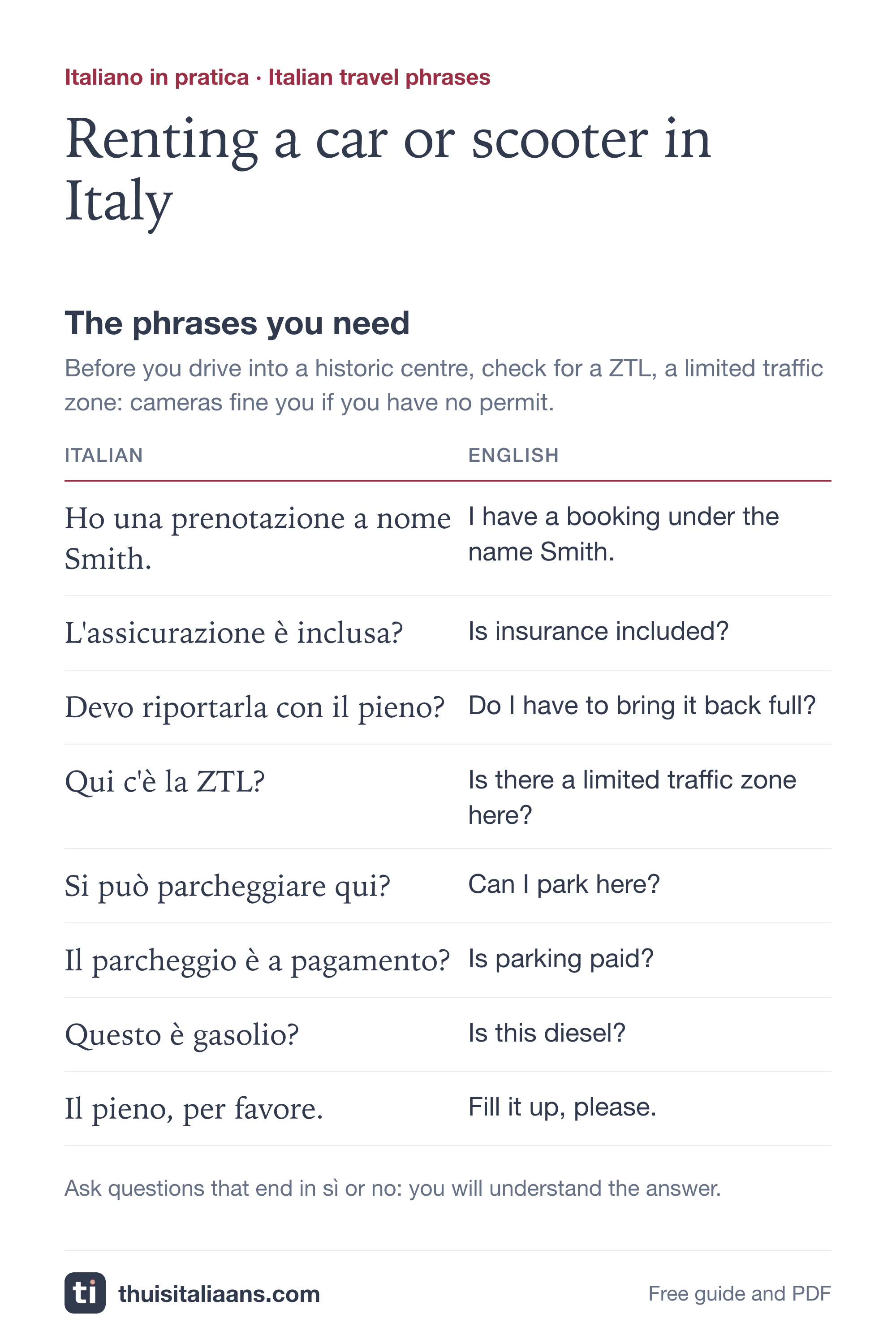 Italian phrases: Renting a car or scooter in Italy
A «zona a traffico limitato», usually the historic centre, where only permit holders may drive during set hours. Cameras record every car, and fines reach rental customers months later.
Paid parking. Pay at the meter or in an app and leave the ticket visible on the dashboard. White lines are usually free, yellow ones reserved.
«Gasolio». «Benzina» means petrol. Ask «Questo è gasolio?» if you're not sure.
If your driving licence was issued outside the EU, you are generally required to carry one together with your licence. Check with your rental company before you travel.
Yes, on every scooter and moped, for the rider and the passenger.