Italiano in pratica
by Alessio · teacher of Italian for foreigners, ITALS master’s in teaching Italian abroad (Ca’ Foscari University, Venice) and a master’s in teaching Italian as a second language (Giustino Fortunato University, Benevento)
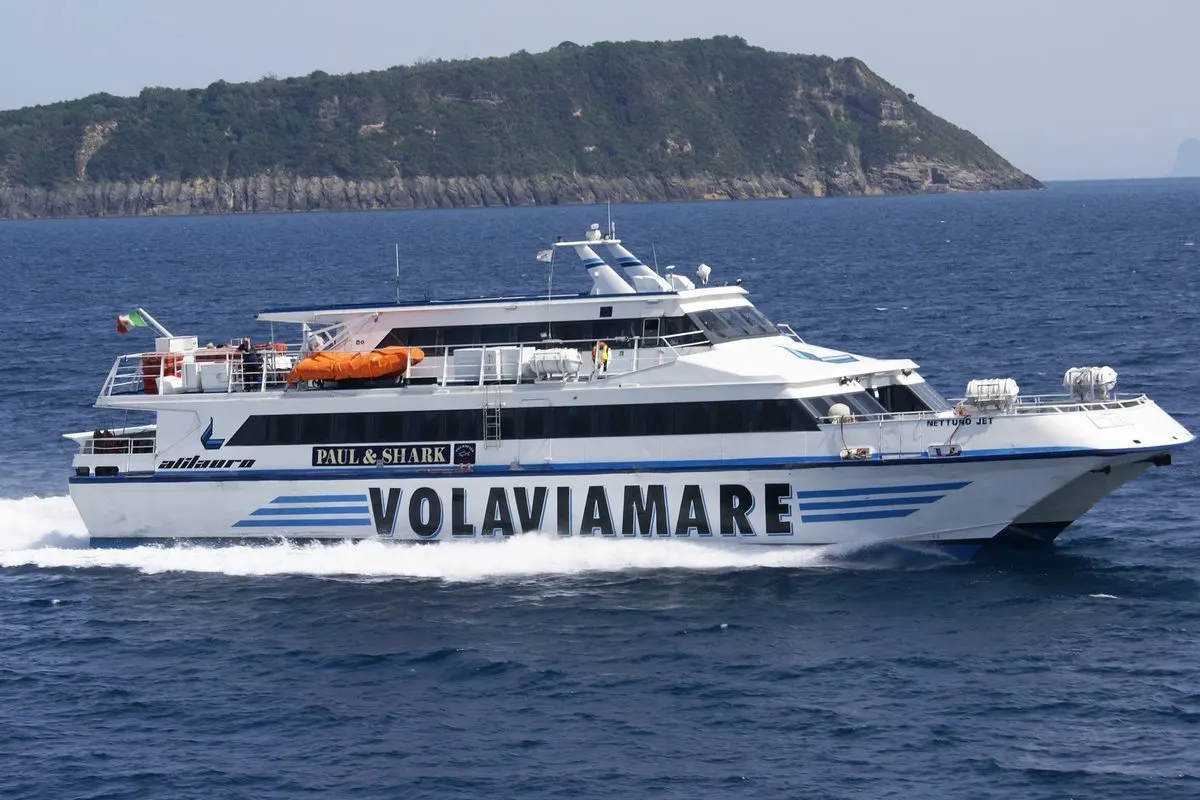
A traghetto is a ferry, often with cars on board; an aliscafo is a hydrofoil, faster, smaller, for foot passengers only. Buy tickets online or at the port biglietteria, and arrive early. With rough sea, mare mosso, crossings can be cancelled at short notice.
Capri, the Amalfi coast, the lakes, Sicily, Sardinia: a lot of Italy is reached by boat. The port is busy, the boats leave on time, and the words on the screen are not the ones you learned at school.
Here's how to buy the right ticket, find your boat and understand what's said when the sea turns rough, with closed questions that get a sì or a no.
| Italian | English |
|---|---|
| Un biglietto per Capri, per favore. | A ticket to Capri, please. |
| È il traghetto o l'aliscafo? | Is it the ferry or the hydrofoil?a choice of two |
| Da quale molo parte? | Which pier does it leave from? |
| È questa la barca per Positano? | Is this the boat for Positano?answer: sì or no |
| Oggi le corse ci sono? | Are the boats running today?answer: sì or no |
| C'è posto all'aperto? | Is there room outside, on deck?answer: sì or no |
| Si può portare la bicicletta? | Can you bring a bike?answer: sì or no |
| Ho il mal di mare. | I'm seasick. |
Read the Italian out loud once before you need it. The questions marked sì or no get a one-word answer you can understand.
A traghetto is the ferry: slower, bigger, with cars and often a bar on board. An aliscafo is the hydrofoil: faster and dearer, foot passengers only, and the first to stop when the sea is rough. A battello is a smaller boat, the kind you take on the lakes.
Long crossings to Sardinia and Sicily run overnight: there you choose between a seat, poltrona, and a cabin, cabina.
| You say | English |
|---|---|
| È il traghetto o l'aliscafo? | Is it the ferry or the hydrofoil?a choice of two |
| Quanto dura la traversata? | How long is the crossing? |
| C'è una cabina libera? | Is there a cabin free?sì or no |
| You hear | English |
|---|---|
| Il traghetto ci mette un'ora e mezza. | The ferry takes an hour and a half. |
| L'aliscafo è più veloce. | The hydrofoil is faster. |
Online or at the biglietteria at the port. Say where you're going, how many people and, for a ferry, whether you have a car. In summer the popular routes fill up: buy ahead.
Some islands charge a small landing tax included in the ticket. Keep the ticket at hand: it's checked when you board.
| You say | English |
|---|---|
| Un biglietto per Capri, per favore. | A ticket to Capri, please. |
| Andata e ritorno. | Return.solo andata: one way |
| Siamo in due, con la macchina. | There are two of us, with the car. |
| Si può portare la bicicletta? | Can you bring a bike?sì or no |
| You hear | English |
|---|---|
| Con auto o solo passeggeri? | With a car or foot passengers only?a choice of two |
| La corsa delle dieci è piena. | The ten o'clock boat is full. |
| La prossima è alle undici e mezza. | The next one is at half past eleven. |

Look for the pier, il molo, on your ticket or on the screens, and arrive early: foot passengers board shortly before departure, cars well before. If in doubt, ask the crew with a closed question: è questa la barca per Positano?
Imbarco is boarding, sbarco is getting off. With a car, staff wave you into a lane: follow the hand, not the satnav.
| You say | English |
|---|---|
| Da quale molo parte? | Which pier does it leave from? |
| È questa la barca per Positano? | Is this the boat for Positano?sì or no |
| Dove si fa l'imbarco auto? | Where do cars board? |
| You hear | English |
|---|---|
| Molo Beverello. | The Beverello pier.Naples, for the islands |
| L'imbarco inizia tra dieci minuti. | Boarding starts in ten minutes. |
| Biglietto, prego. | Ticket, please. |

In the  amo Italian app you practise inside real-life pathways: il bar, il ristorante, i trasporti, la casa and more, with listening, dialogues and the grammar explained in English. This page gives you the phrases; the app trains your ear.
Half the A1 course free, no sign-up
★★★★★(22)by Alessio, teacher since 2018
Downloadamo Italian for iPhone ↗︎Search for amo Italian
Two closed questions cover most of it: whether there's room on deck, c'è posto all'aperto?, and whether a seat is free, è libero? Luggage usually goes in a rack near the entrance.
On ferries the bar sells coffee and sandwiches; on hydrofoils you stay seated, and going outside is often not allowed during the crossing.
| You say | English |
|---|---|
| C'è posto all'aperto? | Is there room outside, on deck?sì or no |
| È libero? | Is this seat free?sì or no |
| Dove lascio la valigia? | Where do I leave the suitcase? |
| You hear | English |
|---|---|
| I bagagli vanno lì. | Luggage goes there. |
| Restate seduti durante la navigazione. | Stay seated during the crossing. |

With mare mosso, rough sea, or strong wind, crossings can be delayed or cancelled, hydrofoils first. The word on the screen is sospesa or soppressa. Ask at the ticket office before you queue: oggi le corse ci sono?
If you're prone to seasickness, mal di mare, sit low and in the middle of the boat, and look at the horizon. Pharmacies sell tablets for it.
| You say | English |
|---|---|
| Oggi le corse ci sono? | Are the boats running today?sì or no |
| La corsa è confermata? | Is the crossing confirmed?sì or no |
| Posso cambiare il biglietto? | Can I change the ticket?sì or no |
| Ho il mal di mare. | I'm seasick. |
| You hear | English |
|---|---|
| Corse sospese per mare mosso. | Crossings suspended due to rough sea.no boats |
| Parte con ritardo. | It's leaving late. |
| Le rimborsiamo il biglietto. | We'll refund your ticket. |
Italy has thousands of kilometres of coast, two large islands and dozens of small inhabited ones. For people who live on Capri, Ischia, Procida, the Aeolian Islands or Elba, the boat is not an excursion: it is the bus to school, to hospital and to work on the mainland. In summer the same boats fill with visitors; in winter the timetables thin out, and a few days of rough sea can cut an island off. Islanders check the sea before they check the weather.

Small islands have their own way of coping with the crowds. By national law they may charge a landing fee, the contributo di sbarco, instead of a hotel tax: up to €2.50 per passenger, and up to €5 in special cases. Capri doubled its fee to €5 in 2025. It is usually added to the ferry ticket, which is why the price at the port can be higher than the fare you saw advertised.
On the big northern lakes, boats are public transport in the same way: on Como, Garda and Maggiore the ferries run by a state agency link villages that are slow to reach by road. In Venice the boat is the bus, literally: the vaporetto is the city's public transport. Since 2024 day visitors also pay an access fee on the busiest days of spring and summer; in 2026 it was €5 if booked at least four days ahead and €10 after that, on top of the boat fare.
Read next: Why are Italian beaches lined with rows of umbrellas? · How do trains fit into everyday life in Italy?
Italians rarely answer with a bare sì or no. These are the forms you will actually hear, so you know which way the answer went.
| You hear | English | It means |
|---|---|---|
| Sì, certo. | Yes, of course. | yes |
| Certo! | Sure! | yes |
| Come no! | Of course! (literally: how not?) | yes |
| Volentieri. | Gladly. | yes |
| Va bene. | Fine, OK. | yes |
| Prego. | Go ahead / please do. | yes |
| No, mi dispiace. | No, I'm sorry. | no |
| Purtroppo no. | Unfortunately not. | no |
| Non c'è. | There isn't any. | no |
| È finito. | It's sold out / all gone. | no |
| Non si può. | That's not allowed. | no |
| Non ancora. | Not yet. | no |
Six real replies. Tap Yes or No for each one.
The grammar behind them
This guide as two printable pages, in English: the phrases to say, the yes/no questions and what you will hear.
All 43 phrase PDFs · €9Already included in the full course · €39 a year.
Or keep the eight phrases as an image, to save on your phone or pin:
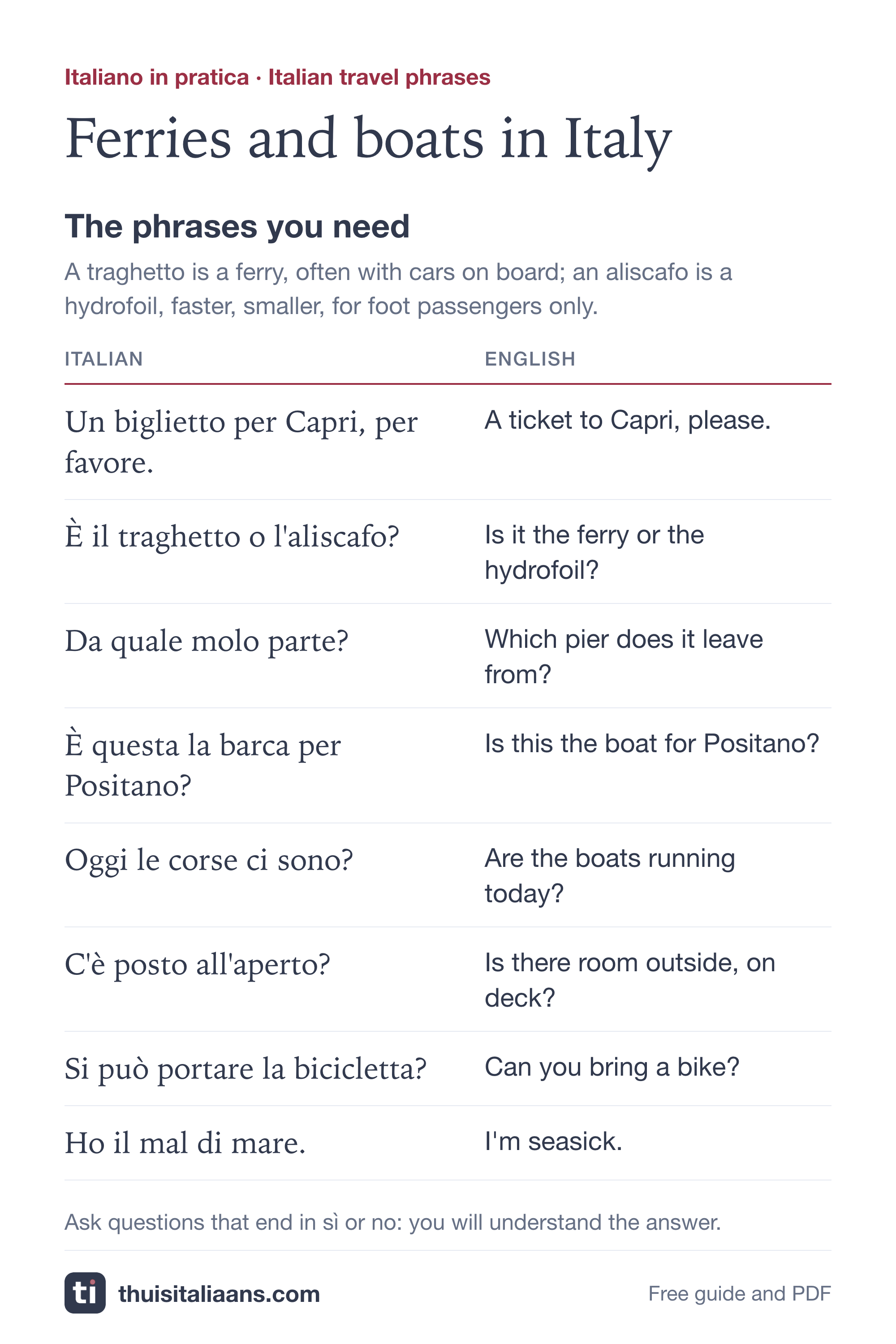 Italian phrases: Ferries and boats in Italy
A traghetto is a ferry, slower and often with cars; an aliscafo is a hydrofoil, faster, for foot passengers only, and more affected by rough sea.
Rough sea. With «mare mosso» ferry and hydrofoil crossings can be delayed or cancelled.
On popular routes in summer, yes: boats fill up. Out of season you can usually buy at the port ticket office.
The pier the boat leaves from. It's printed on the ticket or shown on the screens at the port.