Italiano in pratica
by Alessio · teacher of Italian for foreigners, ITALS master’s in teaching Italian abroad (Ca’ Foscari University, Venice) and a master’s in teaching Italian as a second language (Giustino Fortunato University, Benevento)
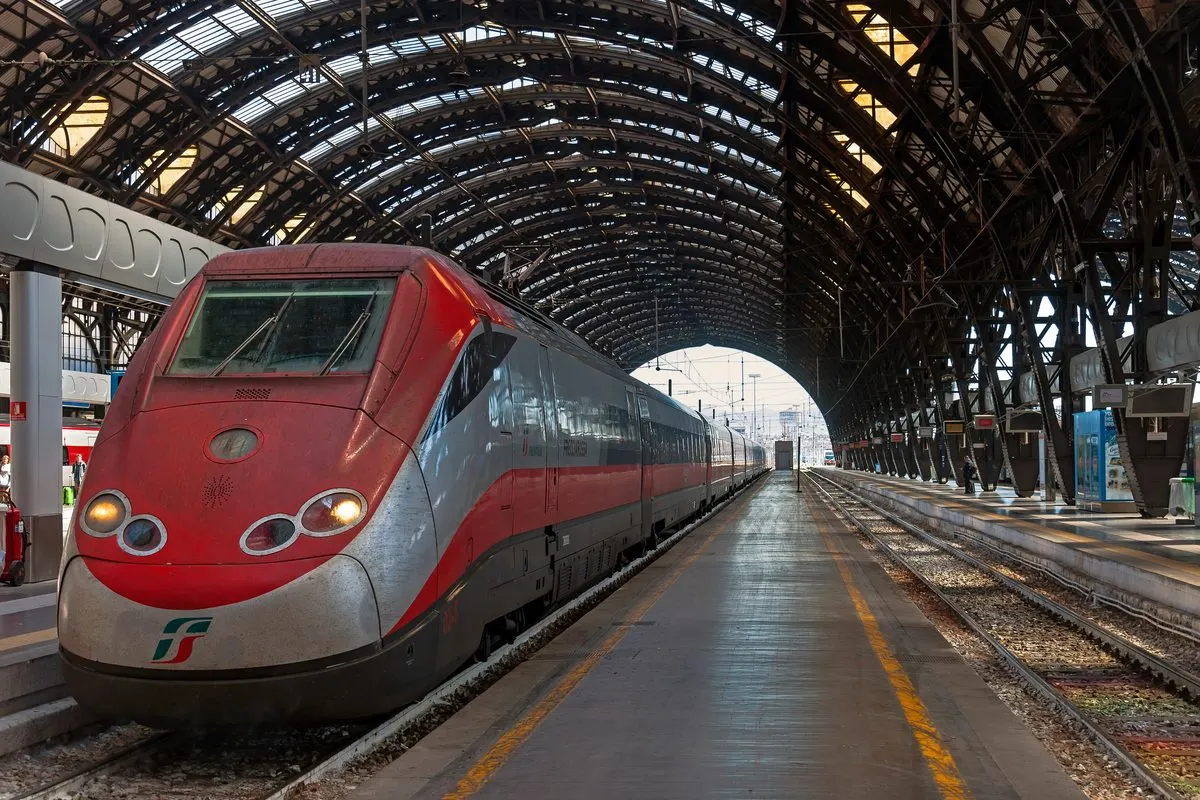
Transport strikes in Italy are announced in advance: public service strikes need at least ten days' notice, and the official calendar is published by the Ministry of Infrastructure and Transport. On strike days some trains still run: on weekdays regional trains are guaranteed from 6 to 9 and from 18 to 21, plus a list of guaranteed services published by the train company.
Sooner or later a word appears on the departures board that your phrasebook didn't mention: sciopero. It means strike, and it's far less chaotic than it sounds, because in Italy strikes have rules, dates and guaranteed hours.
Here is how to see a strike coming, what still runs, what the announcements say, and the closed questions to ask at the desk when your train is late or cancelled.
| Italian | English |
|---|---|
| Domani c'è sciopero? | Is there a strike tomorrow?answer: sì or no |
| Questo treno è garantito? | Is this train guaranteed?answer: sì or no |
| Il treno è in ritardo? | Is the train late?answer: sì or no |
| Il treno è stato cancellato? | Has the train been cancelled?answer: sì or no |
| Posso prendere il prossimo? | Can I take the next one?answer: sì or no |
| Ho diritto al rimborso? | Am I entitled to a refund?answer: sì or no |
| C'è un autobus sostitutivo? | Is there a replacement bus?answer: sì or no |
| Da che binario parte adesso? | Which platform does it leave from now? |
Read the Italian out loud once before you need it. The questions marked sì or no get a one-word answer you can understand.
Strikes in public transport must be announced at least ten days in advance, and they appear in the official strike calendar of the Ministry of Infrastructure and Transport, searchable by sector and date. Train and bus companies also publish notices on their websites and apps a few days before.
Most strikes last a set number of hours, often from 21:00 the evening before to 21:00 on the day, and they're frequently on a Friday or Monday. Check the day before you travel; strikes are sometimes called off or reduced at the last minute.
| You say | English |
|---|---|
| Domani c'è sciopero? | Is there a strike tomorrow?sì or no |
| Lo sciopero è anche per i treni? | Does the strike include trains?sì or no |
| A che ora finisce lo sciopero? | What time does the strike end? |
| You hear | English |
|---|---|
| È stato revocato. | It's been called off.good news |
| Dalle 21 di stasera alle 21 di domani. | From 9 pm tonight to 9 pm tomorrow. |
Yes. On weekdays, regional trains run in guaranteed time bands, fasce di garanzia, usually from 6:00 to 9:00 and from 18:00 to 21:00, for commuters. The train companies also publish a list of guaranteed services, treni garantiti, including some long-distance trains.
Outside those bands, any train may be cancelled. If your train is on the guaranteed list, it should run; if it isn't, plan for it not to. Rules for buses and metros are set city by city.
| You say | English |
|---|---|
| Questo treno è garantito? | Is this train guaranteed?sì or no |
| Ci sono treni garantiti per Firenze? | Are there guaranteed trains to Florence?sì or no |
| Il Frecciarossa delle otto viaggia? | Is the eight o'clock Frecciarossa running?sì or no |
| You hear | English |
|---|---|
| Sì, è nella lista dei garantiti. | Yes, it's on the guaranteed list. |
| Non è garantito. | It isn't guaranteed.no |
| Può subire cancellazioni. | It may be cancelled.plan for no |
Four words cover most of it: in ritardo, late, followed by the minutes; cancellato or soppresso, cancelled; sciopero, strike; and binario, platform, which may change at the last minute: cambio binario.
Announcements start with the train type and number, then the destination: il treno regionale 2134 per Pisa è in ritardo di quindici minuti. Listen for your destination, then for the number of minutes.
| You say | English |
|---|---|
| Il treno è in ritardo? | Is the train late?sì or no |
| Il treno è stato cancellato? | Has the train been cancelled?sì or no |
| Da che binario parte adesso? | Which platform does it leave from now? |
| You hear | English |
|---|---|
| In ritardo di venti minuti. | Twenty minutes late. |
| Il treno è soppresso. | The train is cancelled.no |
| Cambio binario: binario quattro. | Platform change: platform four. |


In the  amo Italian app you practise inside real-life pathways: il bar, il ristorante, i trasporti, la casa and more, with listening, dialogues and the grammar explained in English. This page gives you the phrases; the app trains your ear.
Half the A1 course free, no sign-up
★★★★★(22)by Alessio, teacher since 2018
Downloadamo Italian for iPhone ↗︎Search for amo Italian
Go to the ticket office or the customer service desk and ask closed questions: can you take the next train with the same ticket, is there a replacement bus, and are you entitled to a refund. Keep your ticket and booking code: you'll need them for any claim.
On a cancelled train you can usually travel on the next available one, or ask for a refund. For long delays, EU passenger rules give you compensation on many trains, claimed through the company's website.
| You say | English |
|---|---|
| Posso prendere il prossimo? | Can I take the next one?sì or no |
| C'è un autobus sostitutivo? | Is there a replacement bus?sì or no |
| Ho diritto al rimborso? | Am I entitled to a refund?sì or no |
| Il biglietto vale sul prossimo regionale? | Is the ticket valid on the next regional train?sì or no |
| You hear | English |
|---|---|
| Sì, con lo stesso biglietto. | Yes, with the same ticket. |
| Il bus parte dal piazzale. | The bus leaves from the forecourt. |
| Faccia la richiesta online. | Make the claim online. |

Air transport strikes also have protected hours: flights scheduled from 7:00 to 10:00 and from 18:00 to 21:00 normally operate. Local bus and metro strikes follow guaranteed bands set city by city, often around the morning and evening rush hours.
Check with your airline the day before: they list which flights are cancelled. In cities, the transport company's website publishes the guaranteed times for that strike.
| You say | English |
|---|---|
| Il mio volo è confermato? | Is my flight confirmed?sì or no |
| La metro funziona oggi? | Is the metro running today?sì or no |
| A che ora riprende il servizio? | What time does service resume? |
| You hear | English |
|---|---|
| Il volo è regolare. | The flight is on schedule.yes |
| Servizio garantito fino alle 8:45. | Service guaranteed until 8:45. |
Strikes surprise visitors in Italy mostly because they are so often in the news. What surprises them less, once they know, is how regulated they are. Since 1990 a national law has governed strikes in essential public services, transport included: unions must give at least ten days' notice, state how long the strike will last, and guarantee a minimum service. An independent authority, the Commissione di garanzia, checks that the rules are respected and can fine those who break them.

For trains, the minimum service takes the form of protected time bands. On weekdays, regional trains run from 6 to 9 in the morning and from 18 to 21 in the evening, the hours when commuters travel, and the companies publish lists of guaranteed trains. Strikes in the air sector have their own protected hours, and city transport sets its bands locally.
The practical consequence is that a strike is something you can plan around. The Ministry of Infrastructure and Transport keeps a public calendar of announced strikes, searchable by sector and date, and many strikes are later called off or shortened. It's not perfect: on some strike days even guaranteed trains are cancelled. But a traveller who checks the calendar a few days ahead is rarely caught out.
Read next: How do trains fit into everyday life in Italy? · What surprises visitors at Italian airports?
Italians rarely answer with a bare sì or no. These are the forms you will actually hear, so you know which way the answer went.
| You hear | English | It means |
|---|---|---|
| Sì, certo. | Yes, of course. | yes |
| Certo! | Sure! | yes |
| Come no! | Of course! (literally: how not?) | yes |
| Volentieri. | Gladly. | yes |
| Va bene. | Fine, OK. | yes |
| Prego. | Go ahead / please do. | yes |
| No, mi dispiace. | No, I'm sorry. | no |
| Purtroppo no. | Unfortunately not. | no |
| Non c'è. | There isn't any. | no |
| È finito. | It's sold out / all gone. | no |
| Non si può. | That's not allowed. | no |
| Non ancora. | Not yet. | no |
Six real replies. Tap Yes or No for each one.
The grammar behind them
This guide as two printable pages, in English: the phrases to say, the yes/no questions and what you will hear.
All 43 phrase PDFs · €9Already included in the full course · €39 a year.
Or keep the eight phrases as an image, to save on your phone or pin:
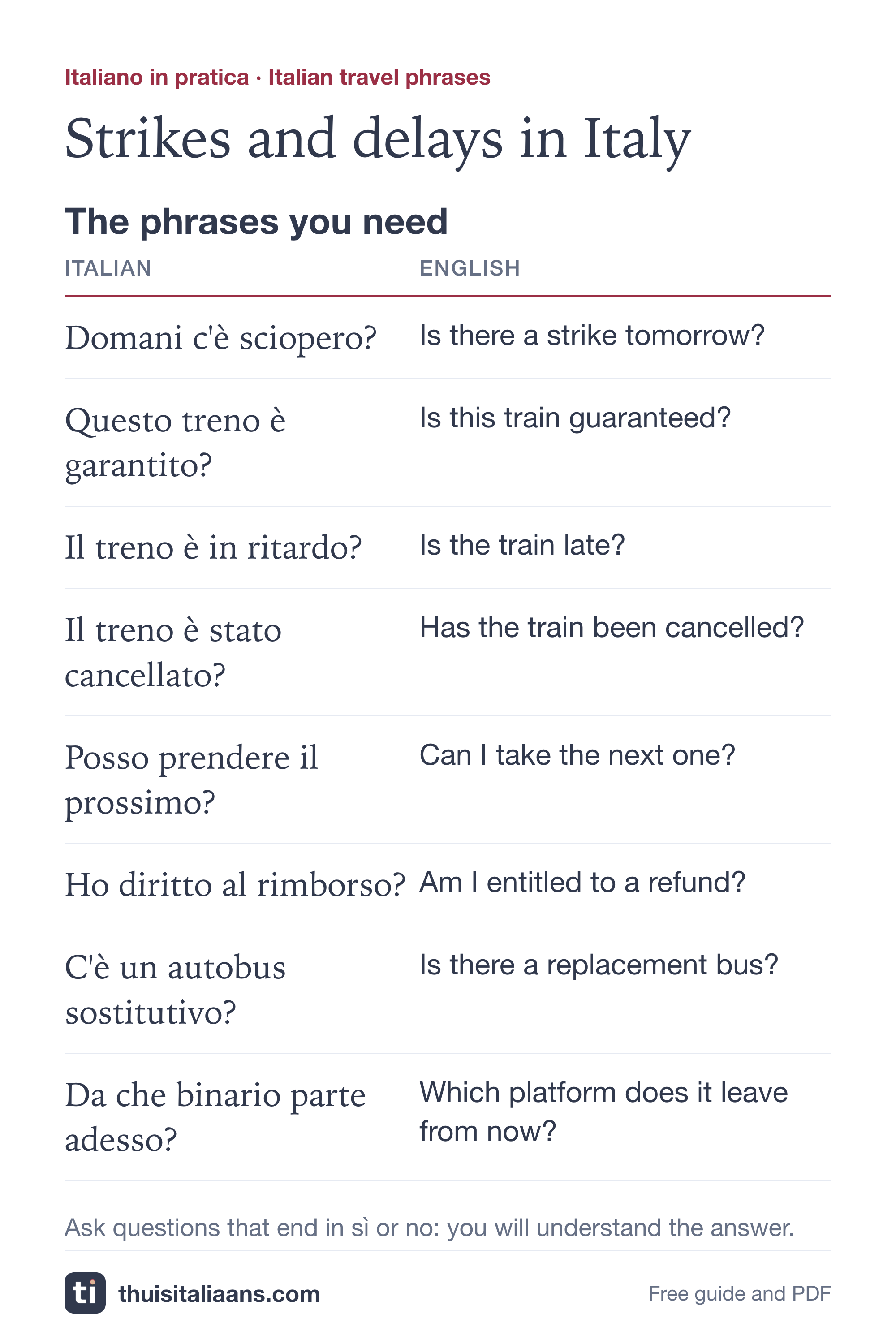 Italian phrases: Strikes and delays in Italy
Strikes in essential public services, including transport, need at least ten days' notice. They are listed in the official calendar of the Ministry of Infrastructure and Transport.
Some do. On weekdays regional trains are guaranteed from 6 to 9 and from 18 to 21, and the train companies publish a list of guaranteed services, including some long-distance trains.
Strike. «Treno soppresso» or «cancellato» means the train is cancelled, «in ritardo» means late.
Usually yes, or you can ask for a refund. Ask at the ticket office: «Posso prendere il prossimo con lo stesso biglietto?»
On the strike calendar of the Ministry of Infrastructure and Transport, and on the websites and apps of the train, bus and airline companies.