Italiano in pratica
by Alessio · teacher of Italian for foreigners, ITALS master’s in teaching Italian abroad (Ca’ Foscari University, Venice) and a master’s in teaching Italian as a second language (Giustino Fortunato University, Benevento)
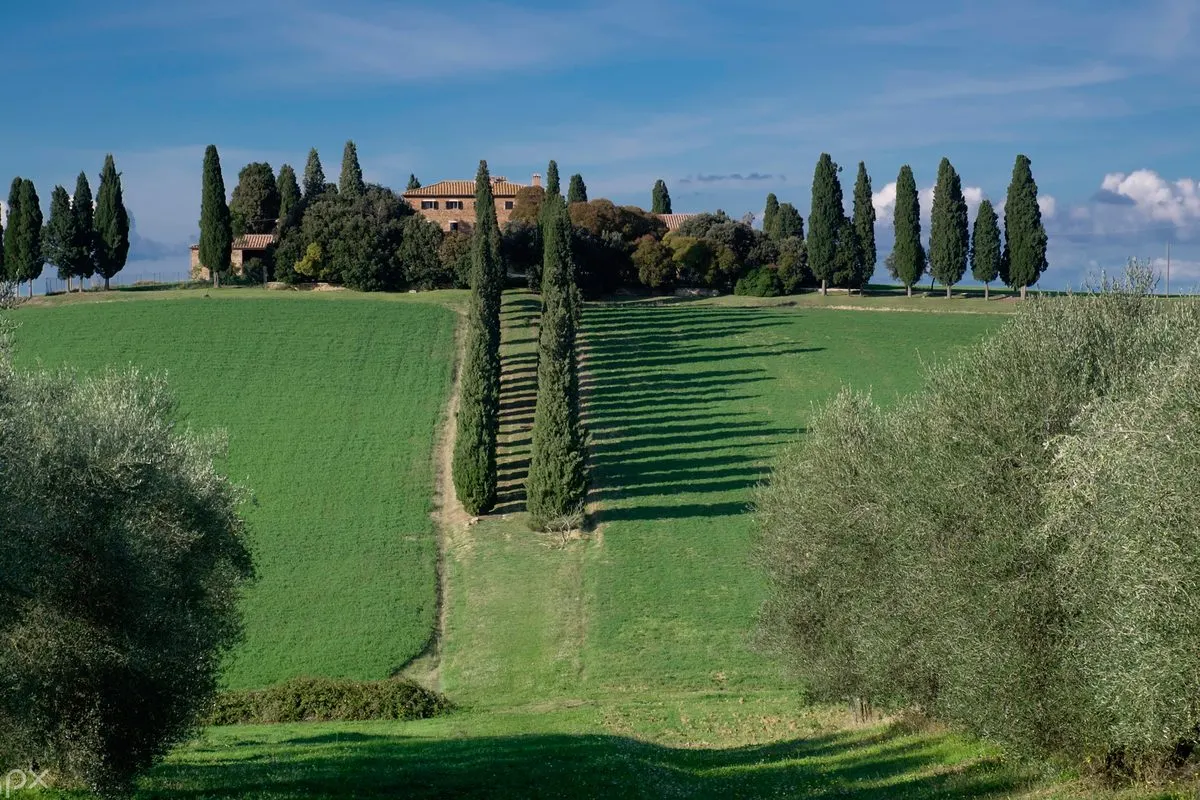
An agriturismo is not a country hotel: by Italian law it's a working farm where the farmer also offers rooms and meals, and much of what's served must come from the farm itself. Expect a set dinner at a fixed time, products for sale, and a host who knows every field.
The road turns to gravel, a dog runs out to meet the car, and someone in boots walks over from the olive trees to give you a key. That's an agriturismo, and it's one of the best ways to see rural Italy.
Here is what to expect, from the dinner that everyone eats at the same time to the jar of honey you'll take home, with closed questions for the host.
| Italian | English |
|---|---|
| Abbiamo una prenotazione a nome Brown. | We have a booking under the name Brown. |
| A che ora è la cena? | What time is dinner? |
| Possiamo cenare qui stasera? | Can we have dinner here tonight?answer: sì or no |
| È tutto di vostra produzione? | Is everything produced here?answer: sì or no |
| Vendete l'olio? | Do you sell the olive oil?answer: sì or no |
| Si possono vedere gli animali? | Can we see the animals?answer: sì or no |
| La colazione è inclusa? | Is breakfast included?answer: sì or no |
| C'è un menù vegetariano? | Is there a vegetarian menu?answer: sì or no |
Read the Italian out loud once before you need it. The questions marked sì or no get a one-word answer you can understand.
Under Italian law (Law 96 of 2006) an agriturismo is hospitality offered by a farmer, connected to the farm's own work: growing crops, keeping animals, managing woodland. The farming must remain the main activity, and food and drink served are largely the farm's own produce, or made from its raw materials.
So the experience varies: one agriturismo is a vineyard with four rooms, another a dairy farm with a restaurant full of locals on Sunday. Read what the farm produces before you book; it tells you what you'll eat.
| You say | English |
|---|---|
| È un'azienda agricola vera? | Is it a real working farm?sì or no |
| Cosa producete? | What do you produce? |
| È tutto di vostra produzione? | Is everything produced here?sì or no |
| You hear | English |
|---|---|
| Facciamo olio, vino e formaggio. | We make olive oil, wine and cheese. |
| Il pane lo facciamo noi. | We bake the bread ourselves. |
Often there's no menu: dinner is a set meal, at a set time, with several courses decided by the cook that day. Book it in the morning or when you arrive, and say if anyone has allergies or doesn't eat meat.
Dinner usually starts around eight, sometimes at shared tables. Wine from the farm is often included or sold by the carafe. Many agriturismi are also open to outside guests for meals, especially at weekends.
| You say | English |
|---|---|
| Possiamo cenare qui stasera? | Can we have dinner here tonight?sì or no |
| A che ora è la cena? | What time is dinner? |
| C'è un menù vegetariano? | Is there a vegetarian menu?sì or no |
| Mia figlia è celiaca. | My daughter has coeliac disease. |
| Il vino è compreso? | Is the wine included?sì or no |
| You hear | English |
|---|---|
| Stasera c'è il menù della casa. | Tonight it's the house menu. |
| Si cena alle otto. | Dinner is at eight. |
| Me lo dica stamattina. | Let me know this morning. |

Agriturismi are small, run by families who are also out in the fields, so agree an arrival time in advance and call if you're late. The last kilometres are often an unpaved road, strada bianca: drive slowly, and don't trust the satnav's shortcuts.
Many places have a gate code or a key left for late arrivals. Write down the host's mobile number before you lose signal in the hills.
| You say | English |
|---|---|
| Abbiamo una prenotazione a nome Brown. | We have a booking under the name Brown. |
| Arriviamo verso le sette, va bene? | We'll arrive around seven, is that OK?sì or no |
| La strada è sterrata? | Is the road unpaved?sì or no |
| Il navigatore ci manda di qua: è giusto? | The satnav sends us this way: is it right?sì or no |
| You hear | English |
|---|---|
| Dopo il cancello, sempre dritto. | After the gate, straight on. |
| Il navigatore sbaglia, segua i cartelli. | The satnav is wrong, follow the signs. |

In the  amo Italian app you practise inside real-life pathways: il bar, il ristorante, i trasporti, la casa and more, with listening, dialogues and the grammar explained in English. This page gives you the phrases; the app trains your ear.
Half the A1 course free, no sign-up
★★★★★(22)by Alessio, teacher since 2018
Downloadamo Italian for iPhone ↗︎Search for amo Italian
Often yes, but ask first: it's a workplace. Many farms offer a tour of the cellar, the olive mill or the cheese room, a tasting, or activities for children with the animals. In autumn some let guests join the grape or olive harvest, la vendemmia and la raccolta delle olive.
Close every gate behind you, and keep children away from machines and from animals unless the host is with you.
| You say | English |
|---|---|
| Si possono vedere gli animali? | Can we see the animals?sì or no |
| Fate visite alla cantina? | Do you do tours of the cellar?sì or no |
| Possiamo partecipare alla vendemmia? | Can we join the grape harvest?sì or no |
| You hear | English |
|---|---|
| Domattina alle nove vi porto io. | Tomorrow at nine I'll take you. |
| Chiudete il cancello, per favore. | Close the gate, please. |

Usually yes, and it's one of the pleasures of staying: olive oil, wine, honey, cheese or jam from the farm, often cheaper than in town. Ask the day before you leave, so they can prepare bottles or vacuum-pack the cheese.
If you're flying, ask for sealed packaging, and remember the liquid limits in hand luggage: oil and wine go in the checked bag.
| You say | English |
|---|---|
| Vendete l'olio? | Do you sell the olive oil?sì or no |
| Me lo mette sottovuoto? | Can you vacuum-pack it for me?sì or no |
| Si può pagare con la carta? | Can you pay by card?sì or no |
| You hear | English |
|---|---|
| L'olio nuovo arriva a novembre. | The new oil arrives in November. |
| Glielo preparo per domani. | I'll get it ready for tomorrow. |
In English «farm stay» can mean anything from a barn conversion to a luxury lodge with a few goats for decoration. In Italy the word agriturismo has a legal meaning. A national law of 2006 defines it as hospitality offered by a farmer, using the farm and connected to its real agricultural work: crops, animals, woods. The farming has to remain the main business; the rooms and meals come second.

The same law explains what you eat. Food and drink count as the farm's own when they are produced and processed on the farm, or made from its raw materials even if processed elsewhere, like olives pressed at a nearby mill. That's why the menu changes with the season and why the host can tell you which field your vegetables came from. Each region then sets its own rules on how much must come from the farm and from other local producers.
For a visitor this means two things. An agriturismo is usually more rural, simpler and more tied to the seasons than a hotel, and the people running it have another job outside your door. It also means that the dinner, the oil and the wine are the point of the stay, not an extra. Book the dinner, and ask what the farm produces before you arrive.
Read next: How do Italians drink wine, and how is it different from home? · Why does Bologna measure its tagliatelle?
Italians rarely answer with a bare sì or no. These are the forms you will actually hear, so you know which way the answer went.
| You hear | English | It means |
|---|---|---|
| Sì, certo. | Yes, of course. | yes |
| Certo! | Sure! | yes |
| Come no! | Of course! (literally: how not?) | yes |
| Volentieri. | Gladly. | yes |
| Va bene. | Fine, OK. | yes |
| Prego. | Go ahead / please do. | yes |
| No, mi dispiace. | No, I'm sorry. | no |
| Purtroppo no. | Unfortunately not. | no |
| Non c'è. | There isn't any. | no |
| È finito. | It's sold out / all gone. | no |
| Non si può. | That's not allowed. | no |
| Non ancora. | Not yet. | no |
Six real replies. Tap Yes or No for each one.
The grammar behind them
This guide as two printable pages, in English: the phrases to say, the yes/no questions and what you will hear.
All 43 phrase PDFs · €9Already included in the full course · €39 a year.
Or keep the eight phrases as an image, to save on your phone or pin:
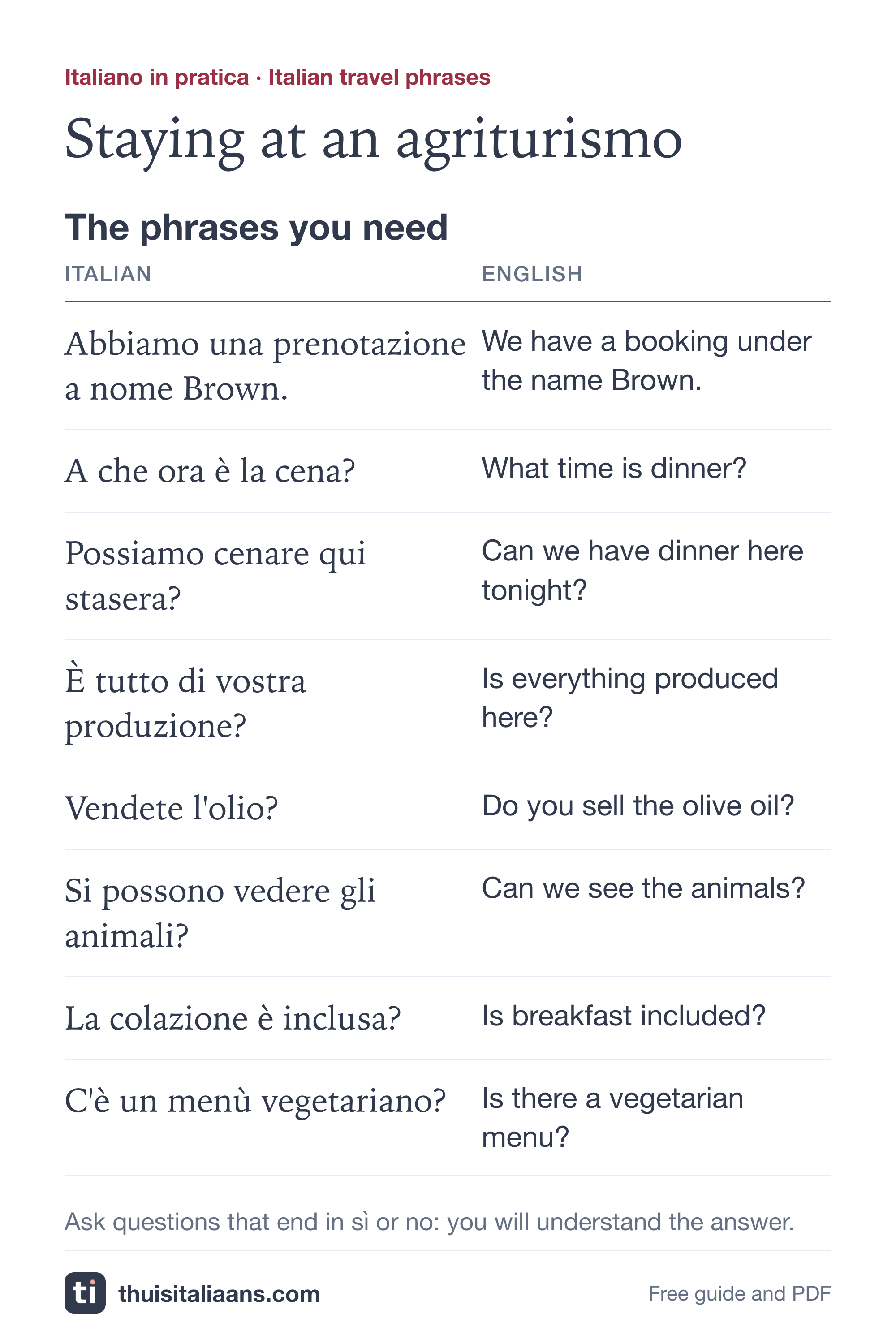 Italian phrases: Staying at an agriturismo
A farm stay: under Italian law, hospitality offered by a farmer as part of a working farm, where much of the food served comes from the farm itself.
Not always. Many offer a set dinner at a fixed time that you book in advance; breakfast is more often included. Ask when you book.
Often very: animals, space outdoors and simple food. Ask whether there's a pool fence and which animals children can visit.
Usually yes: olive oil, wine, honey or cheese from the farm. Ask the day before you leave.
Almost always: most are in the countryside, often at the end of an unpaved road.