

Grammar · B2
The passive
by Alessio · teacher of Italian as a foreign language, ITALS master’s

The passive moves the spotlight from the agent to the action: il satellite è stato lanciato ieri. Italian has three versions: essere (neutral), venire (the action as it happens), andare (obligation: va verificato).
- 6min reading
- 15min exercises
- B2level
What you learn
- essere, venire, andare
- When to use the passive
- Active and passive side by side
- Vocabulary: lo spazio
Italian and English side by side
English passives are everywhere and use only be. Italian has three: essere (neutral), venire (stresses the action), andare (expresses obligation: va fatto = it must be done). And it often prefers the si passivante where English keeps the passive.
Take this page with you
This chapter’s sheet as a free printable PDF (tables in Italian): rules, typical mistakes and the quiz with answers. A teacher’s tip: grammar sticks by reviewing it often, not by studying it once.


The words on this page
Drag each Italian word onto its definition, or tap a word first, then its box.
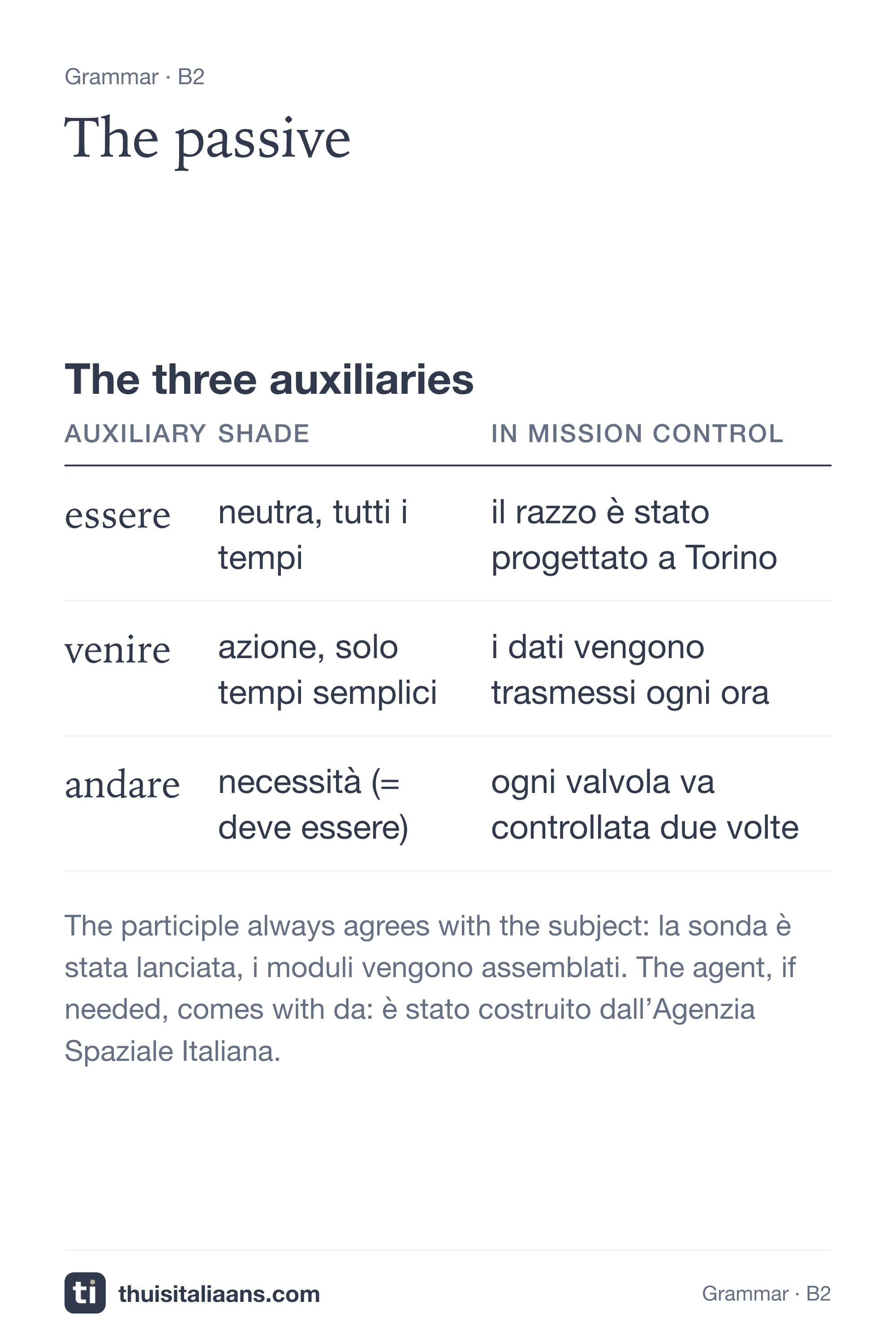
The three auxiliaries
| Auxiliary | Shade | In mission control |
|---|---|---|
| essere | neutra, tutti i tempi | il razzo è stato progettato a Torino |
| venire | azione, solo tempi semplici | i dati vengono trasmessi ogni ora |
| andare | necessità (= deve essere) | ogni valvola va controllata due volte |
Active and passive side by side
| Active | Passive |
|---|---|
| i tecnici controllano i motori | i motori vengono controllati dai tecnici |
| l’ESA ha approvato la missione | la missione è stata approvata dall’ESA |
| bisogna verificare i sensori | i sensori vanno verificati |
The most common mistakes
la sonda è stato lanciata→ la sonda è stata lanciata (double agreement with the subject)i dati vengono stati trasmessi→ i dati sono stati trasmessi (venire has no compound tenses)il modulo va essere controllato→ il modulo va controllato (andare + participle, no essere)
Did you know?
Read and understand
This chapter’s grammar. Example: a report on the reopened bridge.
Il Corriere del Quartiere
giovedì 14 maggio · pagina 2
Lavori
Il ponte è stato riaperto dopo tre mesi
di Sergio Valli
Il ponte sul torrente è tornato in servizio ieri mattina. La struttura era stata chiusa a febbraio, dopo la piena, e per tre mesi il quartiere ha girato al largo.
I controlli ora vengono ripetuti ogni sei mesi: il prossimo sarà fatto in ottobre. Le barriere nuove sono state montate da una ditta della zona in due settimane.
Dai vigili una raccomandazione doppia: la pista sotto il ponte va evitata nelle ore di pioggia forte, e ogni danno va segnalato subito al Comune, anche con una foto.
Questions
Quando era stata chiusa la struttura?
Ogni quanto vengono ripetuti i controlli?
«I controlli vengono ripetuti»: qui «venire» serve a…
«Ogni danno va segnalato» significa che ogni danno…
Completa: «Il pane ___ sfornato ogni mattina alle sei» (venire).
Exercises
Five exercises in order of difficulty. The last ones bring back what you have already seen.
01 Da attiva a passiva
Turn into the passive with essere + participle.
- Il cuoco prepara la cena. →
- Molti leggono questo giornale. →
- L’azienda ha assunto due persone. →
- Il comune costruirà una scuola. →
- I turisti visitano il museo. →
- Qualcuno ha rubato la bici. →
02 Con venire e andare
Venire stresses the action, andare expresses necessity. Complete.
- Il modulo compilato in stampatello. (venire, presente)
- Il modulo compilato entro oggi. (andare, presente)
- Le domande inviate per posta. (venire, presente)
- Le domande inviate entro il 30. (andare, presente)
- La legge approvata l’anno scorso. (venire, passato)
- Questo problema risolto subito. (andare, presente)
03 Il si passivante
Rewrite with si, as in the example: Si vendono case.
- Case sono vendute qui. →
- Il vino è prodotto in questa zona. →
- Gli errori sono corretti in classe. →
- L’italiano è parlato anche qui. →
- Le domande sono accettate online. →
- Il pane è fatto ogni mattina. →
04 Quando la passiva non si può
Only verbs with a direct object allow it. Write sì or no and, where possible, transform.
- Marco ha scritto la lettera. →
- Marco è andato a Roma. →
- Il tecnico ripara la caldaia. →
- Il treno parte alle otto. →
- Tutti apprezzano il suo lavoro. →
- Mi piace questo film. →
05 L’articolo di giornale
Complete with passives, the si passivante and the right tenses.
Review concordanza al congiuntivo · B1: si impersonale
- Ieri (approvare) il nuovo piano del traffico.
- Il provvedimento (volere) dal comune per ridurre le auto in centro.
- Dal primo settembre non (potere) più entrare nella zona rossa.
- I permessi (rilasciare) solo ai residenti.
- Le multe (pagare) entro sessanta giorni.
- Secondo il sindaco, l’aria (migliorare) già nei primi mesi.
These five are a taste. There are over seven hundred on the site, free and with no sign-up. All the exercises →

Every topic, a world
In the  amo Italian app, grammar is practised inside thematic pathways with field-specific vocabulary: il bar, i trasporti, il calcio, la moda, la burocrazia and seventeen more. Choose your world and the grammar comes along by itself, explained in your language too.
Half the path free, no sign-up
★★★★★(11)by Alessio, teacher since 2018
Downloadamo Italian for iPhone ↗︎Search for amo Italian
Read and understand
This chapter’s grammar. Example: a museum sign.
MUSEO CIVICO
Come viene protetta la collezione
Operenon vanno toccate: l'olio delle mani le rovina
Bigliettivengono controllati anche all'uscita
Zainivanno lasciati negli armadietti dell'ingresso
Fotosono permesse, ma il flash va spento
Sala degli specchiè stata riaperta a marzo, dopo il restauro
Visite guidatevengono organizzate ogni sabato alle 11
Il lunedì il museo viene pulito da cima a fondo: si resta chiusi.
Questions
Dove vanno lasciati gli zaini?
Quando è stata riaperta la sala degli specchi?
«Le opere non vanno toccate»: andare + participio esprime…
«Vengono controllati» invece di «sono controllati»: che sfumatura aggiunge venire?
Completa: «I documenti ___ firmati entro venerdì» (andare).
Want another text on this topic? A complaint email · A refund form
One more go
Turn into the right passive:
- Il satellite questa notte.
- I dati in tempo reale.
- Ogni componente prima del volo.
- La missione dall’agenzia.
- Le tute già in rampa.
Frequently asked questions
Why can’t I say è venuto lanciato?
Because venire works as a passive auxiliary only in simple tenses: viene lanciato, veniva lanciato, verrà lanciato. In compound tenses the language switches back to essere: è stato lanciato. It is a hard grammatical wall, not a stylistic preference.
Does andare + participle always mean obligation?
Almost always (va verificato: it must be checked), with one family of exceptions: with verbs of losing and destroying, it just reports the outcome: il pacco è andato perso, i documenti andarono distrutti: the parcel got lost, nobody is ordering it to get lost.
Is si vendono case a passive?
Functionally yes: the passive si (si vendono case = le case vengono vendute) is the everyday way to hide the agent, far more common in speech than the full passive. The mechanics live in the chapter on the impersonal si.
 The three auxiliaries