

Grammar · B1
The imperative with pronouns
by Alessio · teacher of Italian as a foreign language, ITALS master’s

With tu, pronouns attach to the end of the imperative: dimmelo, portamelo, alzati. With Lei they stay in front: me lo dica, si accomodi. And five short imperatives double the pronoun’s consonant: dammi, dimmi, fallo, stacci, vacci.
- 5min reading
- 17min exercises
- B1level
What you learn
- tu, voi, Lei
- When to use the imperative with pronouns
- The most common mistakes
- Vocabulary: il bar
Italian and English side by side
English imperatives are bare and pronouns stay after: call him!, don't call him! Italian attaches them (chiamalo!) and switches to the infinitive in the negative (non chiamarlo!). In the polite form the pronoun moves in front: lo chiami!
Take this page with you
This chapter’s sheet as a free printable PDF (tables in Italian): rules, typical mistakes and the quiz with answers. A teacher’s tip: grammar sticks by reviewing it often, not by studying it once.


The words on this page
Drag each Italian word onto its definition, or tap a word first, then its box.
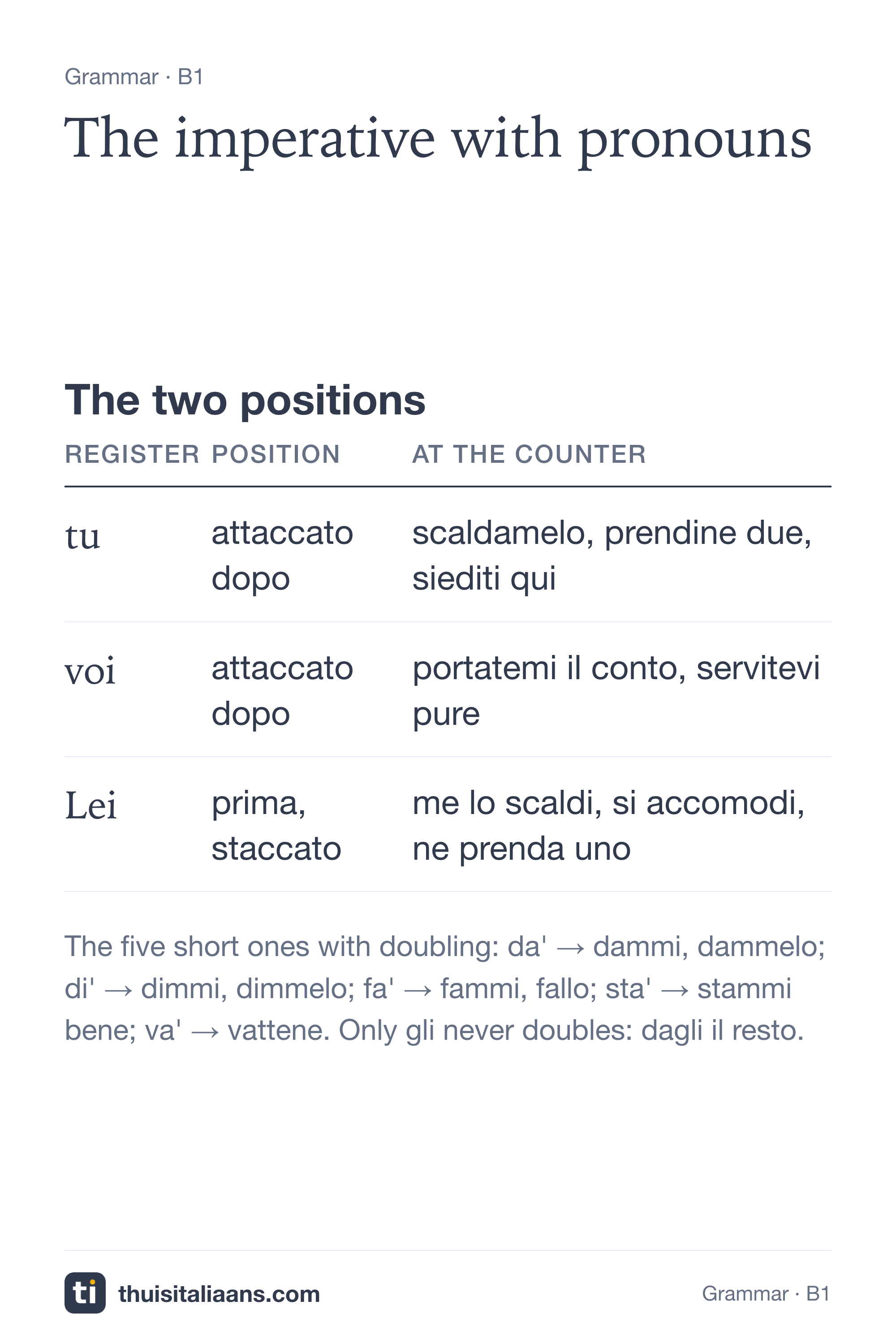
The two positions
| Register | Position | At the counter |
|---|---|---|
| tu | attaccato dopo | scaldamelo, prendine due, siediti qui |
| voi | attaccato dopo | portatemi il conto, servitevi pure |
| Lei | prima, staccato | me lo scaldi, si accomodi, ne prenda uno |
The negative
| Register | Form | Example |
|---|---|---|
| tu | non + infinito (pronome libero) | non dirmelo! / non me lo dire! |
| Lei | non + congiuntivo, pronome prima | non si preoccupi, non me lo dica |
The most common mistakes
lo dimmi subito→ dimmelo subito (with tu the pronoun goes at the end)signora, accomodati→ signora, si accomodi (Lei register)da mi un cornetto→ dammi un cornetto (doubling after da')
Did you know?
Read and understand
This chapter’s grammar. Example: a chat about parmigiana.
online
Questions
Che cosa deve portare, oltre al vino?
Per chi è la sorpresa?
«Dimmi», «portalo», «digli»: dove va il pronome con l'imperativo?
Completa: «Questo libro è per Anna: ___ appena la vedi» (tu, dare, a lei, il libro).
Exercises
Five exercises in order of difficulty. The last ones bring back what you have already seen.
01 Attaccati alla fine
With tu, noi, voi the pronoun attaches. Rewrite.
- Chiama Marco! →
- Scrivi a me! →
- Prendi le chiavi! →
- Diamo il libro a lui! →
- Aspettate noi! →
- Alzati presto! →
02 I cinque verbi corti
Va’, da’, fa’, sta’, di’ double the consonant of the pronoun. Rewrite.
- Dare il libro a me! →
- Dire la verità a me! →
- Fare questo! →
- Andare via! (tu) →
- Stare zitto! (tu) →
- Dare una mano a lui! →
03 Il negativo
With tu the negative uses the infinitive, and the pronoun can go before or attached. Transform.
- Chiamalo! →
- Dimmelo! →
- Alzati! →
- Compratele! (voi) →
- Diamoglielo! →
- Fallo! →
04 Con il Lei: il pronome sta davanti
In the polite form the imperative is a subjunctive and the pronoun comes first. Rewrite.
- Chiamalo! (a un cliente) →
- Dimmi! (a un signore) →
- Scusami! (a una signora) →
- Aspettami! (a un collega, Lei) →
- Siediti! (a un ospite, Lei) →
- Dammelo! (a un impiegato, Lei) →
05 Istruzioni in cucina
Complete with the imperative, the pronouns and the connectives.
Review pronomi combinati · connettivi · A2: imperativo
- (tu / prendere) le uova e (romperle) in una ciotola.
- (aggiungere) il sale, non troppo.
- La pasta? (buttarla) appena l’acqua bolle.
- (non scolare) tutta l’acqua: (tenerne) un po’.
- (mescolare) la crema (essere) liscia. (finché)
- Se serve, (chiedere) a tua madre: (lei / spiegartelo) meglio di me.
These five are a taste. There are over seven hundred on the site, free and with no sign-up. All the exercises →

Every topic, a world
In the  amo Italian app, grammar is practised inside thematic pathways with field-specific vocabulary: il bar, i trasporti, il calcio, la moda, la burocrazia and seventeen more. Choose your world and the grammar comes along by itself, explained in your language too.
Half the path free, no sign-up
★★★★★(11)by Alessio, teacher since 2018
Downloadamo Italian for iPhone ↗︎Search for amo Italian
Read and understand
This chapter’s grammar. Example: an app's getting-started page.
Tre minuti, poi pensaci tu
Scarica l'app e apri il primo capitolo: leggilo con calma, sono due schermate.
Il test di livello fa paura a tutti: fallo lo stesso, e non prenderlo troppo sul serio. Serve a noi, non a giudicare te.
Gli esercizi sbagliati tornano da soli dopo tre giorni: rifalli senza guardare le soluzioni. Se un audio è troppo veloce, rallentalo con il tasto tartaruga.
Un dubbio di grammatica? Scrivicelo: risponde una persona, non un robot. E la serie dei giorni di studio… non fartela scappare!
Questions
Dopo quanti giorni tornano gli esercizi sbagliati?
A che cosa serve il tasto tartaruga?
«Fallo» ha due elle perché…
Completa: «È un segreto: ___ per te» (tu, tenere, il segreto).
Want another text on this topic? The doctor's answering machine · The tiramisù recipe
One more go
Attach or detach the pronoun:
- Questo caffè è freddo: , per favore.
- Prego signora, al tavolo.
- la verità: è decaffeinato?
- Le paste sono fresche: due.
- Non : avete finito i cornetti.
Frequently asked questions
In the negative, where do the pronouns go?
Two correct options with tu, noi, voi: attached to the infinitive/imperative (non dirmelo, non ditemelo) or before it (non me lo dire, non me lo dite). Choose by rhythm: both are standard.
And with formal Lei, in the negative?
Pronouns always stay in front, negative or not: non me lo dica, non si preoccupi, non glielo mandi. The Lei imperative never lets pronouns attach: it is the one register where the order is fixed and formal.
How does it work with noi and voi?
Attached, like with tu: parliamone (let’s talk about it), andiamocene (let’s leave), ditemelo, sedetevi. The noi forms are especially useful: half of Italian social life runs on vediamoci, sentiamoci, organizziamoci.
 The two positions