

Grammar · B1
Combined pronouns
by Alessio · teacher of Italian as a foreign language, ITALS master’s

When an indirect pronoun meets a direct one, they merge: mi + lo = me lo, gli + la = gliela. The order is fixed, indirect first: me lo porta? Glielo chiedo subito.
- 6min reading
- 18min exercises
- B1level
What you learn
- ti, gli / le / Le, ci, vi
- When to use combined pronouns
- The most common mistakes
- Vocabulary: il bar
Italian and English side by side
English keeps object pronouns separate and after the verb: I gave it to him. Italian fuses them into one word before the verb: gliel'ho dato. The order also flips (indirect first, then direct), which is the opposite of the English sequence.
Take this page with you
This chapter’s sheet as a free printable PDF (tables in Italian): rules, typical mistakes and the quiz with answers. A teacher’s tip: grammar sticks by reviewing it often, not by studying it once.


The words on this page
Drag each Italian word onto its definition, or tap a word first, then its box.
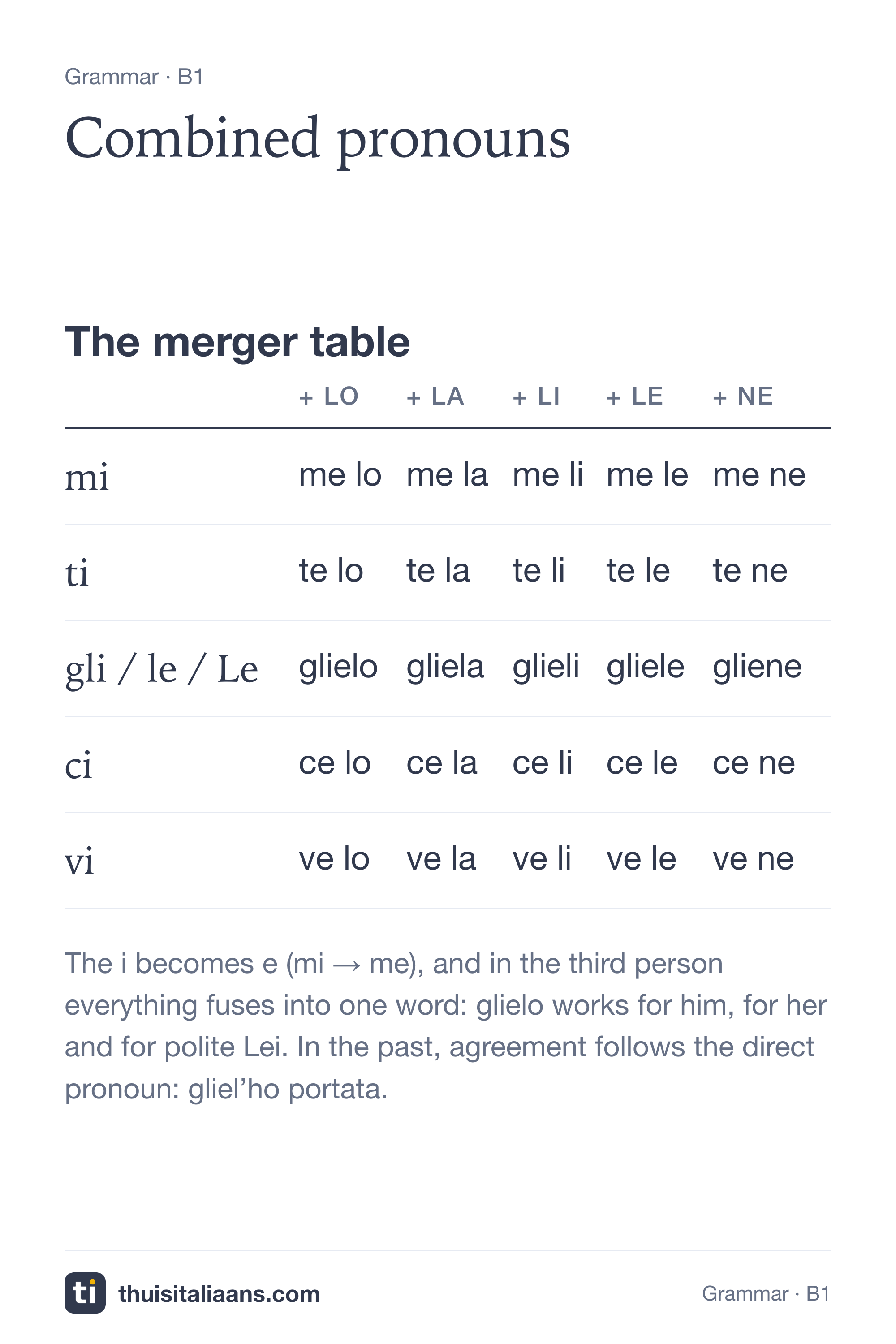
The merger table
| + lo | + la | + li | + le | + ne | |
|---|---|---|---|---|---|
| mi | me lo | me la | me li | me le | me ne |
| ti | te lo | te la | te li | te le | te ne |
| gli / le / Le | glielo | gliela | glieli | gliele | gliene |
| ci | ce lo | ce la | ce li | ce le | ce ne |
| vi | ve lo | ve la | ve li | ve le | ve ne |
At the counter
| Sentence | Inside |
|---|---|
| il solito? Glielo preparo subito | gli + lo |
| me la fa doppia, la tazzina? | mi + la |
| i cornetti? Ve li scaldo | vi + li |
| di brioche ce ne sono due | ci + ne |
The most common mistakes
gli lo porto subito→ glielo porto subito (third person: one single word)mi lo scaldi, per favore?→ me lo scaldi (mi becomes me before lo)gliel’ho portato, la spremuta→ gliel’ho portata (agreement follows la spremuta)
Did you know?
Read and understand
This chapter’s grammar. Example: a chat about a drill.
sta scrivendo…
Questions
Dove porterà il trapano?
Chi ha regalato le punte nuove?
«Te lo porto»: che cosa sono «te» e «lo»?
Completa: «La foto? ___ mando subito» (a voi).
Exercises
Five exercises in order of difficulty. The last ones bring back what you have already seen.
01 La tabella
Join the indirect and the direct pronoun.
- mi + lo →
- ti + la →
- gli + li →
- le + lo →
- ci + le →
- vi + lo →
- gli + ne →
02 Sostituisci tutto
Rewrite the sentence with the combined pronoun.
- Do il libro a Marco. →
- Presti la macchina a me? →
- Mando le foto a voi. →
- Compro i biglietti per te. →
- Spiego la regola agli studenti. →
- Porti il caffè a noi? →
03 Dove si mettono
Before the verb, or attached to the infinitive and the imperative. Complete.
- Il libro? do domani. (a te)
- Le chiavi? Devo dar. (a lui)
- La verità? Voglio dir. (a voi)
- Il numero? Dammi! (a me, il numero)
- I documenti? mandi tu? (a noi)
- La risposta? Puoi dar subito. (a me)
04 Al passato: il participio segue
With lo, la, li, le the participle agrees. Complete.
- La lettera? ho spedit ieri. (a lui)
- I libri? ho dat stamattina. (a te)
- Le foto? ha mandat Marco. (a noi)
- Il messaggio? hanno scritt loro. (a me)
- Le chiavi? ho lasciat in portineria. (a voi)
- Il regalo? abbiamo comprat insieme. (a lei)
05 Al lavoro
Complete with combined pronouns and the right tenses.
Review A2: pronomi diretti · pronomi indiretti · ne e ci
- — Hai mandato il preventivo al cliente? — Sì, ho mandato ieri.
- — E le condizioni? — ho spiegate al telefono.
- — Puoi girare la mail anche a me? — Certo, giro subito.
- — Se chiede lo sconto? — Non possiamo fare, purtroppo.
- — I documenti mancanti? — Ha detto che manda domani. (a noi)
- — Bene, poi dici tu com’è andata? (a me)
These five are a taste. There are over seven hundred on the site, free and with no sign-up. All the exercises →

Every topic, a world
In the  amo Italian app, grammar is practised inside thematic pathways with field-specific vocabulary: il bar, i trasporti, il calcio, la moda, la burocrazia and seventeen more. Choose your world and the grammar comes along by itself, explained in your language too.
Half the path free, no sign-up
★★★★★(11)by Alessio, teacher since 2018
Downloadamo Italian for iPhone ↗︎Search for amo Italian
Read and understand
This chapter’s grammar. Example: an email from a museum.
La visita del 20: ve la confermiamo
daUfficio gruppi <gruppi@museocivico.it>
ascuola.manzoni@edu.it
dataven 6 mar, 12:02
Gentile professoressa,
la visita per le due classi è confermata: ve la segniamo per venerdì 20 alle 9.30.
I biglietti non serve stamparli: ai ragazzi glieli diamo noi all'ingresso, insieme alla mappa. Le audioguide invece sono poche: ve ne possiamo garantire quindici.
Il laboratorio del pomeriggio è la parte più bella: il materiale ce lo mettiamo noi, voi portate solo i grembiuli.
Se vi serve la fattura, ce lo dica entro mercoledì e gliela prepariamo per il giorno stesso.
A presto,
l'ufficio gruppi
Questions
Quante audioguide possono garantire?
Che cosa deve portare la scuola?
«Ve ne possiamo garantire quindici»: «ne» sta per…
Completa: «Serve la conferma a Marta? ___ mando io» (a lei, la conferma).
Want another text on this topic? The condo notice
One more go
Merge the pronouns:
- Il caffè per il dottore? porto io.
- Questa brioche è buonissima: consiglio.
- Il resto? tenga pure.
- Di paste sono rimaste tre.
- La ricevuta? un attimo fa.
Frequently asked questions
Where do combined pronouns go with an infinitive?
Attached to the end, as one word: puoi portarmelo? vado a comprartela. With a modal verb you can also let them climb: me lo puoi portare? Both orders are correct: attached is compact, climbed is more colloquial.
How does ne combine with the indirect pronouns?
Like lo/la: the indirect pronoun shifts its vowel and comes first: me ne, te ne, se ne, ce ne, ve ne, gliene. So: ti servono soldi? Te ne presto io. Gliene ho parlato ieri.
In gliel’ho detto, who is glie-?
Potentially everyone: him, her, formal Lei, and in spoken Italian even “them”. Gliel’ho detto can mean I told him, her, you (formal) or them: context disambiguates. If you need precision in writing, unpack it: l’ho detto a lei, l’ho detto a loro.
 The merger table