

Grammar · C2
Literary tenses
by Alessio · teacher of Italian as a foreign language, ITALS master’s

Italian narrative has its own tense mechanics: the passato remoto carries the action (uscì, vide, disse), the imperfetto lays the background, the trapassato remoto (quando ebbe finito, partì) lives only after quando and appena. Reading the classics means watching it at work.
- 6min reading
- 17min exercises
- C2level
What you learn
- passato remoto, imperfetto, trapassato prossimo, trapassato remoto
- When to use literary tenses
- The engine of narrative
- Vocabulary: la narrativa storica
Italian and English side by side
English narrative uses the simple past throughout. Italian literary narration adds the passato remoto and the rare trapassato remoto after appena or dopo che: appena ebbe finito, uscì. Reading nineteenth-century prose without them is impossible.
Take this page with you
This chapter’s sheet as a free printable PDF (tables in Italian): rules, typical mistakes and the quiz with answers. A teacher’s tip: grammar sticks by reviewing it often, not by studying it once.
The trapassato remoto comes before the passato remoto, and only after appena or dopo che: appena ebbe finito, uscì.


The words on this page
Drag each Italian word onto its definition, or tap a word first, then its box.
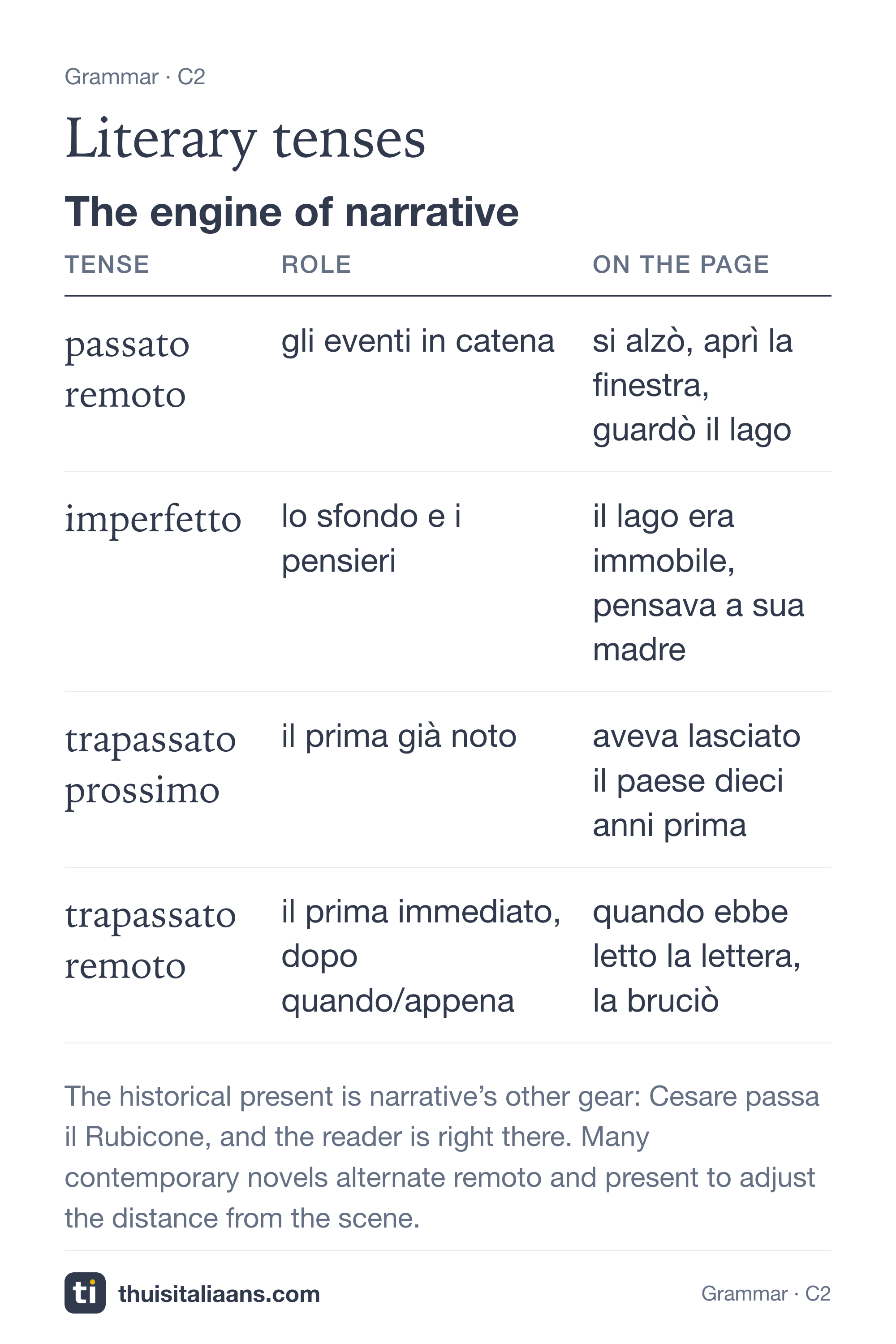
The engine of narrative
| Tense | Role | On the page |
|---|---|---|
| passato remoto | gli eventi in catena | si alzò, aprì la finestra, guardò il lago |
| imperfetto | lo sfondo e i pensieri | il lago era immobile, pensava a sua madre |
| trapassato prossimo | il prima già noto | aveva lasciato il paese dieci anni prima |
| trapassato remoto | il prima immediato, dopo quando/appena | quando ebbe letto la lettera, la bruciò |
Manzoni in miniature
| Sentence | Mechanics |
|---|---|
| don Abbondio tornava tranquillo, quando vide i bravi | sfondo all’imperfetto, evento al remoto |
| appena li ebbe visti, si fermò | trapassato remoto: anteriorità immediata |
| aveva sempre evitato i guai: quella sera non potè | trapassato prossimo per l’abitudine precedente |
The most common mistakes
quando aveva finito la lettera, la bruciò→ quando ebbe finito la lettera, la bruciò (after quando + remoto: trapassato remoto)si alzava, apriva la porta e uscì (catena di eventi)→ si alzò, aprì la porta e uscì (chained events take the remoto)il paese fu povero e la gente partì ogni anno→ il paese era povero e la gente partiva ogni anno (background and habit)
Did you know?
Exercises
Five exercises in order of difficulty. The last ones bring back what you have already seen.
01 Il trapassato remoto
Si usa solo dopo quando, dopo che, appena con un passato remoto. Completa.
- Appena (lui / finire) di parlare, uscì.
- Dopo che (loro / arrivare) , cominciò la cerimonia.
- Quando (io / leggere) la lettera, capii tutto.
- Appena (noi / uscire) , cominciò a piovere.
- Dopo che (lei / partire) , la casa parve vuota.
- Quando (loro / mangiare) , si alzarono da tavola.
02 Il congiuntivo nei testi antichi
Riscrivi in italiano d’oggi, mantenendo il senso.
- Ch’io vada o resti, poco importa. →
- Volle che si facesse silenzio. →
- Temeva non giungesse in tempo. →
- Fosse anche vero, non cambierebbe nulla. →
- Chiunque ei sia, lo riceva. →
- Pria che il sole tramonti… →
03 Il presente storico
Riscrivi il passo al presente storico, come si fa nelle cronache e nei saggi.
- Nel 1861 l’Italia si unì. →
- Dante scrisse la Commedia in esilio. →
- Nel 1348 la peste arrivò a Firenze. →
- Galileo pubblicò il Sidereus Nuncius nel 1610. →
- Cavour morì poco dopo. →
- L’assemblea approvò la legge. →
04 Riconoscere il tempo
Scrivi il nome del tempo verbale.
- ebbe detto →
- disse →
- aveva detto →
- avrebbe detto →
- dicesse →
- avesse detto →
05 La pagina di romanzo
Completa con i tempi della narrazione letteraria.
Review C1: passato remoto · concordanza dei tempi
- Quando (lui / entrare) nella stanza, tutti (tacere) .
- Appena (sedersi) , (cominciare) a parlare.
- Nessuno (osare) interromperlo, benché molti (dissentire) .
- Disse che l’indomani (partire) per non tornare.
- Solo più tardi (loro / capire) che cosa (accadere) davvero.
- Ma allora (essere) troppo tardi.
These five are a taste. There are over seven hundred on the site, free and with no sign-up. All the exercises →

Every topic, a world
In the  amo Italian app, grammar is practised inside thematic pathways with field-specific vocabulary: il bar, i trasporti, il calcio, la moda, la burocrazia and seventeen more. Choose your world and the grammar comes along by itself, explained in your language too.
Half the path free, no sign-up
★★★★★(11)by Alessio, teacher since 2018
Downloadamo Italian for iPhone ↗︎Search for amo Italian
One more go
Stage the scene like a narrator:
- La sera calda; Renzo fino al ponte.
- Appena il biglietto, lo strappò.
- il paese da ragazzo, e nessuno lo ricordava.
- La porta di colpo: tutti .
Frequently asked questions
Can remoto and prossimo mix in the same story?
Yes, meaningfully: the remoto narrates the closed events, the prossimo reaches into the narrator’s present: quel giorno capì ciò che non ho mai dimenticato. What a careful writer avoids is random alternation: every switch of tense should move the camera, not reveal a distracted hand.
Why does C’era una volta use the imperfetto if fairy tales run on the remoto?
Because openings paint scenery: c’era una volta un re sets the backdrop, then the plot engages the remoto: un giorno il re partì… The two-tense engine of Italian narrative in miniature: imperfetto for the world, remoto for what happens to it.
Trapassato remoto or trapassato prossimo in narration?
Ebbe finito only after quando, appena, dopo che, only with a remoto main clause, and only to mark instant succession: appena ebbe firmato, partì. Everywhere else, the trapassato prossimo: aveva firmato da poco. One is a precision tool; the other is the everyday pluperfect.
 The engine of narrative