

Grammar · C2
Regional variation
by Alessio · teacher of Italian as a foreign language, ITALS master’s

Standard Italian lives in books; in the streets lives the Italian of the regions: anguria in Milan, cocomero in Rome, melone d’acqua in Sicily. C2 does not judge: it recognises where a sentence speaks from, and knows that at the table geography is heard more than anywhere else.
- 6min reading
- 15min exercises
- C2level
What you learn
- anguria, michetta (Milano), formaggio grattugiato
- How it works: regional variation
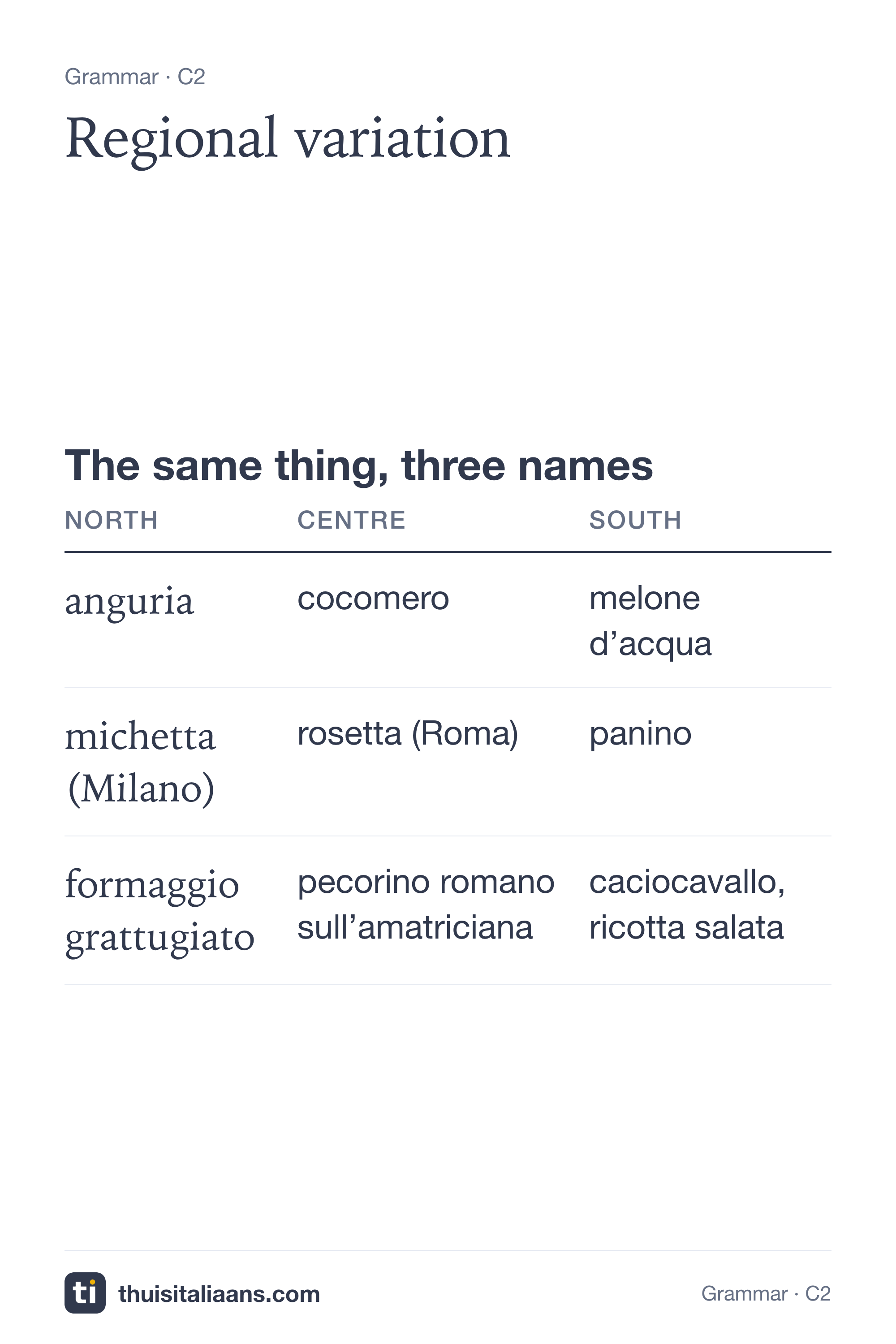
- The same thing, three names
- Vocabulary: la tavola regionale
Italian and English side by side
English speakers rarely hear Italian regional variation, but it is everywhere: esci il cane for porta fuori il cane, the passato remoto in Sicily for this morning's events, non ci sta nessuno in Rome and the South. It is not error but regional Italian, and it does not belong in writing.
Take this page with you
This chapter’s sheet as a free printable PDF (tables in Italian): rules, typical mistakes and the quiz with answers. A teacher’s tip: grammar sticks by reviewing it often, not by studying it once.


The words on this page
Drag each Italian word onto its definition, or tap a word first, then its box.
The same thing, three names
| North | Centre | South |
|---|---|---|
| anguria | cocomero | melone d’acqua |
| michetta (Milano) | rosetta (Roma) | panino |
| formaggio grattugiato | pecorino romano sull’amatriciana | caciocavallo, ricotta salata |
Grammar with an accent
| Trait | Where | Example |
|---|---|---|
| passato remoto nel parlato | Sud | ieri andai al mercato e comprai i pomodori |
| articolo coi nomi propri | Nord | la Giulia porta il tiramisù |
| stare per essere | Centro-Sud | sto qua, il vino sta sul tavolo |
| mica rafforzativo | Centro-Nord | mica male questo vino! |
The most common mistakes
il cocomero è il nome sbagliato dell’anguria→ they are regional names for the same thing: neither is wrongdire «la Giulia» è un errore di articolo→ it is a Northern regional trait, informal but alivea Palermo parlano male perché usano il passato remoto→ in Palermo the remoto in speech is the local norm
Did you know?
Exercises
Five exercises in order of difficulty. The last ones bring back what you have already seen.
01 Nord o Sud
Scrivi N o S secondo l’area in cui l’uso è più diffuso.
- Sono stato dal dottore. / Sono ito dal dottore. →
- Ho lavorato tutto il giorno (passato prossimo per fatti lontani) →
- Lavorai tutto il giorno (passato remoto per l’ieri) →
- Ci ho parlato ieri (uso estensivo di ci) →
- Ti telefono io / Io ti telefono (soggetto ripetuto) →
- Vado in giù / Scendo giù →
02 Parole diverse, stessa cosa
Scrivi la forma standard.
- anguria / cocomero / melone d’acqua →
- scannetto / sgabello →
- mocio / straccio per pavimenti →
- cocco / noce di cocco →
- tovaglietta / tovagliolo →
- spanna / palmo →
03 Dal regionale allo standard
Riscrivi in italiano standard.
- Esci il cane. →
- Mi sa che oggi non ci sta nessuno. →
- Ci siamo visti a Natale scorso. →
- Sali la valigia. →
- Non ci ho tempo. →
- Vengo con lui, che dici? →
04 Standard, regionale o dialettale
Scrivi S (standard), R (italiano regionale) o D (dialetto).
- Non ci sta nessuno. →
- Non c’è nessuno. →
- Nun ce sta nisciuno. →
- Vado a comprare il pane. →
- Vado a fare la spesa dal panettiere. →
- Te lo dico mo’. →
05 Il dialogo da rifare
Riscrivi il dialogo in italiano standard, senza appiattire il tono.
Review linguaggi settoriali · costruzioni marcate
- — Allora, che fai di bello oggi? →
- — Niente, sto a casa che devo studiare. →
- — Ma dai, esci un attimo che è bello fuori! →
- — Non ci ho voglia, sono stanco assai. →
- — Va bene, ci sentiamo dopo allora. →
- — Ci vediamo, statti bene. →
These five are a taste. There are over seven hundred on the site, free and with no sign-up. All the exercises →

Every topic, a world
In the  amo Italian app, grammar is practised inside thematic pathways with field-specific vocabulary: il bar, i trasporti, il calcio, la moda, la burocrazia and seventeen more. Choose your world and the grammar comes along by itself, explained in your language too.
Half the path free, no sign-up
★★★★★(11)by Alessio, teacher since 2018
Downloadamo Italian for iPhone ↗︎Search for amo Italian
One more go
Geography at the table:
- A Milano la chiamano anguria, a Roma .
- «Ieri andai al mercato»: chi parla è probabilmente del .
- «La Giulia porta il dolce»: tratto tipico del .
- «Mica male questo pecorino!» Qui mica .
- Sull’amatriciana, a Roma, va il .
Frequently asked questions
Are Italian dialects corrupted Italian?
No: they are Latin’s other children: Sicilian, Venetian, Neapolitan and the rest evolved directly from spoken Latin in parallel with Florentine, which became the standard for literary prestige, not linguistic superiority. Many have their own literature: sisters of Italian, not its mistakes.
Why do some Italians say la Giulia, with the article?
Northern regional habit: the article before female first names (la Giulia, la Franca) is normal from Lombardy to Tuscany, in some areas for male names too (il Marco). The standard omits it: in formal writing, plain Giulia: at a Milanese dinner table, la Giulia is simply how she is called.
Is scendi il cane wrong?
It is Southern regional Italian: transitive scendere and salire (scendi il cane, sali la spesa) are widespread in the South, listed in dictionaries as regional, and famously discussed by the Crusca. In local informal speech they work: in exams, formal writing and the North, keep portare giù / portare su.
 The same thing, three names