

Grammar · A1
The alphabet and pronunciation
by Alessio · teacher of Italian as a foreign language, ITALS master’s

Italian is read exactly as it is written, with very few exceptions: learn four pronunciation rules and you can read any word. The real work is in c, g and double consonants.
- 5min reading
- 16min exercises
- A1level
What you learn
- c dolce (ci), c dura (k), g dolce (gi), g dura (gh)
- How it works: the alphabet and pronunciation
- Three special clusters
- Vocabulary: i cibi del bar
Italian and English side by side
English spelling and sound drifted apart centuries ago; Italian never did. Every letter is pronounced, always the same way, so once you know the seven sounds of c and g you can read any Italian word aloud, even one you have never seen. The trap is the opposite of English: don't swallow final vowels, and don't reduce unstressed ones to a schwa. Telefono has four clear vowels, not two and a mumble.
Take this page with you
This chapter’s sheet as a free printable PDF (tables in Italian): rules, typical mistakes and the quiz with answers. A teacher’s tip: grammar sticks by reviewing it often, not by studying it once.


The words on this page
Drag each Italian word onto its definition, or tap a word first, then its box.
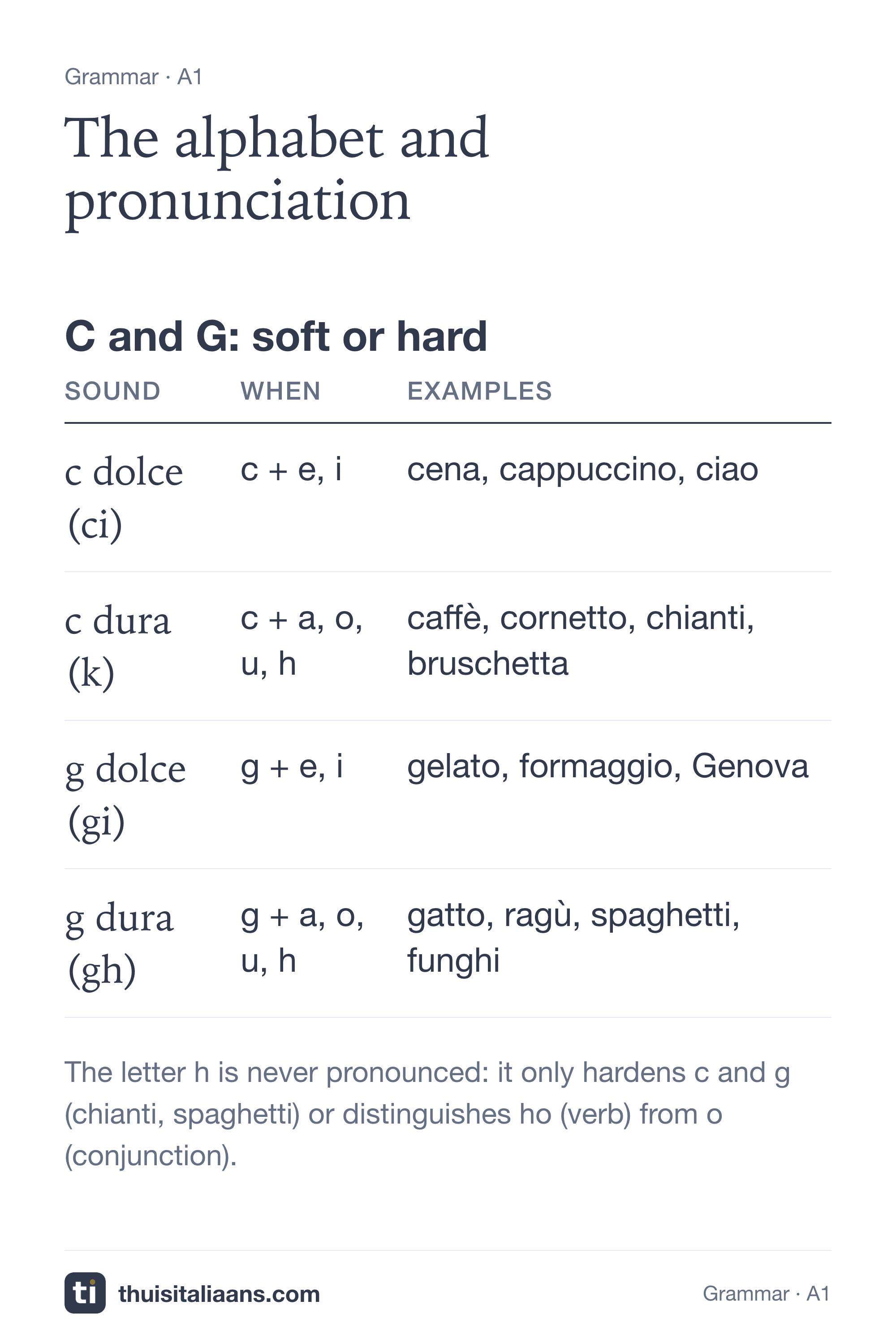
C and G: soft or hard
| Sound | When | Examples |
|---|---|---|
| c dolce (ci) | c + e, i | cena, cappuccino, ciao |
| c dura (k) | c + a, o, u, h | caffè, cornetto, chianti, bruschetta |
| g dolce (gi) | g + e, i | gelato, formaggio, Genova |
| g dura (gh) | g + a, o, u, h | gatto, ragù, spaghetti, funghi |
Three special clusters
| Cluster | Sound | Examples |
|---|---|---|
| gn | come la n di … | gnocchi, lasagne, bagno |
| gli | l morbida, tutta sul palato | famiglia, aglio, bottiglia |
| sc + e, i | come sh | pesce, prosciutto, uscita |
Double consonants change the word
Double consonants are truly heard, longer and stronger: pala and palla are not the same word, nor are caro and carro, sete and sette, pena and penna.
The most common mistakes
un capucino→ un cappuccino (the double c is written and heard)i spagetti→ gli spaghetti (the h keeps the g hard)la ciesa→ la chiesa (c + h + ie: hard sound)
Did you know?
Read and understand
This chapter’s grammar. Example: a chat with the barista.
online
Questions
Come fanno lo spelling gli italiani?
L'acca in «Chianti» serve per…
Quale di queste parole ha il suono duro «k»?

Exercises
Five exercises in order of difficulty. The last ones bring back what you have already seen.
01 Dura o dolce?
Write D if the sound is hard (as in casa, gatto), M if it is soft (as in cena, gelato).
- cucina →
- cinema →
- gonna →
- giorno →
- chiave →
- gelato →
- spaghetti →
- arancia →
02 I gruppi difficili
Complete with gn, gli or sc.
- la famia
- il bao
- il pee
- la mona
- il fio
- lo iatore
- gli occhi
03 Dove cade l’accento
Split into syllables and mark the stressed one in capitals. Example: telefono → te-LE-fo-no.
- cucina →
- macchina →
- caffè →
- difficile →
- università →
- sabato →
- perché →
04 Una consonante o due?
Double consonants change the word. Choose the form that matches the meaning given.
- Prendo la (pala / palla) per giocare a calcio. →
- Metto i soldi in (casa / cassa). →
- Il (nono / nonno) di Marco ha ottant’anni. →
- Ho comprato una (copia / coppia) del giornale. →
- Vado in Italia a (sete / sette) agosto. →
- Bevo un (cafè / caffè). →
05 Scrivi come si dice
Say the word in your head and write it. Watch the silent h and the groups ch/gh.
- (io, verbo avere)
- gli amici / le amie
- il iesa → luogo dove si prega
- luni (plurale di lungo)
- anno tre figli
- il ilo (pasta lunga e sottile)
These five are a taste. There are over seven hundred on the site, free and with no sign-up. All the exercises →

Every topic, a world
In the  amo Italian app, grammar is practised inside thematic pathways with field-specific vocabulary: il bar, i trasporti, il calcio, la moda, la burocrazia and seventeen more. Choose your world and the grammar comes along by itself, explained in your language too.
Half the path free, no sign-up
★★★★★(11)by Alessio, teacher since 2018
Downloadamo Italian for iPhone ↗︎Search for amo Italian

Read and understand
This chapter’s grammar. Example: a café sign.
Bar Centrale
Listino, prezzi in euro
un caffè1,20
un cappuccino1,60
una spremuta3,50
uno gnocco fritto2,00
un bicchiere di Chianti4,00
Oggi niente cassa veloce: si paga al banco.
Questions
Che cosa si può bere al Bar Centrale?
In «cappuccino» ci sono…
«Pala» e «palla» sono…
One more go
Choose the correctly spelled word:
- Al bar ordino un e un cornetto.
- Stasera mangiamo fatti in casa.
- Mi piace il stagionato.
- Vorrei una d’acqua.
- Il oggi è freschissimo.
Frequently asked questions
How many letters does the Italian alphabet have?
Twenty-one. The letters j, k, w, x, y are not part of the native alphabet: you meet them only in loanwords and foreign names (jeans, karaoke, weekend, yogurt), which keep their original spelling.
Is it perché or perchè?
With the acute accent: perché. The acute (é) marks a closed e, as in perché, poiché, né, sé; the grave (è) marks an open e, as in è, caffè, cioè. Many Italians type the wrong one because of keyboard habits, but dictionaries and careful writing keep the distinction.
Do Italians really hear the difference between single and double consonants?
Yes, instantly: the double is held longer, and it changes the word. Pala is a shovel, palla is a ball; casa is a house, cassa is a till. If doubles do not exist in your language, practise by exaggerating the pause: pal-la.
 C and G: soft or hard