

Grammar · C1
The sequence of tenses
by Alessio · teacher of Italian as a foreign language, ITALS master’s

At C1, tense agreement stops being a list of cases and becomes a single clock: the main clause sets the observation point, the subordinate declares whether the fact comes before, together or after. It holds for the indicative and the subjunctive, and the prose of the classics demonstrates it on every page.
- 6min reading
- 15min exercises
- C1level
What you learn
- dice che, disse che
- How it works: the sequence of tenses
- The system with the indicative
- Vocabulary: la letteratura
Italian and English side by side
English has no formal sequence-of-tenses rules for mood; Italian does, and at C1 they become automatic or they betray you. The one to watch is the future-in-the-past: disse che sarebbe partito, where English uses would and stops there.
Take this page with you
This chapter’s sheet as a free printable PDF (tables in Italian): rules, typical mistakes and the quiz with answers. A teacher’s tip: grammar sticks by reviewing it often, not by studying it once.
The trapassato says what had already happened before another past event.


The words on this page
Drag each Italian word onto its definition, or tap a word first, then its box.
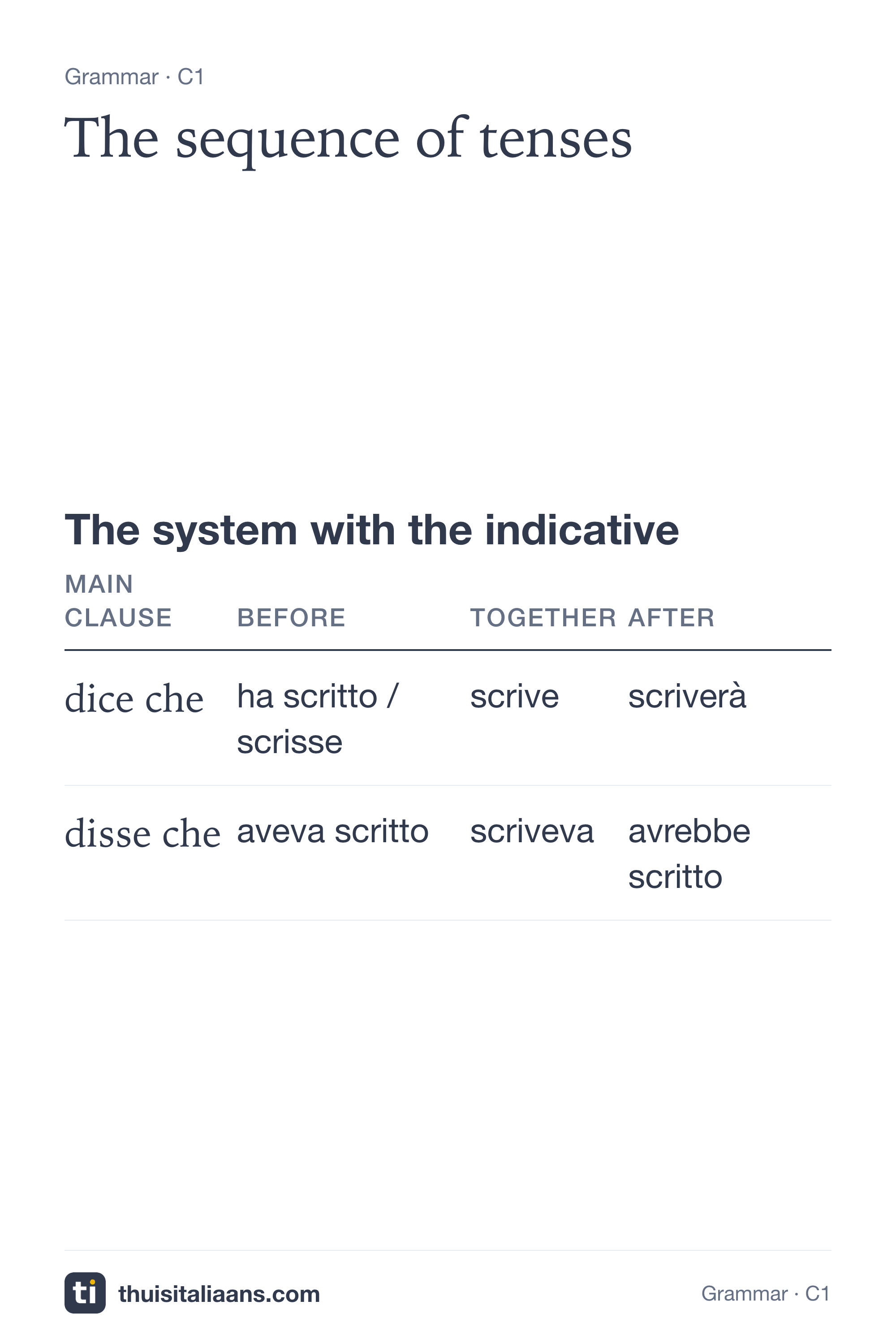
The system with the indicative
| Main clause | Before | Together | After |
|---|---|---|---|
| dice che | ha scritto / scrisse | scrive | scriverà |
| disse che | aveva scritto | scriveva | avrebbe scritto |
The system with the subjunctive
| Main clause | Before | Together / after |
|---|---|---|
| crede che | abbia scritto | scriva |
| credeva che | avesse scritto | scrivesse |
In the prose of the classics
| Sentence | Mechanics |
|---|---|
| Renzo credeva che la giustizia fosse uguale per tutti | credeva → contemporaneo → imperfetto |
| capì che don Abbondio aveva avuto paura | capì → anteriore → trapassato |
| Lucia sperava che tutto si sarebbe risolto | sperava → posteriore → condizionale passato |
The most common mistakes
sapeva che il romanzo diventerà famoso→ sapeva che il romanzo sarebbe diventato famoso (future in the past)credeva che l’autore è morto giovane→ credeva che l’autore fosse morto giovane (pluperfect subjunctive)penso che Leopardi scrivesse questa poesia a vent’anni→ penso che Leopardi abbia scritto questa poesia a vent’anni (anterior to now)
Did you know?
Exercises
Five exercises in order of difficulty. The last ones bring back what you have already seen.
01 Il posteriore nel passato
Dopo un verbo al passato, il futuro diventa condizionale composto. Completa.
- Disse che (partire) il giorno dopo.
- Pensavo che (tu / arrivare) prima.
- Sapevamo che (loro / non venire) .
- Aveva promesso che ci (aiutare) .
- Speravo che la cosa (finire) presto.
- Era chiaro che (esserci) dei problemi.
02 Indicativo o congiuntivo, e quale
Completa scegliendo il tempo esatto: presente, passato, imperfetto o trapassato del congiuntivo.
- Credo che ieri (lui / sbagliare) .
- Credevo che ieri (lui / sbagliare) .
- Dubito che ora (loro / capire) .
- Dubitavo che allora (loro / capire) .
- Mi sembra che (voi / già decidere) .
- Mi sembrava che (voi / già decidere) .
03 Nelle subordinate implicite
Con lo stesso soggetto si usa l’infinito: semplice per la contemporaneità, composto per l’anteriorità. Completa.
- Credo di (sbagliare) adesso.
- Credo di (sbagliare) ieri.
- Pensava di (arrivare) in tempo.
- Pensava di (arrivare) troppo tardi.
- Sono contento di (vederti) .
- Sono contento di (vederti) ieri sera.
04 Il verbo reggente cambia tutto
Riscrivi la frase mettendo il verbo principale al passato.
- Penso che sia stanco. →
- Credo che abbia finito. →
- Spero che venga domani. →
- Dice che ha capito. →
- Immagino che sia partita. →
- So che tornerà. →
05 La relazione al consiglio
Completa rispettando la concordanza. Attenzione alle maiuscole: alcune lacune aprono la frase.
Review B2: concordanza al congiuntivo · discorso indiretto
- Il presidente ha dichiarato che il bilancio (essere) già stato approvato.
- Nessuno immaginava che i costi (crescere) tanto nel semestre precedente.
- Si riteneva che l’anno successivo (esserci) un recupero.
- opportuno che il consiglio (deliberare) entro giugno. (essere, presente)
- Alcuni membri hanno chiesto che la questione (rinviare) alla seduta seguente.
- Si spera ora che la situazione (stabilizzarsi) entro l’autunno.
These five are a taste. There are over seven hundred on the site, free and with no sign-up. All the exercises →

Every topic, a world
In the  amo Italian app, grammar is practised inside thematic pathways with field-specific vocabulary: il bar, i trasporti, il calcio, la moda, la burocrazia and seventeen more. Choose your world and the grammar comes along by itself, explained in your language too.
Half the path free, no sign-up
★★★★★(11)by Alessio, teacher since 2018
Downloadamo Italian for iPhone ↗︎Search for amo Italian
One more go
Set the tense clock:
- Il critico disse che il romanzo nella storia.
- Credevo che Calvino solo romanzi.
- Penso che Elsa Morante una delle voci più grandi del Novecento.
- Sapevamo che la traduzione anni di lavoro.
- Sperava che il suo libro anche all’estero.
Frequently asked questions
Do universal truths follow the sequence of tenses?
No: facts that are always true keep the present even after a past main verb: il professore ha spiegato che l’acqua bolle a cento gradi. Shifting to bolliva would date the law of physics: the sequence bends for permanent truths.
Mi ha detto che è incinta or che era incinta?
Both, with a nuance: è incinta anchors the fact to now (still true as I speak), era incinta anchors it to the moment of speaking (true then, no claim about now). Italian lets you choose the anchor: it is precision, not inconsistency.
After dopo che, which past do I choose?
In everyday prose, trapassato prossimo: dopo che aveva firmato, è uscito. In literary narration with the passato remoto, the trapassato remoto: dopo che ebbe firmato, uscì. Same slot, two registers: the second belongs to the written page only.
 The system with the indicative