

Grammar · B2
Adjective position
by Alessio · teacher of Italian as a foreign language, ITALS master’s

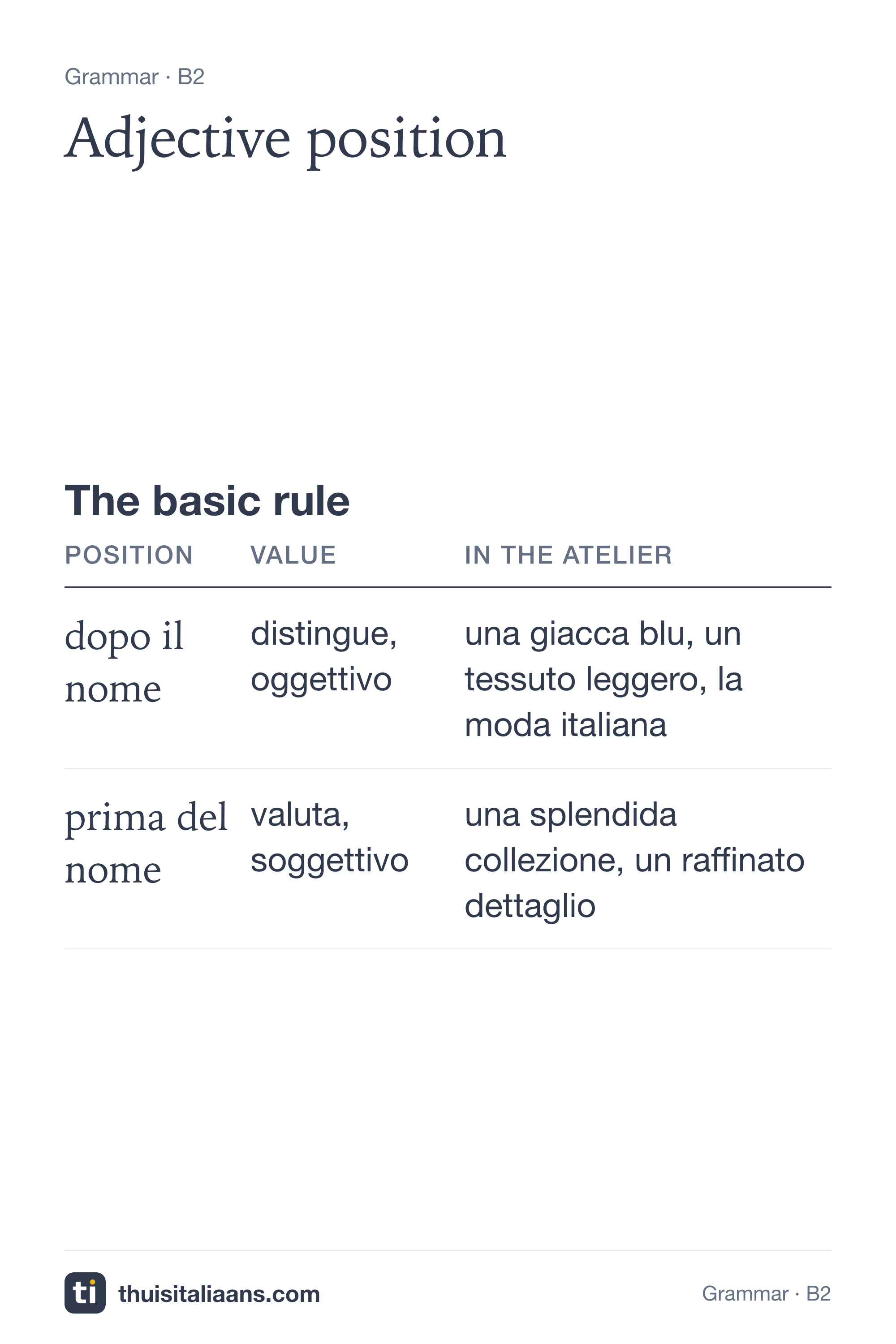
In Italian the adjective can go before or after the noun, and position changes meaning: un vecchio stilista (long-established) is not uno stilista vecchio (elderly). After the noun it describes and distinguishes; before, it evaluates and colours.
- 5min reading
- 15min exercises
- B2level
What you learn
- dopo il nome, prima del nome
- How it works: adjective position
- The pairs that change meaning
- Vocabulary: la moda
Italian and English side by side
English adjectives come before the noun and never move. In Italian position carries meaning: un vecchio amico is a friend of long standing, un amico vecchio an elderly one; un grand'uomo is a great man, un uomo grande a big one. The same pair logic as English an old friend read two ways.
Take this page with you
This chapter’s sheet as a free printable PDF (tables in Italian): rules, typical mistakes and the quiz with answers. A teacher’s tip: grammar sticks by reviewing it often, not by studying it once.


The words on this page
Drag each Italian word onto its definition, or tap a word first, then its box.
The basic rule
| Position | Value | In the atelier |
|---|---|---|
| dopo il nome | distingue, oggettivo | una giacca blu, un tessuto leggero, la moda italiana |
| prima del nome | valuta, soggettivo | una splendida collezione, un raffinato dettaglio |
The pairs that change meaning
| Before | After |
|---|---|
| un grand’uomo (importante) | un uomo grande (di statura) |
| un vecchio amico (di lunga data) | un amico vecchio (anziano) |
| una certa notizia (una qualche) | una notizia certa (sicura) |
| un povero stilista (sfortunato) | uno stilista povero (senza soldi) |
| diverse borse (parecchie) | borse diverse (differenti) |
The most common mistakes
una rossa giacca→ una giacca rossa (colours go after)un amico vecchio mi ha invitato alla sfilata (intendevo di lunga data)→ un vecchio amico mi ha invitato (before = long-standing)un bello vestito→ un bel vestito (bello shortens like the article)
Did you know?
Read and understand
This chapter’s grammar. Example: a property ad.
Case
Una piccola casa con un giardino grande
Vendiamo una vecchia casa di paese, pietre a vista e un secolo di storia: non una casa vecchia da rifare, però. I lavori sono del 2019.
Al piano terra un unico grande spazio con il camino; di sopra due camere e uno studio piccolo ma pieno di luce.
Dietro, un giardino grande con un vecchio ciliegio. Davanti, la solita piazza italiana: bar, forno, chiacchiere.
Un certo fascino non si può spiegare a parole: venite a vederla. Prezzo giusto.
agenzia Sole · 0541 223344
Questions
Di che anno sono i lavori di ristrutturazione?
Che cosa c'è nel giardino?
«Una vecchia casa» e «una casa vecchia»: la prima suggerisce…
«Un certo fascino»: qui «certo» prima del nome significa…
Vuoi dire che Piero è tuo amico da trent'anni. Scegli:
Exercises
Five exercises in order of difficulty. The last ones bring back what you have already seen.
01 Dopo il nome, quasi sempre
Colours, shapes, nationalities and participles come after. Put the adjective in the right place.
- (rosso) una macchina →
- (italiano) un vino →
- (rotondo) un tavolo →
- (stanco) una giornata →
- (nuovo) un telefono →
- (elettrico) una bici →
02 Prima del nome: i più comuni
Bello, buono, grande, piccolo, giovane, vecchio often come first. Complete.
- un ragazzo (bello)
- una idea (buono)
- un problema (grande)
- un appartamento (piccolo)
- i amici (vecchio)
- un uomo (bello)
03 Cambia il senso
Before or after the noun they change meaning. Explain the difference in one word.
- un vecchio amico / un amico vecchio →
- un grand’uomo / un uomo grande →
- un povero uomo / un uomo povero →
- diverse persone / persone diverse →
- un certo signore / una cosa certa →
- una nuova casa / una casa nuova →
04 Bello e buono davanti
They behave like the article. Complete.
- un film (bello)
- un studio (bello)
- dei occhi (bello)
- dei libri (bello)
- un amico (buono)
- un studente (buono)
05 La descrizione di una casa
Complete, putting the adjective in the right place and the right form.
Review verbi pronominali · periodo ipotetico · B1: comparativi
- Cerchiamo una casa fuori città. (grande)
- Vorremmo una casa , magari da ristrutturare. (vecchio: non nuova)
- L’ultima era un appartamento con giardino. (bello)
- Aveva finestre e pavimenti . (nuovo, antico)
- Il proprietario è un amico di mio padre. (vecchio: di lunga data)
- Se (noi / decidere) , (noi / trasferirsi) in primavera.
These five are a taste. There are over seven hundred on the site, free and with no sign-up. All the exercises →

Every topic, a world
In the  amo Italian app, grammar is practised inside thematic pathways with field-specific vocabulary: il bar, i trasporti, il calcio, la moda, la burocrazia and seventeen more. Choose your world and the grammar comes along by itself, explained in your language too.
Half the path free, no sign-up
★★★★★(11)by Alessio, teacher since 2018
Downloadamo Italian for iPhone ↗︎Search for amo Italian
Read and understand
This chapter’s grammar. Example: a restaurant review.
La Gazzetta della Domenica
domenica 19 ottobre · pagina 15
La recensione
Un semplice pranzo, non un pranzo semplice
di Carla Voghera
La trattoria del porto è tornata. In cucina un grande cuoco, che è anche, va detto, un cuoco grande: due metri abbondanti di calma.
Il menu è corto e onesto: diverse paste, tutte fatte a mano, e piatti diversi dal solito, come il raro coniglio in umido.
Il conto? Da povero studente lo temevo: invece prezzi giusti. Solo il povero tiramisù arriva stanco a fine servizio: l'unica vera caduta della serata.
Torneremo un altro sabato, in buona compagnia: certe sale piccole chiedono voci basse e forchette felici.
Questions
Com'è il menu della trattoria?
Qual è l'unica vera caduta della serata?
«Diverse paste» e «piatti diversi»: che cosa cambia con la posizione?
«Un grande cuoco che è anche un cuoco grande»: la battuta funziona perché…
Vuoi dire che Anna ha pochi soldi. Scegli:
Want another text on this topic? A restaurant review
One more go
Before or after?
- Ha sfilato con elettrico.
- Alla sfilata ho rivisto dei tempi dell’accademia.
- Che cappotto!
- Ho provato prima di trovare la mia.
- È , oltre che un grande sarto.
Frequently asked questions
Where do two adjectives go?
Usually split: evaluative before, classifying after: un piccolo borgo medievale, una famosa attrice francese. If both classify, both follow: un vino rosso toscano. The noun sits in the middle like a pivot, opinions on one side, categories on the other.
Can a modified adjective stay before the noun?
No: once you add molto, davvero, troppo or any complement, the adjective moves after: una bella casa but una casa molto bella; un ricco mercante but un mercante ricco di fantasia. Weight pushes it rightwards: heavy adjectives sink to the end.
Why can’t I move the adjective in alta moda or belle arti?
Because they are lexicalised: alta moda, belle arti, buon senso, libero mercato are fixed compounds where position froze long ago. Moving the adjective breaks the concept, not just the style: moda alta is tall fashion, whatever that is.
 The basic rule