

Grammar · B1
Modals in the past
by Alessio · teacher of Italian as a foreign language, ITALS master’s

Dovere, potere and volere in the past take the auxiliary of the verb they accompany: ho dovuto compilare (compilare takes avere), sono dovuto andare (andare takes essere). Bureaucracy offers endless examples.
- 6min reading
- 17min exercises
- B1level
What you learn
- senza infinito
- When to use modals in the past
- A morning at the registry office
- Vocabulary: la burocrazia
Italian and English side by side
English says I had to and I could without distinguishing whether it happened. Italian does distinguish: dovevo studiare leaves it open, ho dovuto studiare says it happened. And the auxiliary follows the governed verb: sono dovuto partire.
Take this page with you
This chapter’s sheet as a free printable PDF (tables in Italian): rules, typical mistakes and the quiz with answers. A teacher’s tip: grammar sticks by reviewing it often, not by studying it once.
The passato prossimo tells a finished event; the imperfetto paints the background around it.


The words on this page
Drag each Italian word onto its definition, or tap a word first, then its box.
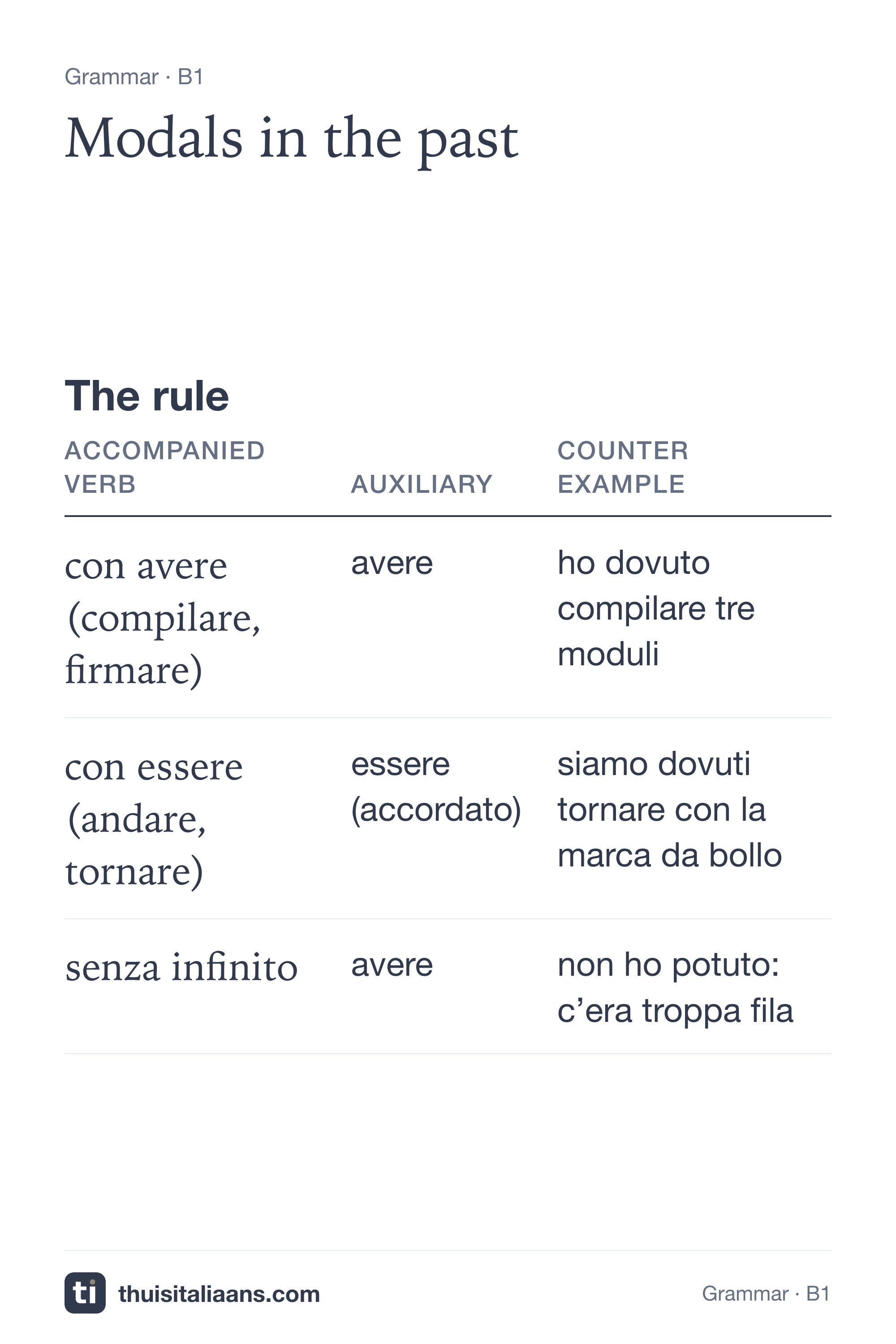
The rule
| Accompanied verb | Auxiliary | Counter example |
|---|---|---|
| con avere (compilare, firmare) | avere | ho dovuto compilare tre moduli |
| con essere (andare, tornare) | essere (accordato) | siamo dovuti tornare con la marca da bollo |
| senza infinito | avere | non ho potuto: c’era troppa fila |
A morning at the registry office
| Sentence | Why |
|---|---|
| ho voluto prenotare online | prenotare: avere |
| sono dovuta andare di persona lo stesso | andare: essere, accordo femminile |
| non ho potuto pagare col bancomat | pagare: avere |
| sono potuti entrare solo in due | entrare: essere |
The most common mistakes
sono dovuto firmare il modulo→ ho dovuto firmare il modulo (firmare takes avere)ho dovuto andarci di persona… anzi: Anna ha dovuta andarci→ Anna è dovuta andarci (essere and agreement)mi ho dovuto svegliare all’alba→ mi sono dovuto svegliare (pronoun first: essere)
Did you know?
Read and understand
This chapter’s grammar. Example: a chat after the meeting.
ultimo accesso 18:50
Questions
Perché non è potuta andare alla riunione?
Quanto hanno dovuto aspettare in ospedale?
«Non sono potuta venire»: perché essere e non avere?
Completa: «Marco ___ restare a casa» (dovere, passato prossimo).
Exercises
Five exercises in order of difficulty. The last ones bring back what you have already seen.
01 Quale ausiliare
The modal takes the auxiliary of the verb it governs. Write only the auxiliary.
- dovuto studiare
- dovuto partire
- potuto mangiare
- potuto uscire
- voluto restare
- voluto leggere
02 Al passato prossimo
Complete and make it agree where needed.
- Ieri (io / dovere) lavorare fino a tardi.
- Anna (dovere) andare dal medico.
- (noi / non potere) venire alla festa.
- (loro / volere) pagare loro il conto.
- (tu / potere) finire il lavoro?
- Le ragazze (volere) tornare a piedi.
03 Con i pronomi cambia l’ausiliare
If the pronoun comes first, the auxiliary follows the governed verb. Complete.
- (io) Non potuto farlo.
- (io) Non potuto alzarmi.
- Non voluto dirmelo. (lui)
- Non voluto venire. (lui)
- dovuti partire subito. (noi)
- dovuto chiamarli. (noi)
04 Imperfetto o passato prossimo?
Dovevo leaves it open whether I did it; ho dovuto says it happened. Choose and explain.
- (io / dovere) studiare, ma sono uscito.
- (io / dovere) studiare tutta la notte: l’esame era il giorno dopo.
- (lei / volere) chiamarti, poi si è dimenticata.
- (lei / volere) chiamarti a tutti i costi, e l’ha fatto.
- (noi / potere) partire prima, ma abbiamo aspettato.
- (noi / non potere) partire: c’era sciopero.
05 La giornata storta
Complete with modals in the past, the trapassato and pronouns.
Review trapassato prossimo · pronomi combinati
- Stamattina (io / dovere) alzarmi alle cinque.
- (io / volere) prendere il treno delle sei, ma (partire) già.
- (io / non potere) avvisare nessuno: il telefono (scaricarsi) .
- In ufficio Marta mi (chiedere) i documenti e (io / non potere) dar. (a lei)
- (io / dovere) tornare a casa a prenderli.
- Alla fine tutto (sistemarsi) , ma (essere) una giornata lunga.
These five are a taste. There are over seven hundred on the site, free and with no sign-up. All the exercises →

Every topic, a world
In the  amo Italian app, grammar is practised inside thematic pathways with field-specific vocabulary: il bar, i trasporti, il calcio, la moda, la burocrazia and seventeen more. Choose your world and the grammar comes along by itself, explained in your language too.
Half the path free, no sign-up
★★★★★(11)by Alessio, teacher since 2018
Downloadamo Italian for iPhone ↗︎Search for amo Italian
Read and understand
This chapter’s grammar. Example: a co-op's apology email.
Le consegne di ieri: avremmo dovuto avvisarvi prima
daAndrea Fabbri <a.fabbri@coopverde.it>
aclienti@coopverde.it
datagio 13 nov, 08:30
Gentili clienti,
ieri molte consegne non sono arrivate. Avremmo dovuto avvisarvi subito e non l'abbiamo fatto: scusateci.
Che cosa è successo? Il nostro furgone ha dovuto fermarsi per un guasto e il meccanico non è potuto arrivare prima di sera. Avremmo voluto noleggiarne un altro, ma ieri non abbiamo potuto trovarne uno libero.
Chi doveva ricevere la spesa ieri la riceverà oggi entro le 13, con un piccolo regalo. Chi non vuole aspettare può scriverci per il rimborso.
Grazie della pazienza,
Andrea
Questions
Perché le consegne non sono arrivate?
Entro che ora arriva oggi la spesa di ieri?
«Avremmo dovuto avvisarvi»: che cosa esprime?
«Ieri Anna ___ uscire prima» (dovere): ed è uscita davvero. Completa.
Want another text on this topic? After the job interview
One more go
Choose the modal’s auxiliary:
- (Io) compilare il modulo due volte.
- Anna tornare allo sportello 4.
- Non (noi) prenotare online.
- I testimoni venire di persona.
- (Io) alzare alle sei per fare la fila.
Frequently asked questions
What is the difference between dovevo and ho dovuto?
Ho dovuto: the obligation was met (ho dovuto pagare: I had to, and I paid). Dovevo: the obligation existed, outcome open or unfulfilled (dovevo pagare ieri: I was supposed to, and maybe didn’t). The imperfetto of the modals is the tense of unkept plans.
What does potevi dirmelo! mean?
“You could have told me!”: spoken Italian regularly uses the imperfetto of modals for missed possibilities, where formal grammar would build avresti potuto dirmelo. In conversation both live side by side; in writing, prefer the full past conditional.
Volevo venire or sono voluto venire?
Volevo venire: the intention, seen from inside, result unknown (“I wanted to come…”, often before a ma). Sono voluto venire: the wish carried out (“I insisted on coming, and here I am”). The compound tense closes the story; the imperfetto leaves it open.
 The rule