

Grammar · B2
Pronominal verbs
by Alessio · teacher of Italian as a foreign language, ITALS master’s

These are verbs with built-in particles, the heart of young spoken Italian: farcela (to manage), andarsene (to leave), fregarsene (not to care), volerci (to take/be needed). The dictionary alone is not enough: learn them as blocks.
- 5min reading
- 15min exercises
- B2level
What you learn
- farcela, andarsene, fregarsene, cavarsela, volerci, metterci
- When to use pronominal verbs
- The most common mistakes
- Vocabulary: il trasloco
Italian and English side by side
There is no English equivalent for farcela, andarsene, cavarsela. They look like verb + pronouns but behave as single words with their own meaning: ce l'ho fatta = I made it. Learn them whole, like phrasal verbs, which is exactly what they are.
Take this page with you
This chapter’s sheet as a free printable PDF (tables in Italian): rules, typical mistakes and the quiz with answers. A teacher’s tip: grammar sticks by reviewing it often, not by studying it once.


The words on this page
Drag each Italian word onto its definition, or tap a word first, then its box.
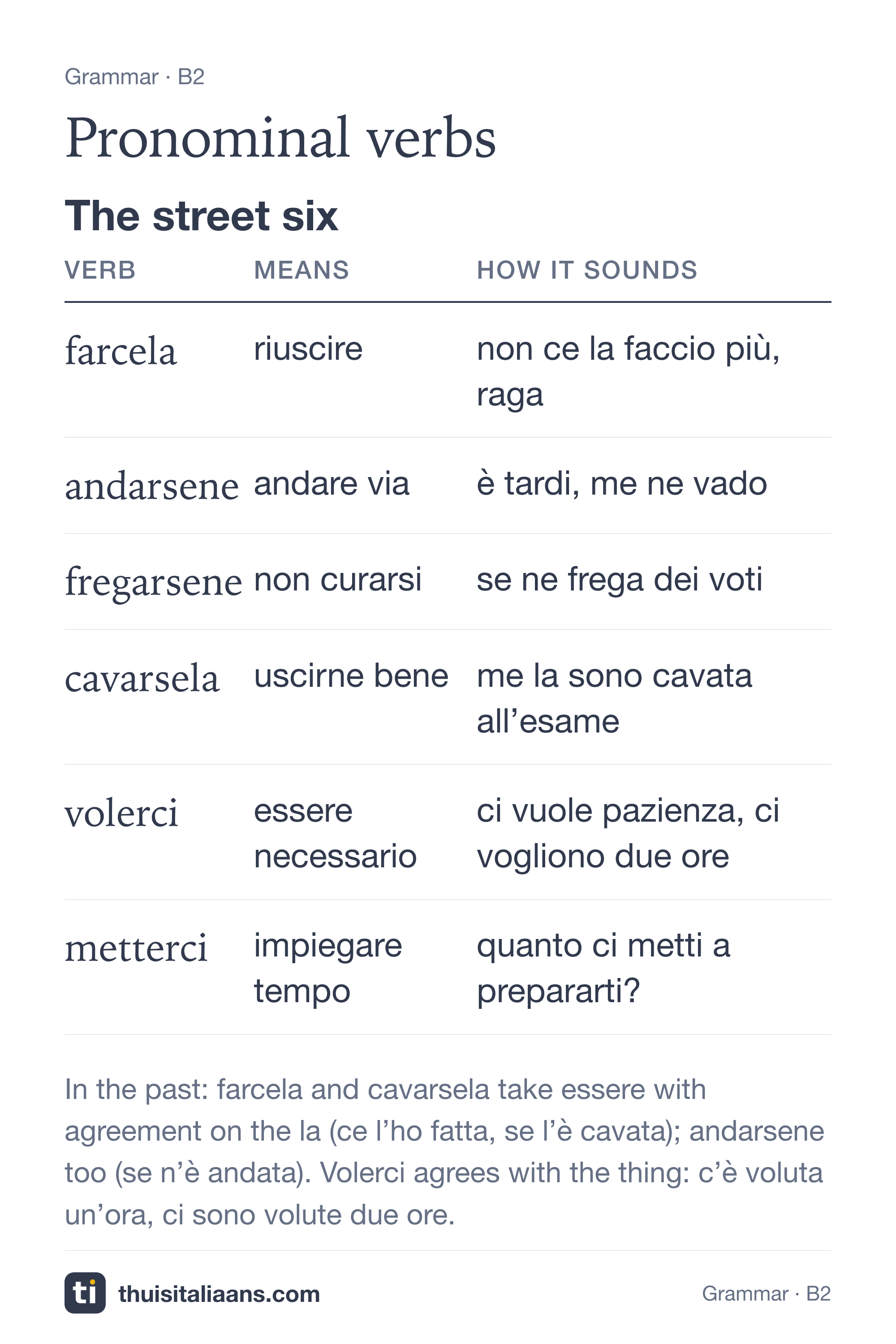
The street six
| Verb | Means | How it sounds |
|---|---|---|
| farcela | riuscire | non ce la faccio più, raga |
| andarsene | andare via | è tardi, me ne vado |
| fregarsene | non curarsi | se ne frega dei voti |
| cavarsela | uscirne bene | me la sono cavata all’esame |
| volerci | essere necessario | ci vuole pazienza, ci vogliono due ore |
| metterci | impiegare tempo | quanto ci metti a prepararti? |
The most common mistakes
non la faccio più→ non ce la faccio più (the block is farcela, with its ce)me ne ho andato presto→ me ne sono andato presto (andarsene takes essere)ci vuole tre ore per arrivarci→ ci vogliono tre ore (volerci agrees)
Did you know?
Read and understand
This chapter’s grammar. Example: a moving-day chat.
sta scrivendo…
Questions
Perché il trasloco è così faticoso?
Perché il vicino se l'è presa?
«Me la sono cavata con un graffio»: cavarsela significa…
«Ci vogliono altre due ore»: perché «vogliono» al plurale?
Completa: «Basta, io ___!» (andarsene, presente).
Exercises
Five exercises in order of difficulty. The last ones bring back what you have already seen.
01 Farcela, andarsene
Complete with the pronominal verb in the present.
- (io / farcela) da solo.
- (tu / andarsene) già?
- (noi / farcela) a finire per le sei.
- (loro / andarsene) senza salutare.
- (io / non farcela) più.
- (voi / andarsene) presto?
02 Cavarsela, sentirsela, prendersela
Complete.
- In italiano (io / cavarsela) abbastanza bene.
- (tu / sentirsela) di parlare in pubblico?
- Non (lei / prendersela) per una sciocchezza.
- (noi / cavarsela) con poco.
- (io / non sentirsela) di dirglielo.
- (loro / prendersela) sempre con me.
03 Al passato
They take essere, and the participle agrees with la. Complete.
- (io / farcela) per un soffio.
- (lei / andarsene) alle otto.
- (noi / cavarsela) bene.
- (tu / prendersela) troppo.
- (loro / non sentirsela) di venire.
- (io / andarsene) prima della fine.
04 Che cosa vogliono dire
Match the verb with its meaning: riuscire, allontanarsi, offendersi, avere coraggio, arrangiarsi, non sopportare più.
- farcela →
- andarsene →
- prendersela →
- sentirsela →
- cavarsela →
- non poterne più →
05 Il messaggio a un amico
Complete with pronominal verbs, the past and pronouns.
Review gerundio e participio · B1: pronomi combinati
- Ciao, scusa se ieri (io / andarsene) senza salutare.
- (io / non sentirsela) di restare: ero troppo stanco.
- Spero che tu (non prendersela) .
- Con il lavoro (io / non poterne) più: sono tre settimane così.
- Però (io / farcela) a consegnare tutto in tempo.
- Se (tu / avere) tempo sabato, (noi / vedersi) ?
These five are a taste. There are over seven hundred on the site, free and with no sign-up. All the exercises →

Every topic, a world
In the  amo Italian app, grammar is practised inside thematic pathways with field-specific vocabulary: il bar, i trasporti, il calcio, la moda, la burocrazia and seventeen more. Choose your world and the grammar comes along by itself, explained in your language too.
Half the path free, no sign-up
★★★★★(11)by Alessio, teacher since 2018
Downloadamo Italian for iPhone ↗︎Search for amo Italian
Read and understand
This chapter’s grammar. Example: an advice column.
«Non ce la faccio più con il mio coinquilino»
Caro Michele, ho letto la tua lettera due volte. Il coinquilino che se ne va ogni weekend lasciando i piatti nel lavandino: conosco bene il tipo.
Primo: non prendertela in silenzio. Chi tace poi esplode, e ci rimette sempre chi aveva ragione.
Secondo: parlagli. Se ci tieni alla convivenza, diglielo con calma; ci vuole il momento giusto, e non è il lunedì mattina.
E se dopo tutto questo non cambia niente? Allora vattene senza sensi di colpa: ce la si fa benissimo anche da soli, e spesso si respira meglio.
In bocca al lupo: faccelo sapere, come finisce.
Questions
Che cosa fa il coinquilino ogni weekend?
Qual è il momento sbagliato per parlargli?
«Ci rimette sempre chi aveva ragione»: rimetterci significa…
«Se ci tieni alla convivenza»: tenerci a significa…
Completa: «Tranquillo, ___ da solo» (farcela, io, presente).
Want another text on this topic? The class group chat
One more go
Take them as blocks:
- L’esame era tosto, ma .
- Che noia questa festa: .
- Quanto ad arrivare in centro?
- Per capire lo slang orecchio.
- Lui di quello che pensano.
Frequently asked questions
What is the difference between volerci and metterci?
Volerci is impersonal: the time or resource is the subject: ci vuole un’ora, ci vogliono due uova. Metterci is personal: you say how long you take: ci metto un’ora. Same topic, opposite camera angle: the task’s requirements versus your performance.
What does entrarci mean?
“To have to do with it”: che c’entra? non c’entra niente, io non c’entro. Indispensable in discussion: it marks relevance. Note the fused spelling c’entra (= ci entra): it literally asks whether something “fits in” the topic.
Avercela con or prendersela con?
Avercela con qualcuno is the state: to have it in for someone (ce l’ha con me da giorni). Prendersela is the reaction: to take offence, get upset (non te la prendere!). One is the grudge, the other is the flare-up.
 The street six