

Grammar · C2
Sentence syntax
by Alessio · teacher of Italian as a foreign language, ITALS master’s

The complex sentence is the architecture of prose: a main clause that holds, subordinates that specify, asides that comment. Great writers dose it: Manzoni builds cathedrals, Calvino polishes short crystalline sentences. C2 means being able to do both.
- 6min reading
- 17min exercises
- C2level
What you learn
- principale, coordinata, subordinata, inciso
- How it works: sentence syntax
- Hypotaxis and parataxis
- Vocabulary: la prosa d'autore
Italian and English side by side
English prefers short sentences and coordination; Italian tolerates long periods with several subordinate levels, especially in writing. At C2 the skill is not building them but breaking them: knowing when an Italian period is elegant and when it has simply lost its subject.
Take this page with you
This chapter’s sheet as a free printable PDF (tables in Italian): rules, typical mistakes and the quiz with answers. A teacher’s tip: grammar sticks by reviewing it often, not by studying it once.


The words on this page
Drag each Italian word onto its definition, or tap a word first, then its box.
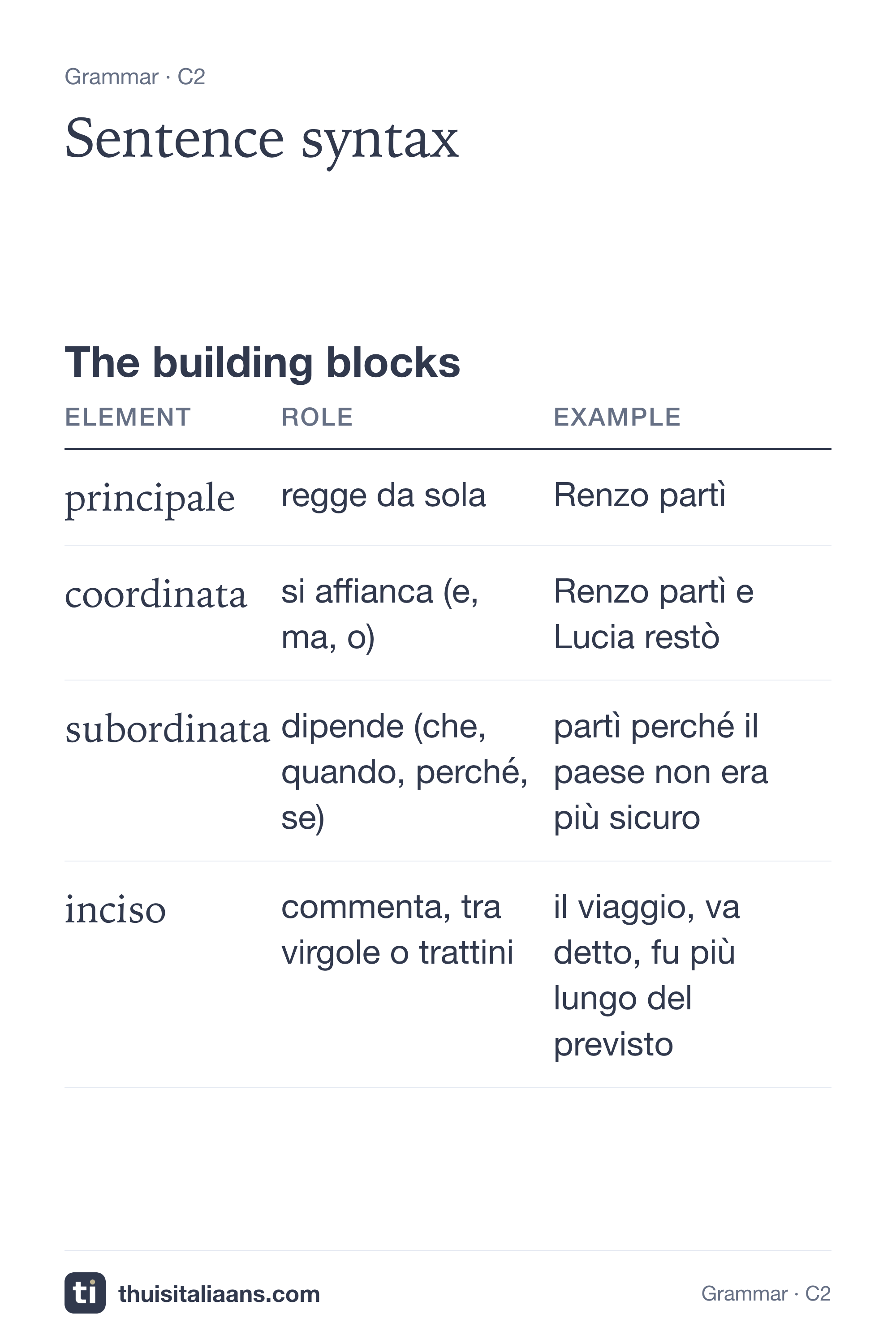
The building blocks
| Element | Role | Example |
|---|---|---|
| principale | regge da sola | Renzo partì |
| coordinata | si affianca (e, ma, o) | Renzo partì e Lucia restò |
| subordinata | dipende (che, quando, perché, se) | partì perché il paese non era più sicuro |
| inciso | commenta, tra virgole o trattini | il viaggio, va detto, fu più lungo del previsto |
Hypotaxis and parataxis
| Style | How it is built | Effect |
|---|---|---|
| ipotassi (Manzoni) | subordinate a più livelli | riflessione, respiro lungo |
| paratassi (Calvino, i verbali) | principali brevi coordinate | velocità, chiarezza |
| misto (la buona prosa) | un periodo lungo, poi uno breve | ritmo |
The most common mistakes
Renzo, che era partito all’alba, perché il paese, dove era nato, non era sicuro, che poi si vide→ break it up: control, not accumulationsono andato al colloquio e il direttore era gentile e mi hanno richiamato e ho firmato→ vary the links: coordination is not the only glueil progetto che ti dicevo che era in ritardo che ora è pronto→ il progetto di cui ti parlavo, quello in ritardo, ora è pronto (untangle the che chain)
Did you know?
Exercises
Five exercises in order of difficulty. The last ones bring back what you have already seen.
01 Che tipo di subordinata
Scrivi il tipo: oggettiva, soggettiva, relativa, causale, finale, temporale, concessiva, consecutiva.
- Penso che abbia ragione. →
- È chiaro che ha ragione. →
- Il libro che leggo è bello. →
- Parlo piano affinché tutti capiscano. →
- Era così tardi che nessuno rispose. →
- Benché fosse tardi, uscimmo. →
02 Coordinare o subordinare
Unisci le due frasi con il rapporto indicato, senza cambiare il senso.
- Pioveva. Siamo rimasti a casa. (causale) →
- Era tardi. Siamo usciti lo stesso. (concessiva) →
- Studia molto. Vuole passare l’esame. (finale) →
- Ha parlato a lungo. Tutti si sono annoiati. (consecutiva) →
- Arriverà lui. Poi decideremo. (temporale) →
- Non ha soldi. Non può partire. (causale) →
03 Sciogliere il periodo lungo
Spezza il periodo in due frasi più chiare, senza perdere informazioni.
- Il documento, che era stato approvato in commissione ma non ancora pubblicato, è stato ritirato. →
- Poiché mancavano i dati, che sarebbero arrivati solo dopo, la relazione fu rinviata. →
- Chi arriva in ritardo, anche se avvisa, non entra. →
- L’azienda, dopo aver valutato le offerte, ha scelto la seconda, che costava meno. →
- Sebbene il progetto fosse valido, il finanziamento, che era già stato promesso, non arrivò. →
- Ti scrivo per dirti che, come sai, la riunione è stata spostata. →
04 L’ordine degli elementi
Sposta la subordinata all’inizio e osserva che cosa cambia: riscrivi.
- Uscimmo benché fosse tardi. →
- Ti chiamo quando arrivo. →
- Rimandammo perché mancavano i dati. →
- Ci riuscirai se ci provi. →
- Firmò dopo aver letto tutto. →
- Parlò con calma per farsi capire. →
05 Il periodo d’autore
Completa il periodo mantenendo la coerenza sintattica e i tempi.
Review costruzioni marcate · C1: connettivi complessi · concordanza dei tempi
- Sebbene (essere) evidente a tutti, nessuno (osare) dirlo.
- Chi (leggere) quelle pagine, difficilmente le (dimenticare) .
- Non appena (loro / accorgersi) dell’errore, (correre) ai ripari.
- Il fatto che nessuno (protestare) allora (essere) la cosa più grave.
- Tanto (insistere) che alla fine (ottenere) udienza.
- Se ne andò senza che nessuno (accorgersene) .
These five are a taste. There are over seven hundred on the site, free and with no sign-up. All the exercises →

Every topic, a world
In the  amo Italian app, grammar is practised inside thematic pathways with field-specific vocabulary: il bar, i trasporti, il calcio, la moda, la burocrazia and seventeen more. Choose your world and the grammar comes along by itself, explained in your language too.
Half the path free, no sign-up
★★★★★(11)by Alessio, teacher since 2018
Downloadamo Italian for iPhone ↗︎Search for amo Italian
One more go
As an architect of the sentence:
- Il romanzo preferisco è quello parlavamo ieri.
- Partì all’alba il paese dormiva ancora.
- Il finale, sorprende tutti.
- di scrivere, uscì a camminare.
Frequently asked questions
What exactly is an anacoluthon?
A sentence that changes its syntactic horse midstream: io, i soldi, non me ne importa niente. The opening noun never finds its verb. In speech it is everywhere; in literature it imitates speech: the book title Io speriamo che me la cavo made it a national affection. In an essay, it is still a broken sentence.
How do I punctuate an aside?
With paired marks, always two: commas for light asides, dashes for visible ones, parentheses for whispered ones: il progetto, come previsto, è partito. The classic error is the single comma that opens an aside and never closes it: an inciso is a bracket: whatever opens it must shut it.
How deep can I nest subordinates?
Grammar sets no limit; readers do. The chain to fear is the stacked che: il libro che mi ha prestato il collega che lavora con il dottore che… Two levels read; three creak. The C2 repair kit: split the sentence, or absorb one clause into an implicit form (prestatomi dal collega).
 The building blocks