

Grammar · B2
Imperfect and past subjunctive
by Alessio · teacher of Italian as a foreign language, ITALS master’s

The subjunctive leaves the present: pensavo che fosse un’aria di Verdi (imperfect), temo che il tenore abbia stonato (past). The golden rule: the tense of the main clause drags the subjunctive’s tense along.
- 5min reading
- 15min exercises
- B2level
What you learn
- che lui / lei, che noi, che voi, che loro
- When to use imperfect and past subjunctive
- The most common mistakes
- Vocabulary: il teatro d'opera
Italian and English side by side
English has almost no living subjunctive, so this chapter is pure new ground. Italian needs the imperfect subjunctive after a past main verb (credevo che fosse) and the past subjunctive for something already finished (credo che sia partito). Choosing between them is the whole difficulty.
Take this page with you
This chapter’s sheet as a free printable PDF (tables in Italian): rules, typical mistakes and the quiz with answers. A teacher’s tip: grammar sticks by reviewing it often, not by studying it once.
The subjunctive is a bubble floating above the facts: what is thought, feared or hoped, not what is.


The words on this page
Drag each Italian word onto its definition, or tap a word first, then its box.
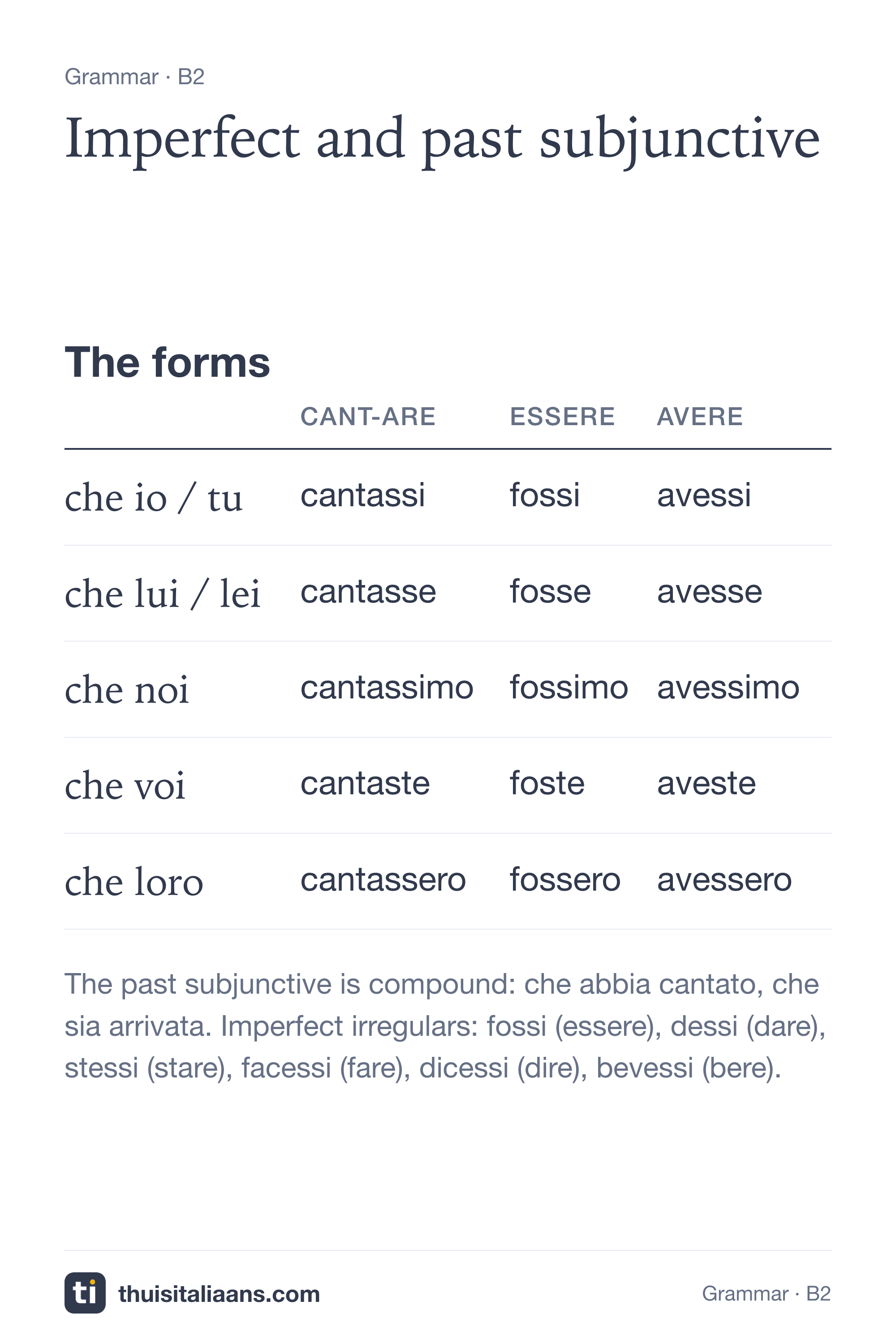
The forms
| cant-ARE | essere | avere | |
|---|---|---|---|
| che io / tu | cantassi | fossi | avessi |
| che lui / lei | cantasse | fosse | avesse |
| che noi | cantassimo | fossimo | avessimo |
| che voi | cantaste | foste | aveste |
| che loro | cantassero | fossero | avessero |
Which one to choose
| Main clause | Subjunctive | At the opera |
|---|---|---|
| presente + fatto contemporaneo | presente | credo che la regia sia audace |
| presente + fatto precedente | passato | credo che il debutto sia andato male |
| passato + fatto contemporaneo | imperfetto | pensavo che il baritono fosse spagnolo |
| desiderio irreale | imperfetto | magari cantasse ancora la Callas! |
The most common mistakes
pensavo che sia un’opera di Puccini→ pensavo che fosse un’opera di Puccini (past main clause: imperfect)credo che ieri il coro era stanco→ credo che ieri il coro fosse stanco (opinion about a described past state)speravo che venissi… anzi: che tu vieni→ speravo che tu venissi (past hope: imperfect subjunctive)
Did you know?
Read and understand
This chapter’s grammar. Example: a chat about a missed dinner.
online
Questions
Perché Marta non è venuta alla cena?
Come capiscono che sta bene?
«Pensavo che venisse»: perché il congiuntivo imperfetto?
«Temo che si sia segnata la data sbagliata»: perché il passato?
Completa: «Non sapevo che tu ___ il francese» (parlare).
Exercises
Five exercises in order of difficulty. The last ones bring back what you have already seen.
01 Le forme dell’imperfetto
Complete with the imperfect subjunctive (congiuntivo imperfetto).
- che io (parlare)
- che tu (prendere)
- che lui (dormire)
- che noi (lavorare)
- che voi (scrivere)
- che loro (finire)
02 Gli irregolari
Complete. There are few of them, but they come back all the time.
- che io (essere)
- che tu (fare)
- che lei (dare)
- che noi (stare)
- che voi (dire)
- che loro (bere)
03 Il congiuntivo passato
Present subjunctive of essere/avere + participle. Complete.
- Credo che (lui / partire) ieri.
- Mi dispiace che (voi / non venire) .
- Penso che (loro / capire) tutto.
- Non sono sicuro che (lei / ricevere) la mail.
- È strano che (tu / non accorgersi) di niente.
- Spero che (io / non dire) una sciocchezza.
04 Quale dei due
The past for something already over, the imperfect for something happening at the same time or later. Choose.
- Credevo che (tu / essere) a Roma in quel momento.
- Credevo che (tu / andare) a Roma la settimana prima.
- Pensavo che (lui / lavorare) ancora qui.
- Pensavo che (lui / cambiare) lavoro l’anno scorso.
- Speravo che (voi / arrivare) in orario.
- Speravo che (voi / già mangiare) .
05 Il reclamo
Complete the email with the imperfect and past subjunctive and the conditional.
Review B1: congiuntivo presente · condizionale presente
- Gentili signori, credevo che il pacco (arrivare) entro venerdì.
- Il vostro sito diceva che (essere) già stato spedito.
- Non pensavo che (voi / avere) bisogno di altri tre giorni.
- Se lo (io / sapere) prima, (scegliere) un’altra consegna.
- Vorrei che qualcuno mi (dire) dove si trova ora.
- Mi (fare) piacere ricevere una risposta entro domani.
These five are a taste. There are over seven hundred on the site, free and with no sign-up. All the exercises →

Every topic, a world
In the  amo Italian app, grammar is practised inside thematic pathways with field-specific vocabulary: il bar, i trasporti, il calcio, la moda, la burocrazia and seventeen more. Choose your world and the grammar comes along by itself, explained in your language too.
Half the path free, no sign-up
★★★★★(11)by Alessio, teacher since 2018
Downloadamo Italian for iPhone ↗︎Search for amo Italian
Read and understand
This chapter’s grammar. Example: a letter to the newspaper.
Il Corriere del Quartiere
lunedì 2 marzo · pagina 7
La lettera
Nessuno pensava che finisse così
di Guido Maran
La merceria di via Piave ha chiuso sabato. Nessuno del quartiere immaginava che chiudesse davvero, benché i segnali ci fossero da mesi.
«Pensavamo che il Comune intervenisse», racconta una cliente storica. «E ci dispiace che nessuno abbia fatto niente, nemmeno una telefonata».
La proprietaria ringrazia tutti: «Non credevo che tanta gente mi volesse così bene. Qualcuno ha persino temuto che me ne andassi senza salutare: mai e poi mai».
Il locale resterà vuoto, a meno che non arrivi presto un'idea nuova. Il quartiere, per una volta, spera di sbagliarsi.
Questions
Quando ha chiuso la merceria?
Che cosa pensavano i clienti che facesse il Comune?
«Nessuno immaginava che chiudesse»: perché il congiuntivo imperfetto?
«Ci dispiace che nessuno abbia fatto niente»: perché il passato e non l'imperfetto?
Completa: «Speravo che il treno ___ in orario» (essere).
Want another text on this topic? Reading hotel reviews
One more go
Choose the right subjunctive:
- Pensavo che questa un’opera di Rossini.
- Temo che il tenore nel finale.
- Speravamo che i biglietti meno.
- Credo che la prima benissimo.
- Magari ancora Pavarotti!
Frequently asked questions
Which tense after come se?
Always the imperfect or pluperfect subjunctive, never the present: mi guarda come se fossi un alieno, parlava come se non fosse successo niente. Come se introduces an unreal comparison, and unreality in Italian speaks in the past subjunctive.
What does magari fosse vero! mean?
“If only it were true!”: magari + imperfect subjunctive is the standard recipe for wishes about the present (magari potessi venire) and, with the pluperfect, regrets about the past (magari l’avessi saputo). The same magari with the indicative just means “maybe”: the mood changes the meaning.
Che io fossi and che tu fossi are identical: how do I avoid confusion?
By writing the pronoun, exactly as with the present subjunctive: pensava che io fossi all’estero, pensava che tu fossi all’estero. The first two persons of every imperfect subjunctive coincide: the pronoun is not emphasis there, it is information.
 The forms