

Grammar · C1
Altered nouns
by Alessio · teacher of Italian as a foreign language, ITALS master’s

Italian reshapes the world with suffixes: un tavolino in the square, una macchinona from America, una giornataccia. Four families (-ino, -etto for small and endearing, -one for big, -accio for bad) and a whole dolce vita to describe.
- 5min reading
- 15min exercises
- C1level
What you learn
- -ino / -etto / -ello, -one, -accio, -uccio
- When to use altered nouns
- The most common mistakes
- Vocabulary: la serata al bar
Italian and English side by side
English does diminutives with adjectives (a little table) or fixed pairs. Italian builds them into the word (tavolino, tavolaccio), and the suffix carries tone, not just size: un lavoretto plays the job down, una giornataccia complains about it.
Take this page with you
This chapter’s sheet as a free printable PDF (tables in Italian): rules, typical mistakes and the quiz with answers. A teacher’s tip: grammar sticks by reviewing it often, not by studying it once.


The words on this page
Drag each Italian word onto its definition, or tap a word first, then its box.
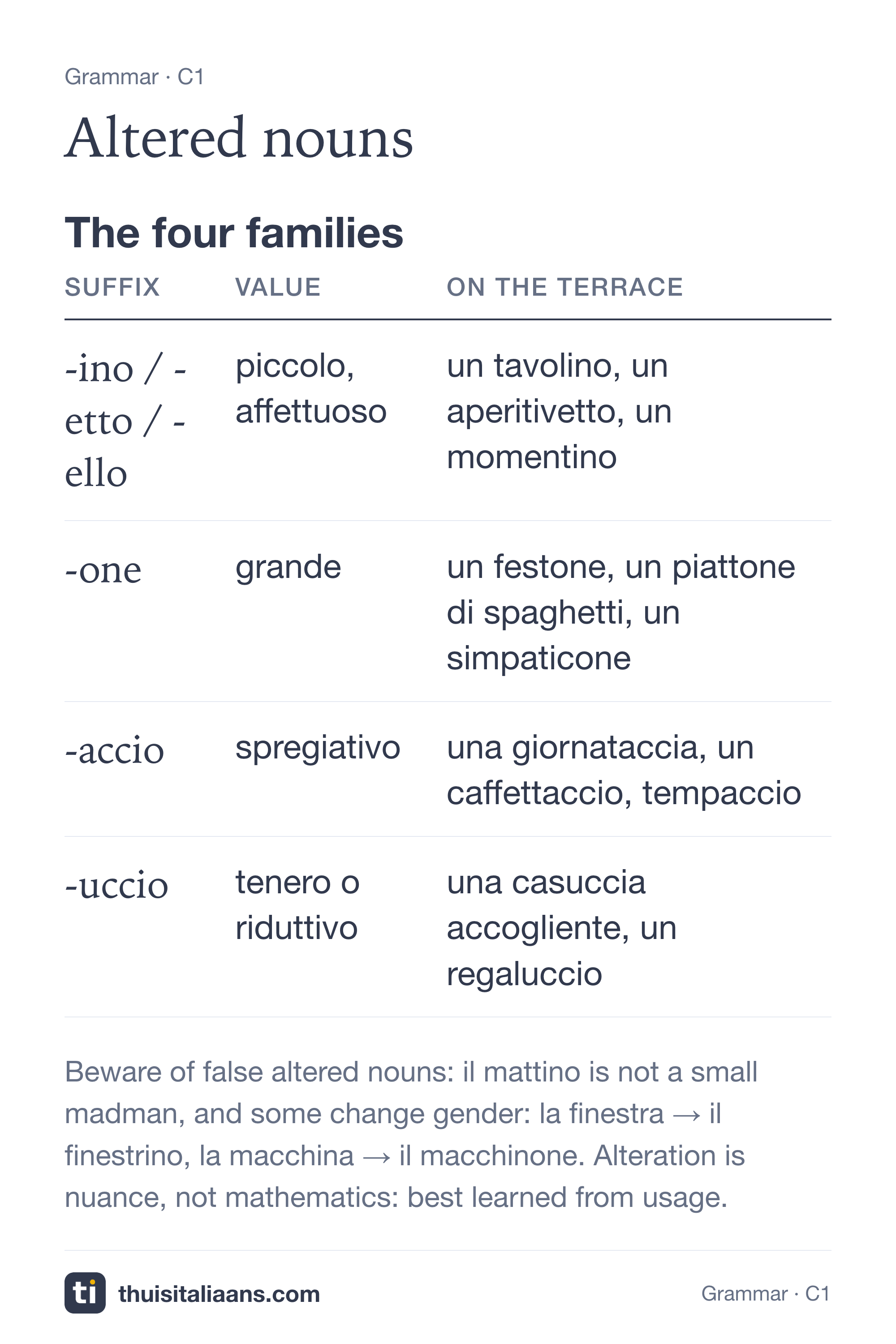
The four families
| Suffix | Value | On the terrace |
|---|---|---|
| -ino / -etto / -ello | piccolo, affettuoso | un tavolino, un aperitivetto, un momentino |
| -one | grande | un festone, un piattone di spaghetti, un simpaticone |
| -accio | spregiativo | una giornataccia, un caffettaccio, tempaccio |
| -uccio | tenero o riduttivo | una casuccia accogliente, un regaluccio |
An Italian evening
| Sentence | Nuance |
|---|---|
| prendiamoci un momentino per noi | affettuoso, rilassato |
| che macchinona ha parcheggiato davanti al bar! | ammirazione per la grandezza |
| dopo una settimanaccia, ci vuole un aperitivo | settimana pesante |
| ha una vocina timida ma una risatona contagiosa | contrasto giocoso |
The most common mistakes
un piccolo tavolino→ un tavolino (the suffix already says small)una giornata accia→ una giornataccia (the suffix welds to the noun)il finestrina del treno→ il finestrino del treno (masculine altered form)
Did you know?
Exercises
Five exercises in order of difficulty. The last ones bring back what you have already seen.
01 I quattro tipi
Scrivi D (diminutivo), A (accrescitivo), V (vezzeggiativo) o P (peggiorativo).
- tavolino →
- librone →
- fratellino →
- parolaccia →
- casetta →
- tempaccio →
02 Forma l’alterato
Scrivi la forma richiesta.
- naso (diminutivo) →
- libro (accrescitivo) →
- ragazzo (peggiorativo) →
- cane (vezzeggiativo) →
- finestra (diminutivo) →
- vento (accrescitivo) →
03 I falsi alterati
Attenzione: non tutto ciò che sembra alterato lo è. Scrivi vero o falso alterato.
- tacchino (da tacco) →
- lampone (da lampa) →
- mattone (da matto) →
- librone (da libro) →
- bottone (da botto) →
- gattino (da gatto) →
04 La sfumatura
L’alterato cambia il tono, non solo la dimensione. Spiega con una parola che effetto dà.
- Fammi un favorino. →
- Che giornataccia! →
- È un lavoretto di due minuti. →
- Ha una vociona. →
- Un caffettino e vado. →
- È un professorone. →
05 Il racconto di famiglia
Completa con gli alterati adatti al tono della frase.
Review registro formale · B2: posizione dell’aggettivo
- Abitavamo in una di due stanze. (casa, diminutivo)
- Mio nonno aveva un che si sentiva da lontano. (voce, accrescitivo)
- D’inverno faceva un terribile. (freddo, peggiorativo)
- La mia preparava il pane ogni sabato. (nonna, vezzeggiativo)
- Era una vita semplice, con qualche ogni tanto. (problema, diminutivo)
- Ma che meravigliosi. (tempo, plurale accrescitivo)
These five are a taste. There are over seven hundred on the site, free and with no sign-up. All the exercises →

Every topic, a world
In the  amo Italian app, grammar is practised inside thematic pathways with field-specific vocabulary: il bar, i trasporti, il calcio, la moda, la burocrazia and seventeen more. Choose your world and the grammar comes along by itself, explained in your language too.
Half the path free, no sign-up
★★★★★(11)by Alessio, teacher since 2018
Downloadamo Italian for iPhone ↗︎Search for amo Italian
One more go
Choose the nuance:
- Ci sediamo a quel in piazza?
- Che : tutto storto dalla mattina.
- Hanno organizzato un per cento invitati.
- Aspetta un , arrivo subito.
- Guarda dal : si vede il mare.
Frequently asked questions
Can suffixes stack?
Yes, and Italian loves it: casa → casetta → casettina, libro → libretto → librettino. Even adverbs take diminutives: bene → benino (so-so), poco → pochino, tardi → tardino. Each layer softens or shrinks a little more: alteration is a dial, not a switch.
What shade does -uccio add?
Warm smallness or gentle pity, depending on the noun: casuccia (a modest, cosy little house), calduccio (pleasant warmth), but avvocatuccio (a small-time lawyer). It is the most emotional of the suffixes: read the speaker’s tone before deciding whether it is a caress or a jab.
Do first names take suffixes too?
Constantly: Paolino, Marietta, Giorgione: affection, family habit, sometimes irony. Many stuck and became independent names or nicknames. Art history keeps one forever: Giorgione is “big George”, one -one that entered the museum catalogues.
 The four families