

Grammar · B1
Passato prossimo or imperfetto?
by Alessio · teacher of Italian as a foreign language, ITALS master’s

The question that torments every learner has a simple answer: the passato prossimo is a point (a fact, with a beginning and an end), the imperfetto is a background (a scene, a habit, a state). The two live in the same sentence: mentre la nonna cucinava, è arrivato lo zio.
- 6min reading
- 21min exercises
- B1level
What you learn
- Passato prossimo or imperfetto?
- Verbs that change meaning
- The most common mistakes
- Vocabulary: i ricordi di famiglia
Italian and English side by side
English has one simple past for both jobs. Italian splits them: ho mangiato for the event that happened, mangiavo for the background around it. The test that works: if English could say was …-ing or used to, Italian wants the imperfetto.
Take this page with you
This chapter’s sheet as a free printable PDF (tables in Italian): rules, typical mistakes and the quiz with answers. A teacher’s tip: grammar sticks by reviewing it often, not by studying it once.
The passato prossimo tells a finished event; the imperfetto paints the background around it.


The words on this page
Drag each Italian word onto its definition, or tap a word first, then its box.
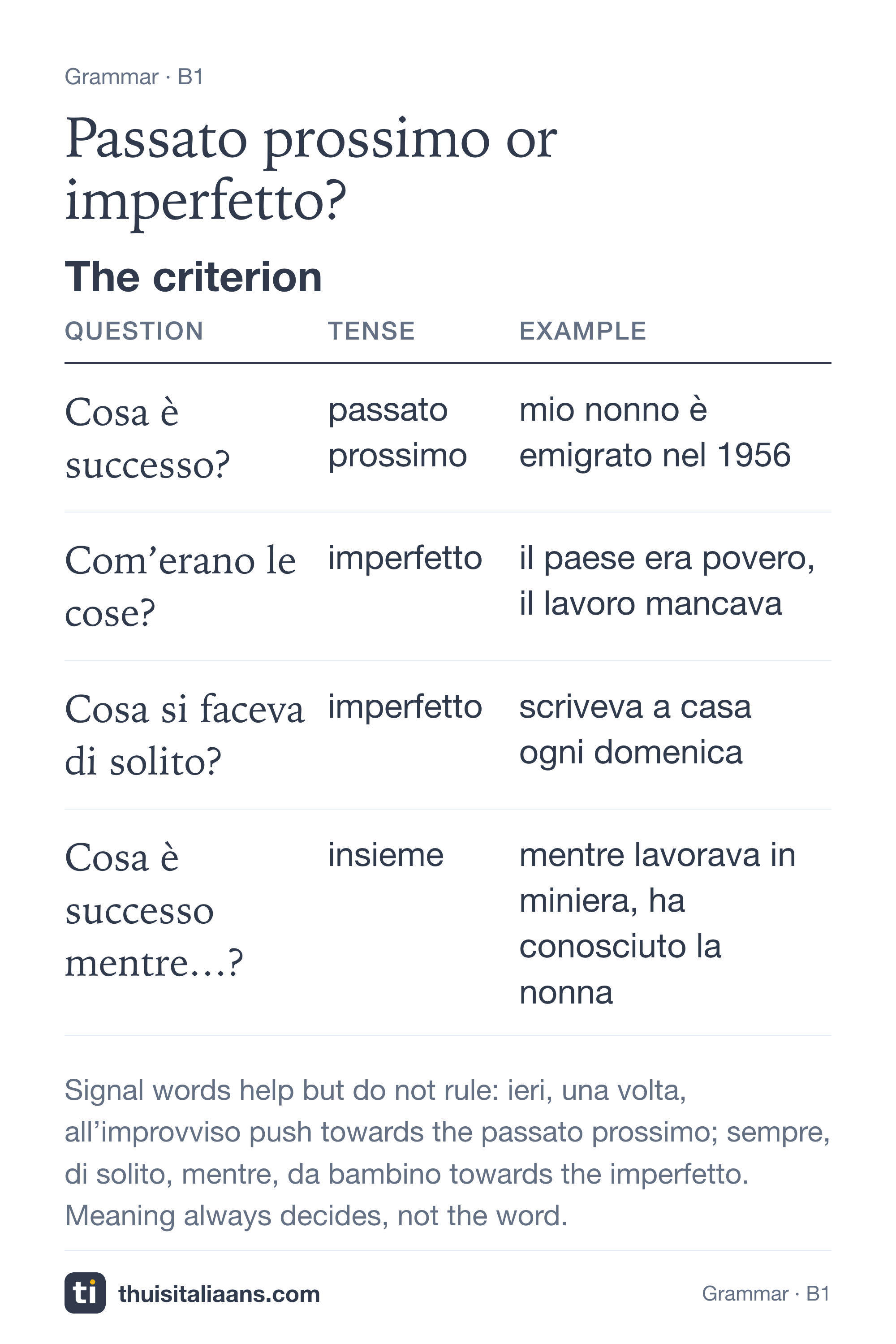
The criterion
| Question | Tense | Example |
|---|---|---|
| Cosa è successo? | passato prossimo | mio nonno è emigrato nel 1956 |
| Com’erano le cose? | imperfetto | il paese era povero, il lavoro mancava |
| Cosa si faceva di solito? | imperfetto | scriveva a casa ogni domenica |
| Cosa è successo mentre…? | insieme | mentre lavorava in miniera, ha conosciuto la nonna |
Verbs that change meaning
| Verb | Imperfetto | Passato prossimo |
|---|---|---|
| sapere | sapevo (conoscevo il fatto) | ho saputo (l’ho scoperto) |
| conoscere | conoscevo (era un conoscente) | ho conosciuto (l’ho incontrato la prima volta) |
| dovere | dovevo (era previsto) | ho dovuto (l’ho fatto davvero) |
| potere | potevo (ne avevo la possibilità) | ho potuto (ci sono riuscito) |
The most common mistakes
mentre cucinavo, il telefono suonava→ mentre cucinavo, il telefono è squillato (the interrupting event is a point)da bambino sono andato ogni estate al paese→ da bambino andavo ogni estate al paese (habit)ieri era una bella giornata e siamo andati al mare→ correct as it is: era describes, siamo andati narrates
Did you know?
Read and understand
This chapter’s grammar. Example: an email from the campsite.
Com'è andata la prima notte in tenda
daGiorgio Neri <giorgio.neri@mail.it>
afamiglia.neri@mail.it
datadom 3 ago, 08:50
Ciao a tutti,
vi racconto. Erano le undici, il campeggio dormiva e noi leggevamo con la torcia. Fuori tirava un vento strano.
A mezzanotte abbiamo sentito un rumore vicino alla tenda. Paolo ha aperto la cerniera piano piano… e ha trovato un riccio che mangiava i nostri biscotti.
Abbiamo riso per dieci minuti. Poi, mentre tornavo a dormire, è iniziato il temporale vero. Ma questa ve la racconto a pranzo.
Giorgio
Questions
Che cosa mangiava il riccio?
A che ora hanno sentito il rumore?
«Il campeggio dormiva e noi leggevamo»: perché l'imperfetto?
Completa: «___ la doccia quando ___ il telefono» (io fare, suonare).
Exercises
Five exercises in order of difficulty. The last ones bring back what you have already seen.
01 Sfondo o fatto
Write S if the verb paints the background (imperfetto) or F if it tells an event that happens (passato prossimo).
- Erano le otto di sera. →
- Improvvisamente è suonato il campanello. →
- Pioveva da giorni. →
- Ho aperto la porta. →
- Non conoscevo quella persona. →
- Le ho chiesto chi fosse. →
02 Mentre e quando
Complete: mentre calls for the imperfetto, quando often for the passato prossimo.
- Mentre (io / cucinare) , (arrivare) Luca.
- Quando (noi / uscire) , (piovere) ancora.
- Mentre (loro / dormire) , qualcuno (bussare) .
- Quando (tu / chiamare) , (io / essere) in riunione.
- Mentre (lei / studiare) , (ascoltare) musica.
- Quando (finire) il film, (noi / andare) a casa.
03 Una volta o tutte le volte
A habit takes the imperfetto, a single episode the passato prossimo. Complete.
- Da studente (io / andare) a lezione in bici ogni giorno.
- Un giorno (cadere) e (rompersi) un braccio.
- D’estate (noi / passare) i pomeriggi al fiume.
- Quell’estate però (noi / restare) in città.
- Mia nonna (raccontare) sempre la stessa storia.
- L’ultima volta la (raccontare) anche ai miei figli.
04 I verbi che cambiano senso
Sapere, conoscere, volere, dovere change meaning with the tense. Choose and explain in a word.
- Ieri (io / sapere) la notizia da Marco.
- Non (io / sapere) che fossi qui.
- (noi / conoscere) Anna a una festa nel 2019.
- (io) La già da bambino.
- (lui / volere) partire e alla fine è partito.
- (lui / volere) partire, ma non l’ha fatto.
05 Il trasloco
Complete the story, choosing between passato prossimo and imperfetto.
Review A2: passato prossimo, imperfetto, scelta dell’ausiliare
- Quando (noi / trasferirsi) a Bologna, (essere) febbraio e (fare) molto freddo.
- L’appartamento (essere) piccolo, ma (avere) un balcone che (dare) sui tetti.
- Il primo giorno (noi / non trovare) le chiavi: le (lasciare) nella scatola dei libri.
- Mentre (io / cercare) , il vicino (affacciarsi) e ci (offrire) un caffè.
- (noi / restare) a parlare un’ora: (lui / conoscere) tutti nel palazzo.
- Da quel giorno (noi / sentirsi) meno stranieri.
These five are a taste. There are over seven hundred on the site, free and with no sign-up. All the exercises →

Every topic, a world
In the  amo Italian app, grammar is practised inside thematic pathways with field-specific vocabulary: il bar, i trasporti, il calcio, la moda, la burocrazia and seventeen more. Choose your world and the grammar comes along by itself, explained in your language too.
Half the path free, no sign-up
★★★★★(11)by Alessio, teacher since 2018
Downloadamo Italian for iPhone ↗︎Search for amo Italian
Read and understand
This chapter’s grammar. Example: the story of the station cat.
Il Corriere del Quartiere
mercoledì 8 luglio · pagina 4
Cronaca
Il gatto che viveva in stazione ha trovato casa
di Paola Renzi
Tutti lo conoscevano: dormiva sulla panchina del binario 2 e aspettava il treno delle 7.40, quello dei pendolari, che gli portavano sempre qualcosa.
Martedì però il gatto non c'era. Si è scoperto presto il perché: una famiglia lo ha adottato e lo ha portato in collina.
«Sembrava triste, ultimamente», racconta il capostazione. «Quando l'ho visto salire in macchina, ho capito che finiva un'epoca».
I pendolari hanno lasciato una ciotola sulla panchina. Non si sa mai.
Questions
Dove dormiva il gatto?
Che cosa hanno lasciato i pendolari?
«Dormiva sulla panchina» ma «lo ha adottato»: perché tempi diversi?
Completa: «Mentre ___, qualcuno ___ alla porta» (piovere, bussare).
Want another text on this topic? The story of the neighbourhood
One more go
Event or background? Choose:
- Mio bisnonno per l’America nel 1913.
- A quel tempo il paese molto povero.
- Ogni mese i soldi alla famiglia.
- Un giorno una lettera che ha cambiato tutto.
- Mentre , a piangere.
Frequently asked questions
“For two years” in the past: which tense?
A closed period, however long, is a point: passato prossimo. Ho vissuto a Londra per due anni, ha piovuto tutta la notte. The imperfetto refuses edges: as soon as you say per + a finished duration, you have drawn the edges yourself.
Which tense for weather, time and age in the past?
The imperfetto, because they are scenery: era una bella giornata, erano le tre, avevo dieci anni. They set the stage on which the passato prossimo then acts: erano le tre quando è arrivato il treno.
Can the imperfetto ever tell the main events?
In one special register, yes: journalists use the so-called imperfetto di cronaca to reconstruct events (il ladro entrava dalla finestra e apriva la cassaforte). It is a stylistic camera effect of news writing: recognise it in the papers, but keep the standard rules in your own Italian.
 The criterion