

Grammar · C1
Implicit forms
by Alessio · teacher of Italian as a foreign language, ITALS master’s

Implicit forms are the high gear of educated writing: pur avendo studiato tutta la notte (although I had studied), dopo aver consegnato la tesi (after handing it in), prima di iscrivermi (before enrolling). They compress subordinate clauses into a few syllables.
- 6min reading
- 15min exercises
- C1level
What you learn
- pur + gerundio, prima di + infinito, senza + infinito, per + infinito passato
- When to use implicit forms
- The most common mistakes
- Vocabulary: l'università
Italian and English side by side
English loves -ing clauses, so implicit forms feel natural. The Italian constraint is stricter: the gerund needs the same subject as the main clause, and the absolute participle (finita la riunione) has no fluent English equivalent beyond the meeting over.
Take this page with you
This chapter’s sheet as a free printable PDF (tables in Italian): rules, typical mistakes and the quiz with answers. A teacher’s tip: grammar sticks by reviewing it often, not by studying it once.


The words on this page
Drag each Italian word onto its definition, or tap a word first, then its box.
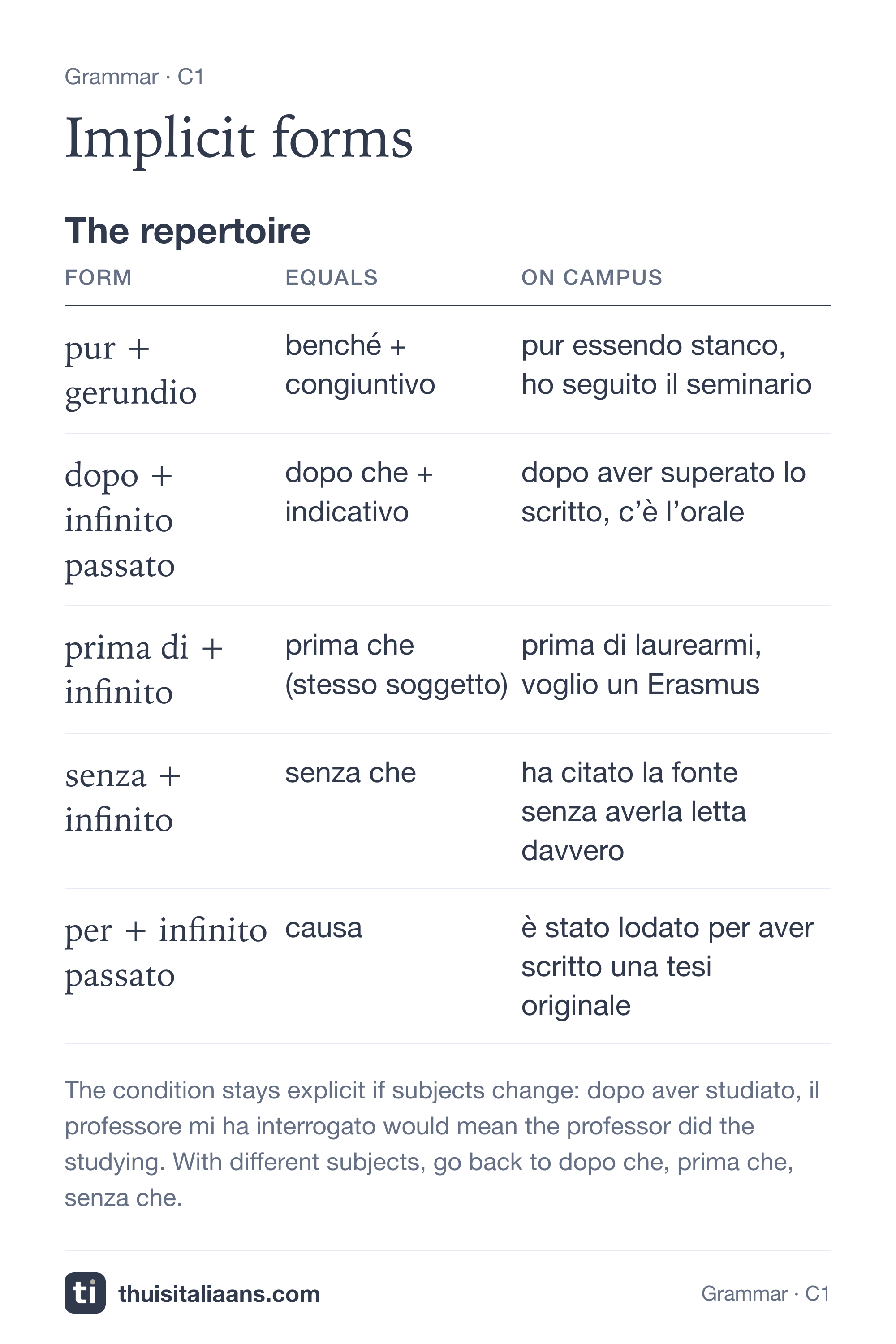
The repertoire
| Form | Equals | On campus |
|---|---|---|
| pur + gerundio | benché + congiuntivo | pur essendo stanco, ho seguito il seminario |
| dopo + infinito passato | dopo che + indicativo | dopo aver superato lo scritto, c’è l’orale |
| prima di + infinito | prima che (stesso soggetto) | prima di laurearmi, voglio un Erasmus |
| senza + infinito | senza che | ha citato la fonte senza averla letta davvero |
| per + infinito passato | causa | è stato lodato per aver scritto una tesi originale |
From chat to essay
| Explicit | Implicit |
|---|---|
| benché avessi poco tempo, ho finito la ricerca | pur avendo poco tempo, ho finito la ricerca |
| dopo che ho discusso la tesi, ho festeggiato | dopo aver discusso la tesi, ho festeggiato |
| siccome era arrivato tardi, ha perso l’appello | essendo arrivato tardi, ha perso l’appello |
The most common mistakes
dopo avere superando l’esame, festeggio→ dopo aver superato l’esame, festeggio (past infinitive, not gerund)pur ho studiato, non ho passato→ pur avendo studiato, non ho passato (pur takes the gerund)prima di che inizi la lezione, ripasso→ prima che inizi la lezione, ripasso (different subjects: explicit)
Did you know?
Exercises
Five exercises in order of difficulty. The last ones bring back what you have already seen.
01 Dall’esplicito all’implicito
Riscrivi con l’infinito, quando il soggetto è lo stesso.
- Penso che io abbia ragione. →
- Credo che io sia in ritardo. →
- Spero che io possa venire. →
- Sono contento che io ti abbia incontrato. →
- Temo che io abbia sbagliato. →
- Dice che lui tornerà presto. →
02 Gerundio, participio, infinito
Sostituisci la subordinata con la forma implicita indicata fra parentesi.
- Poiché non aveva tempo, rimandò. (gerundio) →
- Dopo che ebbe letto la lettera, uscì. (participio) →
- Prima che tu parta, chiamami. (infinito) →
- Se si osserva bene, si nota la differenza. (gerundio) →
- Poiché fu costretto a scegliere, scelse. (participio) →
- Benché fosse stanco, continuò. (gerundio) →
03 Quando l’implicito non si può
L’implicito richiede lo stesso soggetto (o un soggetto proprio nel participio assoluto). Scrivi sì o no.
- Penso che tu abbia ragione. →
- Penso che io abbia ragione. →
- Credo che loro siano partiti. →
- Credo di essere partito troppo tardi. →
- Poiché pioveva, siamo rimasti a casa. →
- Poiché Marco è partito, siamo rimasti soli. →
04 Il valore delle implicite
Scrivi che rapporto esprime la forma implicita: causa, tempo, condizione, concessione, modo.
- Non avendo soldi, rinunciò. →
- Tornando a casa, incontrò Luca. →
- Studiando di più, passeresti. →
- Pur avendo ragione, tacque. →
- Rispose sorridendo. →
- Finita la riunione, uscimmo. →
05 Il testo tecnico
Riscrivi le subordinate in forma implicita, mantenendo il registro.
Review B2: gerundio e participio · concordanza dei tempi
- Poiché sono stati analizzati i dati, si può concludere. →
- Se si considerano i costi, la scelta cambia. →
- Dopo che è stato approvato il piano, si procederà. →
- Benché si riconoscano i limiti, il metodo resta valido. →
- Prima che si prenda una decisione, occorre valutare. →
- Poiché mancano dati aggiornati, l’analisi è parziale. →
These five are a taste. There are over seven hundred on the site, free and with no sign-up. All the exercises →

Every topic, a world
In the  amo Italian app, grammar is practised inside thematic pathways with field-specific vocabulary: il bar, i trasporti, il calcio, la moda, la burocrazia and seventeen more. Choose your world and the grammar comes along by itself, explained in your language too.
Half the path free, no sign-up
★★★★★(11)by Alessio, teacher since 2018
Downloadamo Italian for iPhone ↗︎Search for amo Italian
One more go
Compress the sentence:
- studiato poco, ha preso trenta.
- consegnato la tesi, si è concesso una vacanza.
- iscrivermi, ho confrontato tre atenei.
- Ha citato quel saggio mai letto per intero.
- l’aula piena, la lezione si è spostata in cortile.
Frequently asked questions
Senza + infinitive or senza che + subjunctive?
Same subject: infinitive: è uscito senza salutare. Different subjects: senza che + subjunctive: è uscito senza che nessuno se ne accorgesse. The switch is automatic: the moment a second subject appears, the implicit form must open up into a full clause.
What does da + infinitive add to a noun?
Necessity or destiny: qualcosa da bere (to drink), un film da vedere (worth seeing), una decisione da prendere (to be made). It is a pocket-sized passive of obligation: the same meaning as che va visto, folded into two words.
Why il primo ad arrivare and not il primo che arriva?
Both exist, but after ordinals and unico, solo, ultimo, the infinitive with a is the polished choice: è stata la prima a capirlo, l’unico a saperlo. It is lighter than the relative clause: written Italian reaches for it instinctively.
 The repertoire