

Grammar · B2
Reported speech
by Alessio · teacher of Italian as a foreign language, ITALS master’s

Reporting other people’s words shifts everything: tenses, pronouns, reference points. «Vengo domani» becomes ha detto che sarebbe venuto il giorno dopo. The key is the past conditional for the future-in-the-past.
- 5min reading
- 15min exercises
- B2level
What you learn
- «vincerò» (futuro), «vieni!» (imperativo)
- When to use reported speech
- The most common mistakes
- Vocabulary: le interviste e il consiglio comunale
Italian and English side by side
The tense shift is similar to English, but Italian also moves the mood and the deictics: oggi becomes quel giorno, qui becomes lì, and questions take the subjunctive after a past verb: mi chiese dove abitassi.
Take this page with you
This chapter’s sheet as a free printable PDF (tables in Italian): rules, typical mistakes and the quiz with answers. A teacher’s tip: grammar sticks by reviewing it often, not by studying it once.


The words on this page
Drag each Italian word onto its definition, or tap a word first, then its box.
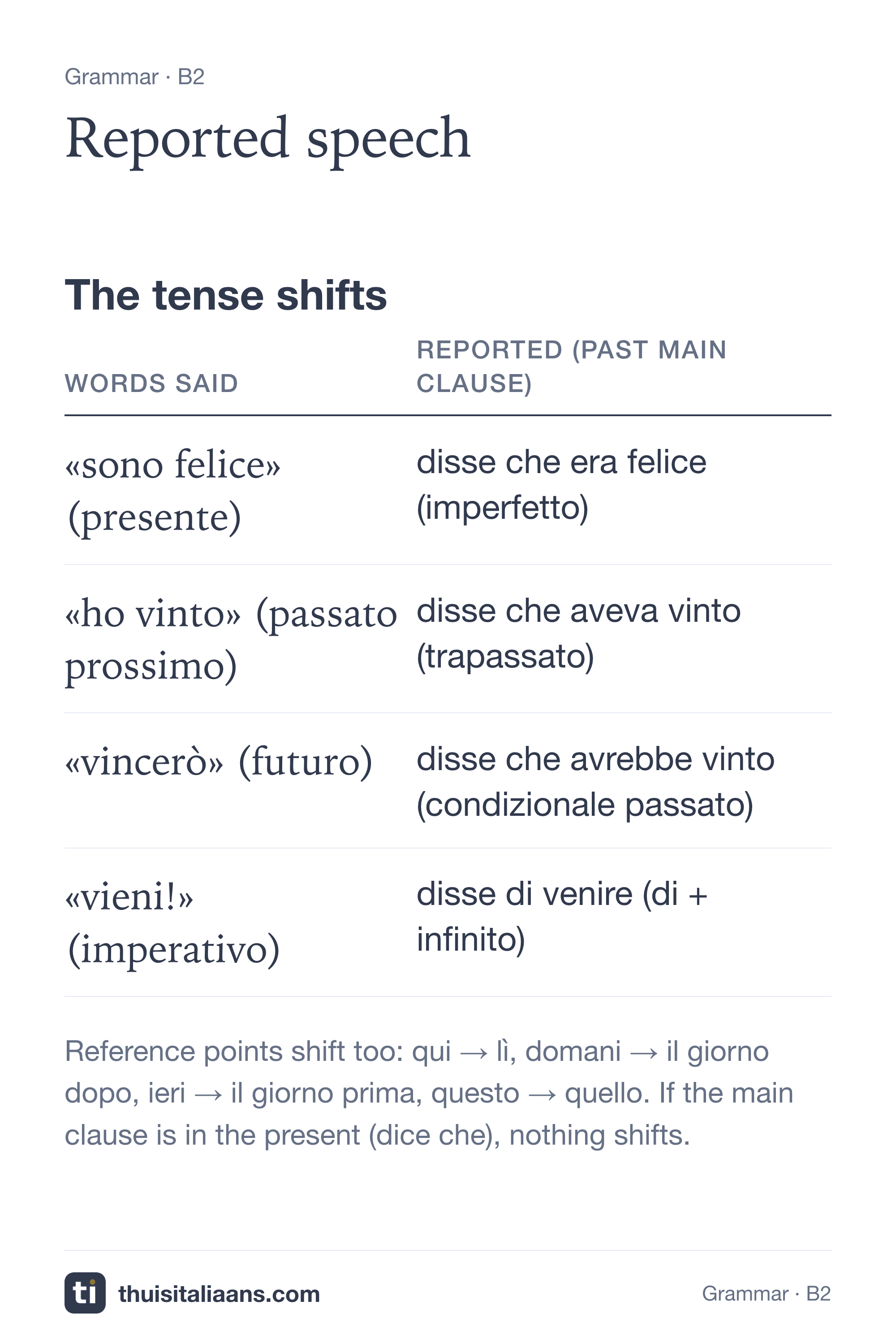
The tense shifts
| Words said | Reported (past main clause) |
|---|---|
| «sono felice» (presente) | disse che era felice (imperfetto) |
| «ho vinto» (passato prossimo) | disse che aveva vinto (trapassato) |
| «vincerò» (futuro) | disse che avrebbe vinto (condizionale passato) |
| «vieni!» (imperativo) | disse di venire (di + infinito) |
Famous interviews
| Direct | Reported |
|---|---|
| Fellini: «i sogni sono l’unica realtà» | Fellini disse che i sogni erano l’unica realtà |
| Ferrari: «costruirò l’auto più bella» | promise che avrebbe costruito l’auto più bella |
| Montessori: «aiutami a fare da solo» | chiedeva di aiutare il bambino a fare da solo |
The most common mistakes
ha detto che verrà domani→ ha detto che sarebbe venuto il giorno dopo (future in the past)disse che è stanco→ disse che era stanco (the present slides to the imperfect)mi ha chiesto che vengo→ mi ha chiesto di venire / se venissi (order or question)
Did you know?
Read and understand
This chapter’s grammar. Example: a chat about the landlord.
online
Questions
Quando passa il padrone di casa?
Che cosa bisogna fare se si esce?
«Ha detto che sarebbe passato»: nel discorso diretto era…
«Ha detto di lasciare la chiave»: di + infinito riporta…
Marco: «Vengo domani». Riporta: «Marco ha detto che ___ il giorno dopo».
Exercises
Five exercises in order of difficulty. The last ones bring back what you have already seen.
01 I cambiamenti di base
Rewrite with dice che.
- «Sono stanco.» →
- «Non ho tempo.» →
- «Verrò domani.» →
- «Ho finito ieri.» →
- «Ti chiamo dopo.» →
- «Vieni con me?» →
02 Quando il verbo introduttivo è al passato
Present → imperfect, passato prossimo → pluperfect, future → compound conditional. Rewrite.
- «Sono stanco.» (Ha detto) →
- «Ho finito.» (Ha detto) →
- «Verrò domani.» (Ha detto) →
- «Ti chiamo stasera.» (Ha detto) →
- «Sto lavorando.» (Ha detto) →
- «Non l’ho visto.» (Ha detto) →
03 Tempo e luogo si spostano
Complete the shift of the adverbs.
- oggi →
- ieri →
- domani →
- qui →
- adesso →
- la settimana prossima →
04 Domande e ordini
Rewrite in reported speech.
- «Dove abiti?» (Mi ha chiesto) →
- «Hai finito?» (Mi ha chiesto) →
- «Chiamami!» (Mi ha detto) →
- «Non farlo.» (Mi ha detto) →
- «Perché sei in ritardo?» (Mi ha chiesto) →
- «Aspettatemi qui.» (Ci ha detto) →
05 Il racconto della telefonata
Report the phone call in reported speech, in the past.
Review concordanza al congiuntivo · congiuntivo imperfetto
- «Ho parlato con il capo ieri.» → Mi ha detto che
- «Domani ti mando il contratto.» → Ha aggiunto che
- «Hai già firmato?» → Mi ha chiesto se
- «Non preoccuparti.» → Mi ha detto di
- «Qui è tutto pronto.» → Ha detto che
- «Ci vediamo la settimana prossima.» → Ha concluso che
These five are a taste. There are over seven hundred on the site, free and with no sign-up. All the exercises →

Every topic, a world
In the  amo Italian app, grammar is practised inside thematic pathways with field-specific vocabulary: il bar, i trasporti, il calcio, la moda, la burocrazia and seventeen more. Choose your world and the grammar comes along by itself, explained in your language too.
Half the path free, no sign-up
★★★★★(11)by Alessio, teacher since 2018
Downloadamo Italian for iPhone ↗︎Search for amo Italian
Read and understand
This chapter’s grammar. Example: a report from the town council.
La Gazzetta della Domenica
domenica 9 febbraio · pagina 3
Il consiglio
Quello che in aula è stato detto davvero
di Dario Neri
Serata lunga in consiglio comunale, sul mercato coperto.
Il sindaco ha ricordato che due anni fa aveva promesso banchi nuovi e ha assicurato che sarebbero arrivati entro la primavera.
L'opposizione ha risposto che la promessa era identica a quella dell'anno prima e ha chiesto se i fondi fossero stati davvero trovati.
Una commerciante ha raccontato che il suo banco perdeva clienti da mesi e ha invitato tutti a passare il sabato mattina, «per capire di che cosa parliamo».
Il presidente ha chiuso dicendo che la delibera sarebbe stata votata entro il mese. In sala, pochi applausi e molti taccuini.
Questions
Che cosa aveva promesso il sindaco due anni fa?
Che cosa ha chiesto l'opposizione?
Nel discorso diretto il sindaco aveva detto «arriveranno». Perché qui «sarebbero arrivati»?
«Ha invitato tutti a passare»: la costruzione a + infinito riporta…
«Ho già pagato», ha detto Anna. Riporta: «Anna ha detto che ___».
One more go
Report the words:
- «Torno presto.» → Disse che presto.
- «Ho firmato il contratto.» → Disse che il contratto.
- «Sono stanco oggi.» → Disse che stanco quel giorno.
- «Chiamami domani!» → Mi chiese il giorno dopo.
- «Vincerò io.» → Giurò che lui.
Frequently asked questions
How do I report an imperative, like “Aspetta!”?
With di + infinitive: mi ha detto di aspettare. It is the standard recipe for reported orders, requests and advice: ci ha chiesto di non fare rumore, le ho detto di chiamarmi. The alternative che + subjunctive (ha detto che aspettassi) is heavier and rarer.
Which mood after mi ha chiesto se…?
Both are correct: mi ha chiesto se ero libero (indicative, neutral) and mi ha chiesto se fossi libero (subjunctive, more formal). Indirect questions are one of the zones where Italian officially allows the choice: the subjunctive raises the register, it does not fix an error.
Can I drop che, as English drops “that”?
Almost never: English “he said he’d come” must become ha detto che sarebbe venuto. Omitting che survives only in a few formal set patterns: in normal prose and speech, every reported clause keeps its che.
 The tense shifts