

Grammar · B1
Connectives
by Alessio · teacher of Italian as a foreign language, ITALS master’s

Connectives turn loose sentences into discourse: quindi draws a conclusion, però introduces an elegant but, mentre contrasts. They are the difference between speaking and arguing, and at university they are worth a grade.
- 5min reading
- 15min exercises
- B1level
What you learn
- aggiungere, contrapporre, concludere, spiegare, ordinare, tempo e confronto
- When to use connectives
- The most common mistakes
- Vocabulary: l'università
Italian and English side by side
English connectives are mostly invariable and take the indicative. Italian splits them by mood: anche se takes the indicative, benché and sebbene take the subjunctive. Same meaning in English, different grammar in Italian.
Take this page with you
This chapter’s sheet as a free printable PDF (tables in Italian): rules, typical mistakes and the quiz with answers. A teacher’s tip: grammar sticks by reviewing it often, not by studying it once.


The words on this page
Drag each Italian word onto its definition, or tap a word first, then its box.
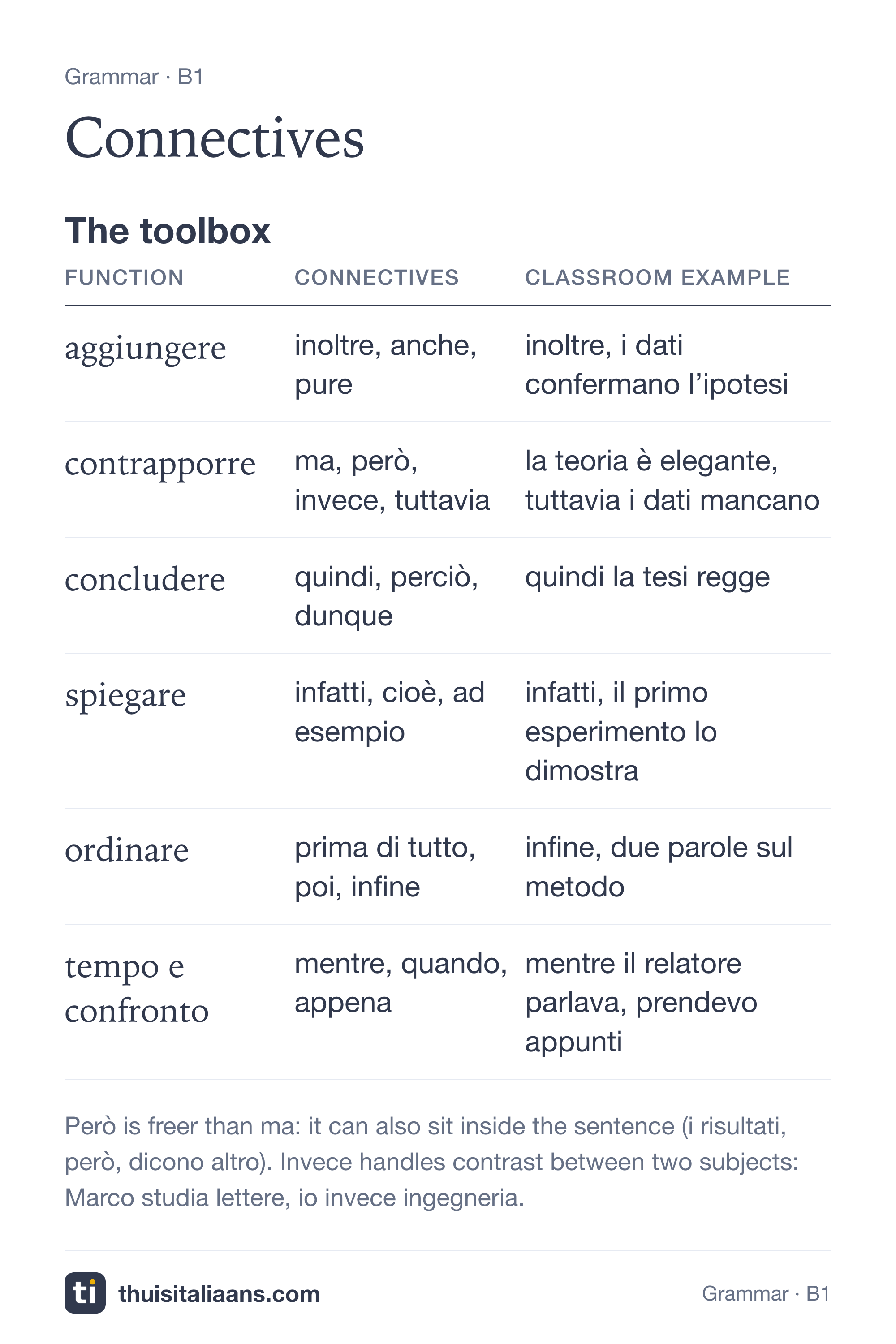
The toolbox
| Function | Connectives | Classroom example |
|---|---|---|
| aggiungere | inoltre, anche, pure | inoltre, i dati confermano l’ipotesi |
| contrapporre | ma, però, invece, tuttavia | la teoria è elegante, tuttavia i dati mancano |
| concludere | quindi, perciò, dunque | quindi la tesi regge |
| spiegare | infatti, cioè, ad esempio | infatti, il primo esperimento lo dimostra |
| ordinare | prima di tutto, poi, infine | infine, due parole sul metodo |
| tempo e confronto | mentre, quando, appena | mentre il relatore parlava, prendevo appunti |
The most common mistakes
piove. Vado all’università. Prendo l’ombrello→ piove, quindi prendo l’ombrello (link, do not list)ma però non sono d’accordo→ però non sono d’accordo (one of the two is enough)studio molto, quindi però non passo l’esame→ studio molto, però non passo l’esame (contrast, not conclusion)
Did you know?
Read and understand
This chapter’s grammar. Example: a postcard from Palermo.
Caro Jan,
Palermo è un caos meraviglioso. Appena arrivi, il traffico ti spaventa; però dopo un giorno capisci le regole del gioco.
Siccome faceva caldo, uscivamo presto: prima il mercato, poi il mare. Mentre gli altri dormivano, io fotografavo le strade vuote.
Il palazzo dei Normanni il martedì è chiuso, quindi ci torniamo domani. Insomma: qui una settimana non basta.
A presto, Teun
ITALIANE
C.P.
Kerkstraat 5
6811 EA Arnhem
Questions
Perché uscivano presto la mattina?
Perché tornano domani al palazzo dei Normanni?
«Siccome faceva caldo, uscivamo presto»: «siccome» introduce…
Completa: «Pioveva, ___ siamo rimasti a casa».
Exercises
Five exercises in order of difficulty. The last ones bring back what you have already seen.
01 Aggiungere, opporre, spiegare
Complete with inoltre, invece, infatti, quindi, però, perché.
- Non ho studiato, non ho passato l’esame.
- Volevo uscire, pioveva.
- È bravo: ha finito prima di tutti.
- Il corso è utile; costa poco.
- Io prendo il caffè, lui il tè.
- Sono rimasto a casa ero stanco.
02 Il tempo del racconto
Complete with prima di, dopo, mentre, appena, finché.
- uscire, chiudi la finestra.
- aver mangiato, siamo usciti.
- parlavo, lui guardava il telefono.
- arrivo, ti chiamo.
- Aspetta non torno.
- la lezione, ci vediamo al bar.
03 Il connettivo giusto per il senso
Choose between the two options.
- Ho studiato molto, (quindi / però) ho passato l’esame. →
- Ho studiato molto, (quindi / però) non ho passato l’esame. →
- Non esco (perché / anche se) piove. →
- Esco (perché / anche se) piove. →
- Parla piano (così / perché) tutti capiscono. →
- (Siccome / Nonostante) era tardi, siamo tornati a casa. →
04 Quelli che vogliono il congiuntivo
Benché, sebbene, affinché, prima che, a meno che call for the subjunctive. Complete.
- Benché (essere) stanco, è venuto.
- Sebbene (piovere) , siamo usciti.
- Te lo spiego affinché tu (capire) .
- Parti prima che (essere) troppo tardi.
- Vengo, a meno che tu (non volere) .
- Nonostante (loro / avere) poco tempo, ci hanno aiutato.
05 La lettera di presentazione
Complete with the connectives and the right moods.
Review congiuntivo presente · condizionale presente
- Le scrivo ho visto il vostro annuncio.
- Ho lavorato tre anni in un’azienda simile; conosco bene il settore.
- non abbia esperienza diretta di export, imparo in fretta.
- , parlo tre lingue e ho la patente B.
- Sono disponibile da subito, preferirei cominciare a settembre.
- Resto a disposizione Lei (volere) altre informazioni.
These five are a taste. There are over seven hundred on the site, free and with no sign-up. All the exercises →

Every topic, a world
In the  amo Italian app, grammar is practised inside thematic pathways with field-specific vocabulary: il bar, i trasporti, il calcio, la moda, la burocrazia and seventeen more. Choose your world and the grammar comes along by itself, explained in your language too.
Half the path free, no sign-up
★★★★★(11)by Alessio, teacher since 2018
Downloadamo Italian for iPhone ↗︎Search for amo Italian
Read and understand
This chapter’s grammar. Example: a newspaper opinion piece.
La Gazzetta della Domenica
domenica 26 aprile · pagina 6
Il commento
La biblioteca apre la sera: perciò qualcosa cambia
di Luca Mondini
Da marzo la biblioteca chiude alle 23. All'inizio sembrava un esperimento; invece è diventata un'abitudine: la sera i tavoli sono pieni.
Infatti i numeri parlano chiaro: tremila ingressi in più in due mesi. Tuttavia non è tutto perfetto: mancano i posti, perciò molti studiano seduti sulle scale.
Poiché lo spazio non si può allargare, il Comune pensa a una seconda sede. Nonostante i costi, l'idea piace: non solo agli studenti, ma anche ai pensionati del quartiere.
Insomma: a volte basta una chiave girata più tardi.
Questions
A che ora chiude adesso la biblioteca?
Perché molti studiano sulle scale?
«Tuttavia non è tutto perfetto»: «tuttavia» somiglia a…
Completa: «___ i prezzi alti, il ristorante è sempre pieno».
Want another text on this topic? The phone bill
One more go
Choose the connective:
- Ho studiato tutta la notte, sono pronto per l’esame.
- La lezione era interessante, l’aula era gelida.
- , presenterò il metodo; poi i risultati.
- Il professore è severo: boccia metà del corso.
- Laura studia medicina, io architettura.
Frequently asked questions
What is the difference between perché and siccome?
Position: siccome (and poiché, more formal) opens the sentence with the cause: siccome pioveva, sono rimasto a casa. Perché follows the main clause: sono rimasto a casa perché pioveva. Starting a sentence with perché + cause is the classic mistake to unlearn.
Quindi or allora?
Quindi draws a logical conclusion: piove, quindi prendo l’ombrello. Allora is looser: consequence, but also “at that time” (allora vivevo a Roma) and the conversational “so…” that opens turns (allora, cosa facciamo?). In an essay, quindi; at the bar, allora.
What does anzi do?
It corrects or upgrades what you just said: non è tardi, anzi (on the contrary), è bravo, anzi bravissimo (or rather). A one-word U-turn: English needs “on the contrary / actually / better still”, Italian does it in four letters.
 The toolbox