

Grammar · B2
Gerund and participle
by Alessio · teacher of Italian as a foreign language, ITALS master’s

Implicit forms compress the sentence: camminando nel bosco ho visto un capriolo (while I was walking), arrivati al rifugio, abbiamo riposato (when we arrived). Fewer words, more stride.
- 5min reading
- 15min exercises
- B2level
What you learn
- tempo (mentre), modo (come), causa (poiché), ipotesi (se)
- When to use gerund and participle
- The absolute past participle
- Vocabulary: la montagna
Italian and English side by side
English uses -ing for almost everything. Italian splits the work: the gerund for cause, time and manner (avendo finito, uscì), the participle for what came before (finita la riunione, uscì). And Italian gerunds need the same subject as the main clause. English is much looser.
Take this page with you
This chapter’s sheet as a free printable PDF (tables in Italian): rules, typical mistakes and the quiz with answers. A teacher’s tip: grammar sticks by reviewing it often, not by studying it once.


The words on this page
Drag each Italian word onto its definition, or tap a word first, then its box.
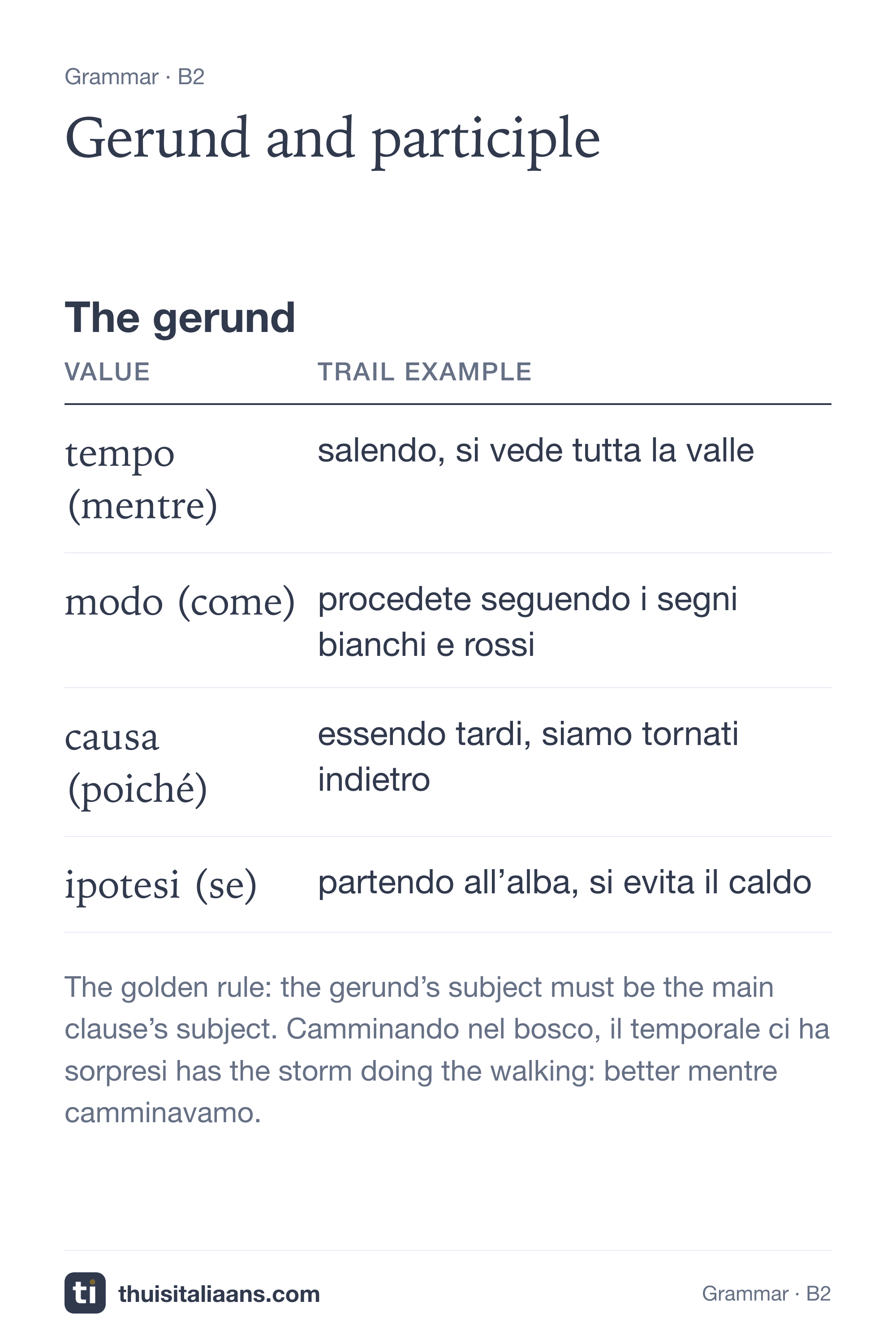
The gerund
| Value | Trail example |
|---|---|
| tempo (mentre) | salendo, si vede tutta la valle |
| modo (come) | procedete seguendo i segni bianchi e rossi |
| causa (poiché) | essendo tardi, siamo tornati indietro |
| ipotesi (se) | partendo all’alba, si evita il caldo |
The absolute past participle
| Sentence | Equals |
|---|---|
| arrivati in cima, abbiamo aperto lo zaino | dopo che siamo arrivati |
| finita la salita, il sentiero spiana | quando la salita è finita |
| vista l’ora, meglio rientrare | considerata l’ora |
The most common mistakes
essendo il sentiero è ripido, andiamo piano→ essendo il sentiero ripido, andiamo piano (no double verb)camminando, la pioggia ci ha bagnati→ mentre camminavamo, la pioggia ci ha bagnati (different subjects)arrivato in cima, abbiamo brindato (noi)→ arrivati in cima, abbiamo brindato (agreement with the subject)
Did you know?
Read and understand
This chapter’s grammar. Example: grandpa's email about the garden.
Come ho salvato l'orto (sbagliando)
daAldo Ferri <aldo.ferri@mail.it>
amatteo.ferri@mail.it
datadom 18 mag, 07:40
Caro Matteo,
l'orto è salvo. Guardando bene le foglie, ho capito che era colpa delle lumache. Cercando su internet ho trovato dieci rimedi; leggendo i commenti ne ho scartati nove.
Finita la pioggia, ho messo la cenere intorno all'insalata: detto tra noi, funziona davvero.
Tua nonna, vedendomi nell'orto alle sei del mattino, ha pensato a un ladro. Chiarito l'equivoco, mi ha portato il caffè.
Sapendo che sabato vieni, pianto anche i pomodori.
Nonno Aldo
Questions
Di chi era la colpa, nell'orto?
Che cosa ha messo intorno all'insalata?
«Guardando bene le foglie, ho capito»: il gerundio qui dice…
«Finita la pioggia» significa…
Completa: «___ di casa, ho incontrato Pia» (uscire).
Exercises
Five exercises in order of difficulty. The last ones bring back what you have already seen.
01 Il gerundio che spiega
Rewrite with the gerund, as in the example: Poiché studia molto, passa gli esami → Studiando molto, passa gli esami.
- Poiché era stanco, è andato a letto. →
- Mentre tornavo a casa, ho incontrato Luca. →
- Se studi ogni giorno, impari. →
- Siccome non aveva soldi, è rimasto a casa. →
- Poiché ho letto il libro, conosco la storia. →
- Mentre parlava, gesticolava molto. →
02 Gerundio semplice o composto
The compound gerund says the action came first. Complete.
- (finire) il lavoro, è uscito.
- (camminare) , pensava ai fatti suoi.
- (arrivare) in ritardo, non è entrato.
- (leggere) la mail, ho capito il problema.
- (aspettare) , ho bevuto un caffè.
- (non dormire) la notte, era stanchissimo.
03 Il participio passato da solo
Rewrite the absolute participle, as in the example: Dopo che ebbe finito → Finito il lavoro…
- Dopo che ha letto la lettera, ha telefonato. →
- Dopo che sono arrivati, si sono seduti. →
- Dopo che ha finito la riunione, è uscito. →
- Dopo che ebbero chiuso il negozio, tornarono a casa. →
- Dopo che ha superato l’esame, ha festeggiato. →
- Dopo che sono uscite, ha piovuto. →
04 Il participio presente
Some present participles are now nouns or adjectives. Complete.
- chi insegna →
- chi studia →
- chi canta →
- che segue →
- che diverte →
- che interessa →
05 La relazione di lavoro
Complete with gerunds, participles and the right tenses.
Review forma passiva · discorso indiretto
- (analizzare) i dati del trimestre, abbiamo notato un calo.
- (non avere) informazioni sui costi, non possiamo concludere.
- (chiudere) il bilancio, invieremo la relazione definitiva.
- Il documento (allegare) contiene i dettagli.
- (leggere) le vostre osservazioni, abbiamo corretto due tabelle.
- Restiamo a disposizione per il punto (seguire) .
These five are a taste. There are over seven hundred on the site, free and with no sign-up. All the exercises →

Every topic, a world
In the  amo Italian app, grammar is practised inside thematic pathways with field-specific vocabulary: il bar, i trasporti, il calcio, la moda, la burocrazia and seventeen more. Choose your world and the grammar comes along by itself, explained in your language too.
Half the path free, no sign-up
★★★★★(11)by Alessio, teacher since 2018
Downloadamo Italian for iPhone ↗︎Search for amo Italian
Read and understand
This chapter’s grammar. Example: the story of a runner.
La Gazzetta della Domenica
domenica 30 marzo · pagina 11
La storia
Correndo ha ritrovato la sua città
di Chiara Bonetti
Ogni mattina, attraversando il parco alle sei, Lena fotografa quello che cambia. Avendo perso il lavoro l'anno scorso, aveva cominciato a correre «per non pensare».
Correndo ha scoperto strade che non conosceva. E pur abitando qui da sempre, racconta, non aveva mai visto l'alba dal ponte vecchio.
Arrivata a mille chilometri, ha aperto un profilo con le sue foto: essendo immagini piene di luce, i giornali locali se ne sono accorti in fretta.
«Messa da parte la paura, la città ti ripaga», sorride. Ora una galleria le ha chiesto una mostra per giugno.
Questions
Perché Lena aveva cominciato a correre?
Che cosa le ha chiesto una galleria?
«Avendo perso il lavoro, aveva cominciato a correre»: il gerundio composto qui indica…
«Pur abitando qui da sempre» significa…
Completa: «___ i compiti, uscì a giocare» (finire).
Want another text on this topic? A cover letter
One more go
Compress the sentence:
- di quota, l’aria si fa più fresca.
- al lago, ci siamo fermati a mangiare.
- il rifugio pieno, abbiamo montato la tenda.
- Si impara la montagna sentiero qualche volta.
- la discesa, ci aspettava la funivia.
Frequently asked questions
How do I translate “Smoking is bad for you”?
With the infinitive, not the gerund: fumare fa male. English -ing nouns are Italian infinitives: leggere rilassa, viaggiare costa. The Italian gerundio is never a subject: if the -ing word is doing noun work, reach for the infinitive.
What does pur + gerund mean?
“Although / even though”: pur essendo stanco, ha continuato (although he was tired). It is the concessive gerund, a compact alternative to anche se + full clause, and a favourite of written Italian: one word, and the whole clause changes direction.
What is avendo fatto?
The compound gerund, for actions completed before the main one: avendo finito il progetto, si è presa una settimana di ferie. Same logic as dopo aver fatto, one degree more formal: written reports and academic prose use it constantly.
 The gerund