

Grammar · B2
Subjunctive agreement
by Alessio · teacher of Italian as a foreign language, ITALS master’s

Four subjunctives, one clock: the main clause sets the time, the subordinate picks the right tense relative to it. Spero che l’offerta arrivi (after), speravo che arrivasse (simultaneous in the past), temo che sia già arrivata a qualcun altro (before).
- 6min reading
- 15min exercises
- B2level
What you learn
- presente, presente, passato, passato
- How it works: subjunctive agreement
- The most common mistakes
- Vocabulary: il colloquio di lavoro
Italian and English side by side
English shifts tenses in reported speech but has no separate agreement rules for mood. Italian does: after a past verb everything moves back a step, and a future becomes a compound conditional: disse che sarebbe partito, he said he would leave.
Take this page with you
This chapter’s sheet as a free printable PDF (tables in Italian): rules, typical mistakes and the quiz with answers. A teacher’s tip: grammar sticks by reviewing it often, not by studying it once.
The subjunctive is a bubble floating above the facts: what is thought, feared or hoped, not what is.


The words on this page
Drag each Italian word onto its definition, or tap a word first, then its box.
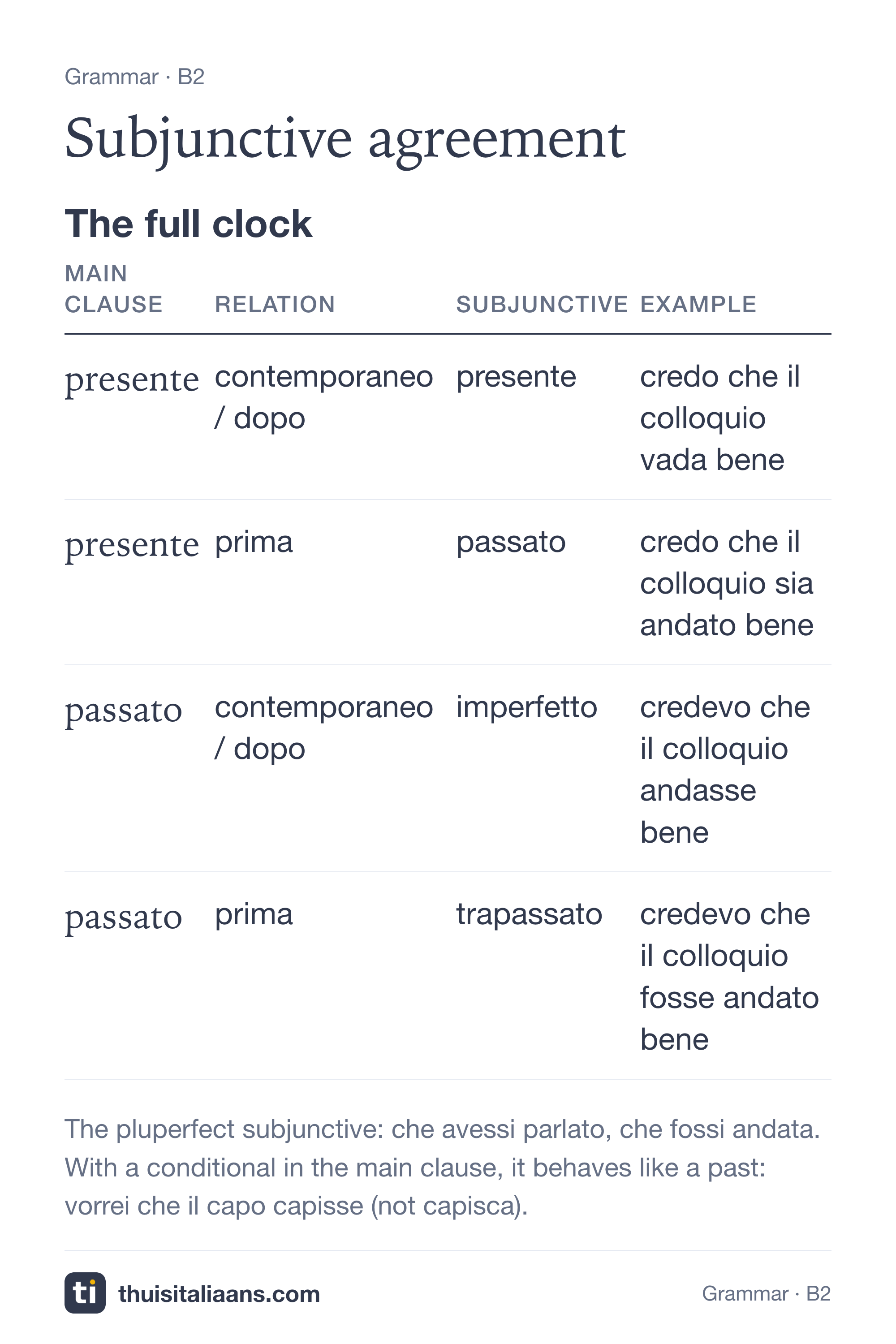
The full clock
| Main clause | Relation | Subjunctive | Example |
|---|---|---|---|
| presente | contemporaneo / dopo | presente | credo che il colloquio vada bene |
| presente | prima | passato | credo che il colloquio sia andato bene |
| passato | contemporaneo / dopo | imperfetto | credevo che il colloquio andasse bene |
| passato | prima | trapassato | credevo che il colloquio fosse andato bene |
Interviews and hopes
| Sentence | Why |
|---|---|
| spero che mi richiamino | presente → futuro: congiuntivo presente |
| speravo che mi richiamassero | passato → contemporaneo: imperfetto |
| temo che abbiano scelto un altro | presente → anteriore: passato |
| vorrei che l’ufficio fosse più vicino | condizionale → imperfetto |
The most common mistakes
credevo che il capo sia d’accordo→ credevo che il capo fosse d’accordo (past → imperfect)vorrei che tu sia più puntuale→ vorrei che tu fossi più puntuale (conditional → imperfect)spero che ieri tutto andasse bene→ spero che ieri tutto sia andato bene (anterior to now)
Did you know?
Read and understand
This chapter’s grammar. Example: an email from a music school.
Crediamo che sia la scelta giusta
daScuola di musica Il Pentagramma <segreteria@ilpentagramma.it>
aallievi@ilpentagramma.it
dataven 26 set, 16:10
Care allieve e cari allievi,
dal mese prossimo le lezioni serali cominciano alle 19. Sappiamo che qualcuno pensava che l'orario vecchio fosse perfetto, e ci dispiace che il cambio sia arrivato con poco preavviso.
Il motivo è semplice: molti temevano che il traffico li facesse arrivare sempre in ritardo alla lezione delle 18. Crediamo che la nuova ora sia più comoda per quasi tutti.
È possibile che a dicembre si aggiunga un secondo turno: era già previsto che la sala grande venisse liberata prima di sera.
Speriamo che il cambiamento vi aiuti. Scriveteci che ne pensate.
La segreteria
Questions
A che ora cominciano le lezioni serali dal mese prossimo?
Che cosa è possibile che succeda a dicembre?
«Pensava che l'orario fosse perfetto»: perché «fosse»?
«Ci dispiace che il cambio sia arrivato»: perché il congiuntivo passato?
Completa: «Temevo che tu ___ l'autobus» (perdere).
Exercises
Five exercises in order of difficulty. The last ones bring back what you have already seen.
01 Verbo principale al presente
Present → present subjunctive (same time) or past subjunctive (earlier). Complete.
- Penso che ora (lui / dormire) .
- Penso che ieri (lui / dormire) male.
- Credo che (loro / arrivare) domani.
- Credo che (loro / arrivare) stamattina.
- Spero che (tu / stare) bene.
- Spero che (tu / non offendersi) .
02 Verbo principale al passato
Past → imperfect subjunctive (same time) or pluperfect (earlier). Complete.
- Pensavo che (lui / dormire) in quel momento.
- Pensavo che (lui / dormire) male la notte prima.
- Credevo che (loro / arrivare) il giorno dopo.
- Credevo che (loro / già arrivare) .
- Speravo che (tu / stare) bene.
- Speravo che (tu / capire) il motivo.
03 Il congiuntivo trapassato
Imperfect subjunctive of essere/avere + participle. Complete.
- che io (parlare)
- che tu (partire)
- che lei (finire)
- che noi (uscire)
- che voi (vedere)
- che loro (arrivare)
04 Il futuro dentro il congiuntivo
The subjunctive has no future: use the present, or the compound conditional after a past tense. Complete.
- Credo che domani (piovere) .
- Credevo che il giorno dopo (piovere) .
- Penso che (lui / venire) la settimana prossima.
- Pensavo che (lui / venire) la settimana seguente.
- Spero che (loro / accettare) la proposta.
- Speravo che (loro / accettare) la proposta.
05 Il verbale della riunione
Complete, respecting the sequence of tenses.
Review congiuntivo imperfetto e passato · periodo ipotetico
- Il direttore ha detto che pensava che il progetto (essere) già pronto.
- Nessuno credeva che il cliente (cambiare) idea il mese prima.
- Si temeva che i costi (aumentare) nei mesi seguenti.
- Ora si spera che il lavoro (finire) entro giugno.
- Sembra che a maggio (esserci) già stato un ritardo simile.
- È stato chiesto che tutti (mandare) un aggiornamento entro venerdì.
These five are a taste. There are over seven hundred on the site, free and with no sign-up. All the exercises →

Every topic, a world
In the  amo Italian app, grammar is practised inside thematic pathways with field-specific vocabulary: il bar, i trasporti, il calcio, la moda, la burocrazia and seventeen more. Choose your world and the grammar comes along by itself, explained in your language too.
Half the path free, no sign-up
★★★★★(11)by Alessio, teacher since 2018
Downloadamo Italian for iPhone ↗︎Search for amo Italian
Read and understand
This chapter’s grammar. Example: an article on the rediscovered painting.
La Gazzetta della Domenica
domenica 7 dicembre · pagina 13
Il caso
Il quadro ritrovato: pare che nessuno sapesse niente
di Elisa Marchetti
Un piccolo ritratto è riapparso nel deposito del teatro. Gli esperti pensano che sia dell'Ottocento e che sia stato dipinto in zona.
Com'è finito lì? Pare che decenni fa qualcuno lo avesse messo in una cassa sbagliata, e che poi tutti se ne fossero dimenticati.
Il custode resta cauto: «Non credo che sia un capolavoro, ma è strano che nessuno lo abbia cercato per tanto tempo».
Il Comune vuole che il quadro venga esposto già a Natale, sebbene il restauro non sia ancora finito.
Questions
Dove è riapparso il ritratto?
Quando vuole esporlo il Comune?
«Pare che qualcuno lo avesse messo in una cassa sbagliata»: perché il congiuntivo trapassato?
«Vuole che il quadro venga esposto»: «venga esposto» è…
Completa: «Era strano che in sala non ___ nessuno» (esserci).
Want another text on this topic? The neighbourhood committee flyer
One more go
Set the clock:
- Spero che l’azienda mi entro venerdì.
- Speravo che il colloquio di meno.
- Temo che un altro candidato.
- Credevo che tu il contratto.
- Vorrei che lo stipendio un po' più alto.
Frequently asked questions
Why prima che parta but dopo che è partito?
Because of time’s arrow: at the moment of the main clause, what comes before has not happened yet, so it is unreal and takes the subjunctive (prima che parta); what comes after is by then a fact, so it takes the indicative (dopo che è partito). The asymmetry is logic wearing grammar.
Can I say penso che fosse, with a present main verb?
Yes, when the subordinate points to the past: penso che allora fosse felice (I think that back then he was happy). The main clause gives your viewpoint now; the imperfect subjunctive dates the fact. The clock serves meaning, not the other way round.
After benché, which subjunctive tense?
The one the timeline asks for: benché sia stanco, esco (now), benché fosse stanco, uscì (then), benché abbia dormito poco, sto bene (before now). Concessive conjunctions fix the mood: the tense stays yours to choose.
 The full clock