

Grammar · C2
Marked constructions
by Alessio · teacher of Italian as a foreign language, ITALS master’s

Spoken Italian focuses information by moving it around: la Vespa, l’ho comprata io (dislocation), è a Roma che voglio vivere (cleft sentence). These are not mistakes: they are the direction of discourse, and the dolce vita is full of them.
- 6min reading
- 15min exercises
- C2level
What you learn
- dislocazione a destra, frase scissa, tema sospeso, ci presentativo
- When to use marked constructions
- Directing the discourse
- Vocabulary: le vacanze italiane
Italian and English side by side
English marks focus with stress and word order stays fixed: I saw HIM. Italian moves the constituent instead: lui l'ho visto, l'ho visto, lui. The cleft sentence works like English it was Marco who…, but Italian uses it far more, and in speech constantly.
Take this page with you
This chapter’s sheet as a free printable PDF (tables in Italian): rules, typical mistakes and the quiz with answers. A teacher’s tip: grammar sticks by reviewing it often, not by studying it once.


The words on this page
Drag each Italian word onto its definition, or tap a word first, then its box.
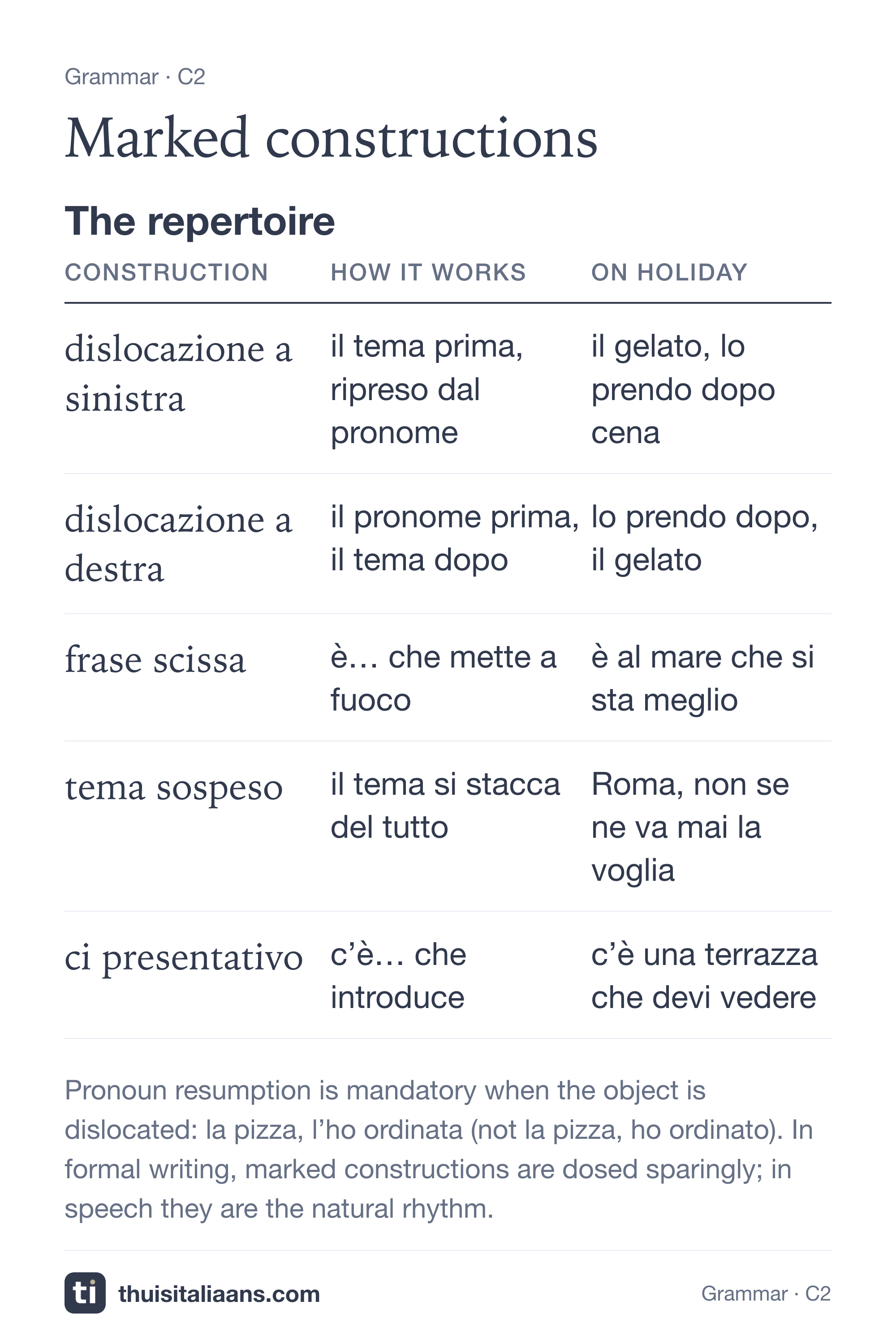
The repertoire
| Construction | How it works | On holiday |
|---|---|---|
| dislocazione a sinistra | il tema prima, ripreso dal pronome | il gelato, lo prendo dopo cena |
| dislocazione a destra | il pronome prima, il tema dopo | lo prendo dopo, il gelato |
| frase scissa | è… che mette a fuoco | è al mare che si sta meglio |
| tema sospeso | il tema si stacca del tutto | Roma, non se ne va mai la voglia |
| ci presentativo | c’è… che introduce | c’è una terrazza che devi vedere |
Directing the discourse
| Neutral | Marked | Effect |
|---|---|---|
| ho comprato io la Vespa | la Vespa, l’ho comprata io | il tema è la Vespa, il nuovo è chi |
| voglio vivere a Roma | è a Roma che voglio vivere | esclude le alternative |
| conosco un posto perfetto | c’è un posto che conosco, perfetto | introduce in scena |
The most common mistakes
la granita, ho assaggiato a Catania→ la granita, l’ho assaggiata a Catania (mandatory resumption)è che voglio vivere a Roma→ è a Roma che voglio vivere (the cleft focuses one element)il tramonto, l’ho visto il tramonto→ il tramonto, l’ho visto (one resumption is enough)
Did you know?
Exercises
Five exercises in order of difficulty. The last ones bring back what you have already seen.
01 La dislocazione a sinistra
Sposta l’oggetto all’inizio e riprendilo con il pronome.
- Ho già letto questo libro. →
- Non conosco quella persona. →
- Ho comprato le sedie ieri. →
- Non ho mai capito la matematica. →
- Ho dato il libro a Marco. →
- Non sopporto queste discussioni. →
02 La dislocazione a destra
Anticipa il pronome e metti l’oggetto in fondo.
- Ho già visto il film. →
- Non trovo le chiavi. →
- Ho detto tutto a Luca. →
- Non conosco quella storia. →
- Ho chiuso la finestra. →
- Non capisco questo passaggio. →
03 La frase scissa
Riscrivi con è … che per mettere in rilievo l’elemento indicato.
- Marco ha rotto il vetro. (Marco) →
- Ti chiamo per questo. (per questo) →
- Parto domani. (domani) →
- Voglio parlare con te. (con te) →
- Mi preoccupa il silenzio. (il silenzio) →
- L’ho saputo ieri. (ieri) →
04 Il tema sospeso e il c’è presentativo
Riscrivi come indicato.
- Non ho ancora parlato con Marco. (tema sospeso) →
- Una persona ti cerca. (c’è presentativo) →
- Un problema complica tutto. (c’è presentativo) →
- Di questo film non mi importa nulla. (tema sospeso) →
- Qualcuno ha suonato. (c’è presentativo) →
- A quella storia non credo. (tema sospeso) →
05 Il parlato di un dialogo
Riscrivi le battute usando le costruzioni marcate del parlato.
Review C1: registro formale · B2: pronomi combinati
- — Hai visto il mio telefono? (dislocazione a destra) →
- — Non ho ancora finito questo lavoro. (a sinistra) →
- — Ti ho chiamato per il preventivo. (scissa) →
- — Una cosa mi preoccupa. (c’è presentativo) →
- — Di Marta non so più niente. (tema sospeso) →
- — Ho dato io la risposta. (scissa) →
These five are a taste. There are over seven hundred on the site, free and with no sign-up. All the exercises →

Every topic, a world
In the  amo Italian app, grammar is practised inside thematic pathways with field-specific vocabulary: il bar, i trasporti, il calcio, la moda, la burocrazia and seventeen more. Choose your world and the grammar comes along by itself, explained in your language too.
Half the path free, no sign-up
★★★★★(11)by Alessio, teacher since 2018
Downloadamo Italian for iPhone ↗︎Search for amo Italian
One more go
Bring into focus:
- Il tiramisù, nel posto giusto: Treviso.
- la terrazza da' il meglio.
- una spiaggetta che conoscono in pochi.
- La Vespa, guido solo d’estate.
- Lo prendo dopo, : prima la passeggiata.
Frequently asked questions
Is a me mi piace a mistake?
In formal writing, avoid it; in speech, it is an emphatic doubling with centuries of use, and linguists (Accademia della Crusca included) treat it as pragmatics, not ignorance: a me sets the topic, mi completes the verb. Know the rule, know the register: correct the essay, not the dinner table.
What changes with right dislocation: l’ho comprata, la Vespa?
The noun becomes an afterthought: you speak as if the listener already knew, then confirm the topic at the end. It marks shared ground and casual intimacy: left dislocation announces the topic, right dislocation nods at it over your shoulder.
Cleft or pseudo-cleft: è Marco che ha pagato or chi ha pagato è Marco?
Same focus, different unveiling: the cleft spotlights immediately (è Marco che…), the pseudo-cleft builds suspense by starting from what is known (chi ha pagato è…). Speech prefers the first; expository writing uses the second to manage the reader’s attention.
 The repertoire