

Grammar · C1
The passato remoto
by Alessio · teacher of Italian as a foreign language, ITALS master’s

The passato remoto is the tense of the completed tale: mio bisnonno partì nel 1902 e non tornò mai più. It lives in novels, in history and in Southern speech: in the North you read it, in Sicily you hear it at the market.
- 5min reading
- 17min exercises
- C1level
What you learn
- tu, lui / lei, noi, voi, loro
- When to use the passato remoto
- When to use it (and when not)
- Vocabulary: l'emigrazione
Italian and English side by side
English has one simple past for everything. Italian keeps the passato remoto for what is cut off from now: history, narrative, and everyday speech in the South. Dante nacque nel 1265, but stamattina ho bevuto un caffè.
Take this page with you
This chapter’s sheet as a free printable PDF (tables in Italian): rules, typical mistakes and the quiz with answers. A teacher’s tip: grammar sticks by reviewing it often, not by studying it once.
The passato remoto cuts the event off from the present: history and narrative. The passato prossimo keeps it connected to now.


The words on this page
Drag each Italian word onto its definition, or tap a word first, then its box.
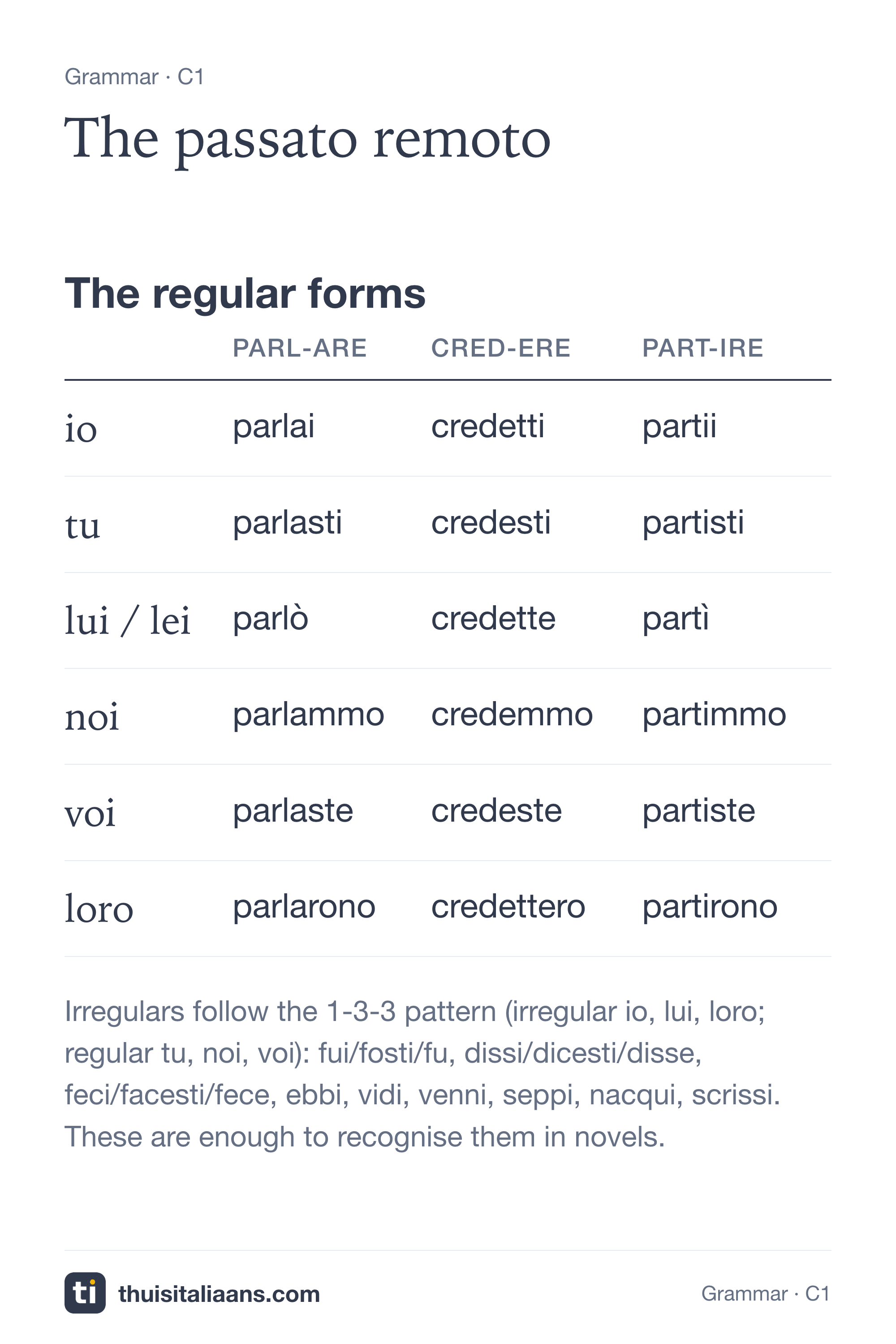
The regular forms
| parl-ARE | cred-ERE | part-IRE | |
|---|---|---|---|
| io | parlai | credetti | partii |
| tu | parlasti | credesti | partisti |
| lui / lei | parlò | credette | partì |
| noi | parlammo | credemmo | partimmo |
| voi | parlaste | credeste | partiste |
| loro | parlarono | credettero | partirono |
When to use it (and when not)
| Context | Right tense |
|---|---|
| storia di famiglia lontana e chiusa | il nonno emigrò, lavorò, tornò ricco |
| romanzo, biografia, storia | Garibaldi sbarcò a Marsala nel 1860 |
| passato che tocca il presente | passato prossimo: quest’anno sono tornato al paese |
| conversazione al Nord | passato prossimo anche per fatti lontani |
The most common mistakes
ieri andai al supermercato (a Milano)→ ieri sono andato al supermercato (recent facts: passato prossimo)mio bisnonno partiva nel 1902 e non tornò più→ mio bisnonno partì nel 1902 (single event, not background)Dante nascette a Firenze→ Dante nacque a Firenze (1-3-3 irregular)
Did you know?
Exercises
Five exercises in order of difficulty. The last ones bring back what you have already seen.
01 I regolari
Completa con il passato remoto.
- io (parlare)
- tu (credere)
- lui (finire)
- noi (parlare)
- voi (credere)
- loro (finire)
02 Gli irregolari e la regola 1-3-3
Molti sono irregolari solo alla 1ª e 3ª singolare e alla 3ª plurale. Completa.
- io (avere)
- tu (avere)
- lui (avere)
- io (fare)
- noi (fare)
- loro (fare)
03 Quelli che tornano di più
Completa la terza persona singolare.
- essere →
- dire →
- venire →
- vedere →
- scrivere →
- nascere →
- volere →
- dare →
04 Passato remoto o prossimo?
Il remoto stacca dal presente, il prossimo lo lega. Scrivi R o P e completa.
- Dante (nascere) nel 1265.
- Stamattina (io / bere) solo un caffè.
- L’Italia (unirsi) nel 1861.
- Ieri (noi / vedere) un bel film.
- Mio nonno (emigrare) in Belgio nel 1954.
- Quest’anno (loro / cambiare) casa.
05 La pagina di storia
Completa il testo con il passato remoto e i tempi che lo accompagnano.
Review concordanza dei tempi · B2: gerundio e participio
- Nel 1786 Goethe (partire) per l’Italia.
- Il viaggio (durare) quasi due anni e lo (portare) fino in Sicilia.
- Mentre (attraversare) le Alpi, (annotare) ogni dettaglio.
- Ciò che (vedere) a Roma gli (cambiare) la vita.
- Quando (tornare) a Weimar, (essere) un altro uomo.
- Il resoconto del viaggio (uscire) molti anni dopo.
These five are a taste. There are over seven hundred on the site, free and with no sign-up. All the exercises →

Every topic, a world
In the  amo Italian app, grammar is practised inside thematic pathways with field-specific vocabulary: il bar, i trasporti, il calcio, la moda, la burocrazia and seventeen more. Choose your world and the grammar comes along by itself, explained in your language too.
Half the path free, no sign-up
★★★★★(11)by Alessio, teacher since 2018
Downloadamo Italian for iPhone ↗︎Search for amo Italian
One more go
Tell the distant past:
- Mia bisnonna da Genova nel 1911.
- Il viaggio ventidue giorni.
- Quando New York, una lettera alla madre.
- I suoi figli non mai in Italia.
Frequently asked questions
Do I actually need to speak the passato remoto?
Recognition first, production second: you need it to read novels and history, and to follow conversation in the Centre-South. Producing it matters if you write narrative or live where it is spoken: a Milanese can go years without saying andò: no Italian can go a week without reading it.
Beyond distance in time, what really decides remoto versus prossimo?
Psychological distance: the remoto files an event as closed and detached (mio nonno emigrò nel 1950); the prossimo keeps it connected to now (mio nonno è emigrato, e per questo sono nato qui). The same fact can take either tense: what changes is whether you are still holding it.
Which tense for historical figures?
Convention says remoto: Dante nacque nel 1265, Verdi morì a Milano. Biographies, encyclopedias and school books all run on it: birth, works and death of the great arrive in the passato remoto, whatever the writer’s region.
 The regular forms