

Grammar · C2
Punctuation
by Alessio · teacher of Italian as a foreign language, ITALS master’s

Punctuation is the breath of the sentence, and in professional emails it is also etiquette: a comma between subject and verb jars like a grammar mistake, and well-placed colons are worth a paragraph of explanation.
- 6min reading
- 17min exercises
- C2level
What you learn
- virgola, due punti, punto e virgola, puntini
- How it works: punctuation
- The rules that carry weight
- Vocabulary: le email di lavoro
Italian and English side by side
Punctuation diverges on two points. Italian uses the serial comma far less, and it uses the colon where English would start a new sentence: Serviva una cosa sola: tempo. And the comma before a relative changes meaning exactly as in English: defining versus non-defining.
Take this page with you
This chapter’s sheet as a free printable PDF (tables in Italian): rules, typical mistakes and the quiz with answers. A teacher’s tip: grammar sticks by reviewing it often, not by studying it once.


The words on this page
Drag each Italian word onto its definition, or tap a word first, then its box.
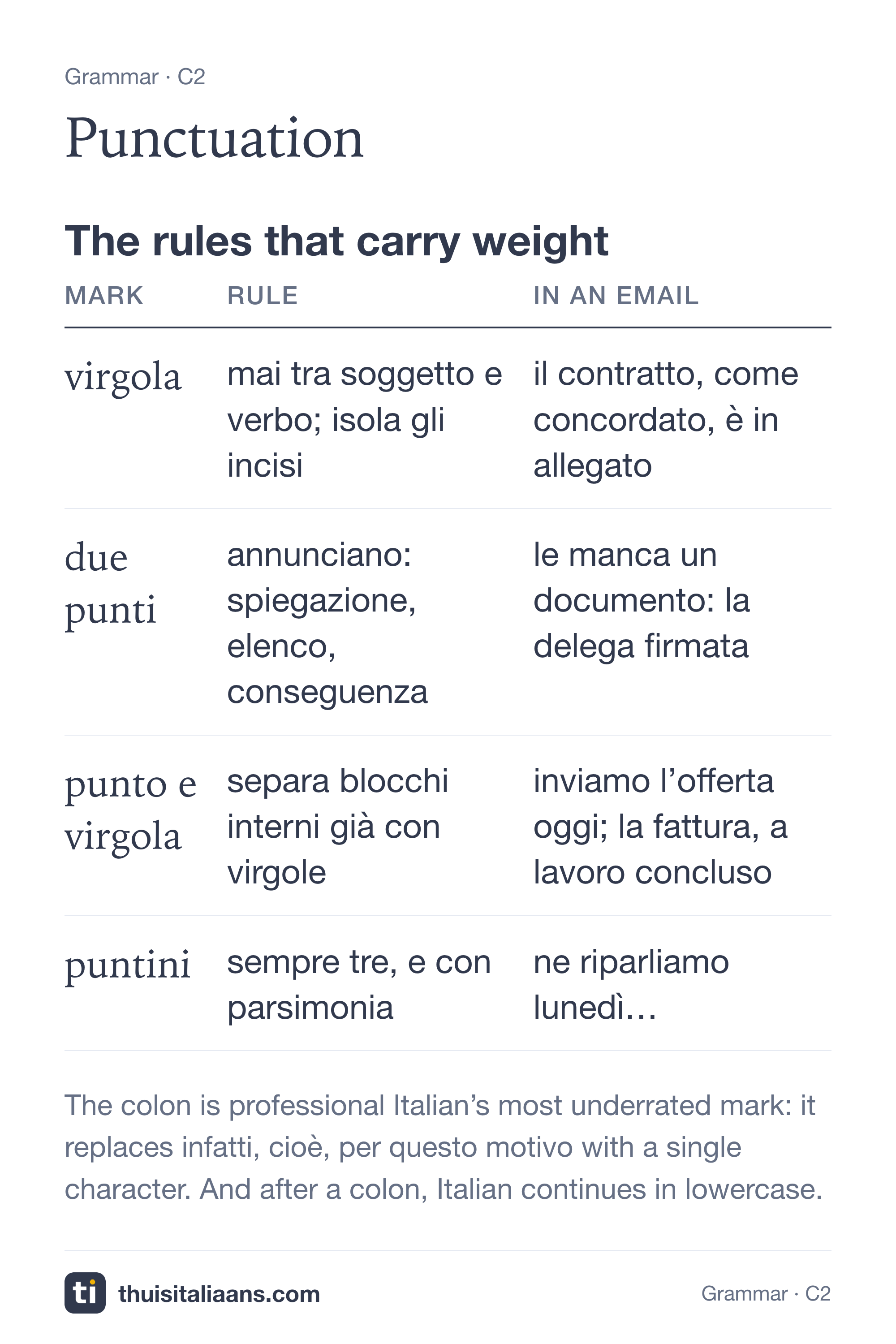
The rules that carry weight
| Mark | Rule | In an email |
|---|---|---|
| virgola | mai tra soggetto e verbo; isola gli incisi | il contratto, come concordato, è in allegato |
| due punti | annunciano: spiegazione, elenco, conseguenza | le manca un documento: la delega firmata |
| punto e virgola | separa blocchi interni già con virgole | inviamo l’offerta oggi; la fattura, a lavoro concluso |
| puntini | sempre tre, e con parsimonia | ne riparliamo lunedì… |
The same email, two breaths
| Sloppy | Polished |
|---|---|
| Le invio il file, è quello aggiornato, me lo confermi | Le invio il file aggiornato: può confermarmi la ricezione? |
| Il collega, ha approvato il budget | il collega ha approvato il budget |
| Grazie mille!!!! | grazie mille. |
The most common mistakes
il direttore, ha firmato il contratto→ il direttore ha firmato il contratto (never a comma between subject and verb)manca un documento, la delega firmata→ manca un documento: la delega firmata (the colon announces)ci vediamo lunedì….→ ci vediamo lunedì… (ellipsis is always three dots)
Did you know?
Exercises
Five exercises in order of difficulty. The last ones bring back what you have already seen.
01 La virgola che cambia il senso
Spiega con una parola la differenza fra le due frasi.
- Gli studenti, che erano stanchi, uscirono. / Gli studenti che erano stanchi uscirono. →
- Non partire, per favore. / Non partire per favore. →
- Ho invitato Marco, mio fratello. / Ho invitato Marco e mio fratello. →
- Vieni, Anna. / Vieni Anna. →
- Mangiamo, nonna! / Mangiamo nonna! →
- Se puoi, aiutami. / Se puoi aiutarmi… →
02 Dove la virgola non va
Scrivi sì se la virgola è corretta, no se va tolta.
- Marco, ha telefonato ieri. →
- Marco, il mio collega, ha telefonato ieri. →
- Penso, che tu abbia ragione. →
- Se vuoi, possiamo rimandare. →
- Il libro, che ho comprato ieri, è bello. →
- Ho comprato pane, latte e uova. →
03 I due punti e il punto e virgola
Scegli il segno giusto: : oppure ;
- Mancava una cosa il tempo.
- Il primo modello è caro il secondo è accessibile.
- Disse solo questo «Non ci sarò».
- Ha studiato molto ha passato l’esame senza fatica.
- Alcuni erano d’accordo altri no.
- Serve una cosa sola pazienza.
04 Virgolette, trattini, parentesi
Completa con il segno adatto e spiega in una parola perché.
- Disse Non ci penso nemmeno (discorso diretto)
- Il libro ormai introvabile è del 1958. (incidentale)
- La riunione (spostata al 12) è confermata. →
- Lo chiamano il professore ma non insegna. (ironia)
- Il termine resilienza è abusato. (parola citata)
- Arrivò finalmente la risposta. (inciso breve)
05 Il testo senza punteggiatura
Riscrivi il passo mettendo la punteggiatura. Qui la correzione guarda anche i segni.
Review sintassi del periodo · costruzioni marcate
- quando arrivò la lettera nessuno la aprì →
- marco che era stanco andò a dormire →
- serviva una cosa sola tempo →
- non venne nessuno né gli amici né i parenti →
- disse non ci sarò e riattaccò →
- la riunione rinviata due volte si tenne il 12 →
These five are a taste. There are over seven hundred on the site, free and with no sign-up. All the exercises →

Every topic, a world
In the  amo Italian app, grammar is practised inside thematic pathways with field-specific vocabulary: il bar, i trasporti, il calcio, la moda, la burocrazia and seventeen more. Choose your world and the grammar comes along by itself, explained in your language too.
Half the path free, no sign-up
★★★★★(11)by Alessio, teacher since 2018
Downloadamo Italian for iPhone ↗︎Search for amo Italian
One more go
Polish the email:
- Il responsabile la proposta.
- Manca un allegato la delega firmata.
- Il progetto, parte a marzo.
- Consegniamo venerdì la fattura seguirà a fine mese.
- A presto
Frequently asked questions
Can a comma ever appear before e?
Normally no: Italian does not use the serial comma: pane, latte e uova. But a comma before e is legitimate to close an aside (il progetto, dopo mesi di lavoro, e con pochi fondi, è partito) or to mark a shift: what is banned is the automatic habit, not the deliberate choice.
Is it È or E'?
È: the accented capital is the correct form, and E' (letter + apostrophe) is a typewriter-era workaround that survives out of habit. Every modern keyboard can produce È: careful writing, publishing and the Crusca all expect it. Same for À, Ì, PERCHÉ in headlines.
When does the semicolon earn its place?
Twice, mainly: between independent clauses too related for a full stop (il progetto è fermo; i fondi non bastano), and in lists whose items contain commas. It is the gear between comma and full stop: rarer than both, and precisely for that, a quiet signal of a practised hand.
 The rules that carry weight