

Grammar · C1
Complex connectives
by Alessio · teacher of Italian as a foreign language, ITALS master’s

These are the connectives that open the subjunctive: affinché (purpose), purché and a patto che (condition), nonostante and sebbene (concession), a meno che non (exception). With them the sentence becomes architecture: precise as a flight plan.
- 6min reading
- 17min exercises
- C1level
What you learn
- purché / a patto che, a meno che non, prima che
- When to use complex connectives
- The most common mistakes
- Vocabulary: le missioni spaziali
Italian and English side by side
English connectives are mood-neutral. Italian splits them: anche se takes the indicative, benché and sebbene the subjunctive, and bensì has no single English word. It is but rather, and it only follows a negative.
Take this page with you
This chapter’s sheet as a free printable PDF (tables in Italian): rules, typical mistakes and the quiz with answers. A teacher’s tip: grammar sticks by reviewing it often, not by studying it once.


The words on this page
Drag each Italian word onto its definition, or tap a word first, then its box.
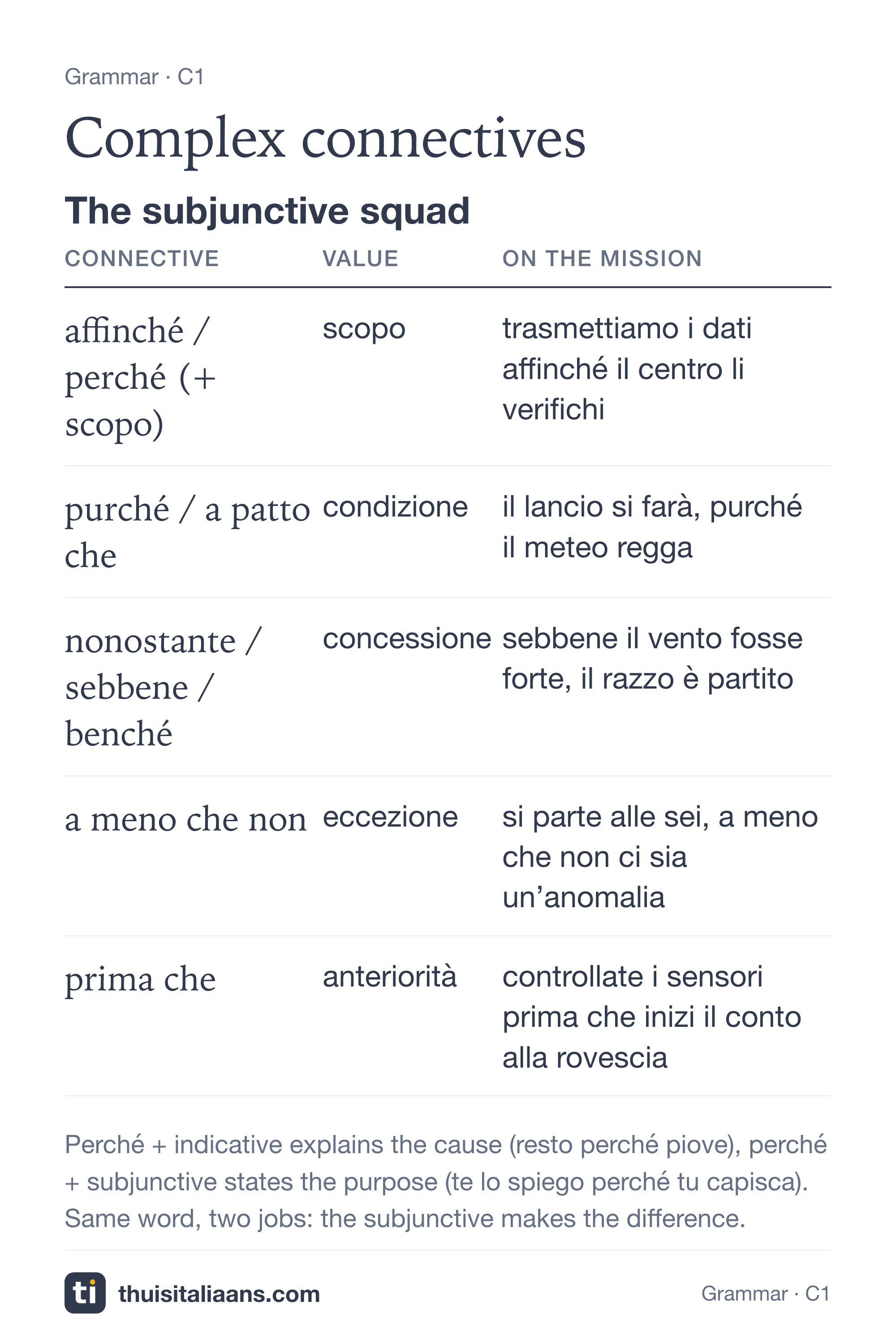
The subjunctive squad
| Connective | Value | On the mission |
|---|---|---|
| affinché / perché (+ scopo) | scopo | trasmettiamo i dati affinché il centro li verifichi |
| purché / a patto che | condizione | il lancio si farà, purché il meteo regga |
| nonostante / sebbene / benché | concessione | sebbene il vento fosse forte, il razzo è partito |
| a meno che non | eccezione | si parte alle sei, a meno che non ci sia un’anomalia |
| prima che | anteriorità | controllate i sensori prima che inizi il conto alla rovescia |
The most common mistakes
nonostante il vento era forte, siamo partiti→ nonostante il vento fosse forte, siamo partiti (concession: subjunctive)ti chiamo affinché ti informo→ ti chiamo per informarti (same subject: infinitive) or affinché tu sia informatopartiamo, a meno che piove→ partiamo, a meno che non piova (the non is customary, with the subjunctive)
Did you know?
Exercises
Five exercises in order of difficulty. The last ones bring back what you have already seen.
01 Concessivi
Completa con per quanto, sebbene, nonostante, benché, anche se. Attenzione al modo del verbo.
- (essere) tardi, continuarono a discutere.
- (lui / avere) ragione, nessuno lo ascoltò.
- (io / provare) , non ci sono riuscito.
- (essere) complesso, il testo è chiaro.
- (loro / insistere) , non cambiò idea.
- (piovere) , uscimmo lo stesso.
02 Causali e consecutivi
Completa con giacché, poiché, in quanto, cosicché, tanto che, al punto che.
- nessuno rispondeva, siamo entrati.
- Il testo è valido documenta una prassi.
- Parlò a lungo, tutti si annoiarono.
- Il traffico era bloccato, arrivammo tardi.
- Era stanco non riusciva a stare in piedi.
- la scadenza è vicina, conviene affrettarsi.
03 Limitativi e avversativi
Completa con per quanto riguarda, quanto a, laddove, mentre, bensì, tuttavia.
- i costi, ne parleremo domani.
- me, sono d’accordo.
- Non è un limite, una scelta.
- Il primo modello è caro; il secondo è accessibile.
- La proposta è interessante; presenta dei rischi.
- Il Nord è industriale, il Sud resta agricolo.
04 Il connettivo e il modo
Scrivi C se il connettivo chiede il congiuntivo, I se l’indicativo.
- benché →
- poiché →
- affinché →
- anche se →
- a condizione che →
- dato che →
05 Il saggio breve
Completa con i connettivi adatti e i modi giusti.
Review forme implicite · registro formale · B2: pronomi relativi
- molti considerino il fenomeno recente, le sue radici sono antiche.
- le fonti disponibili, la ricostruzione resta parziale.
- Il dato non è marginale, centrale nel dibattito.
- L’analisi ha convinto la commissione il progetto è stato finanziato.
- i limiti metodologici, si segnala l’assenza di dati regionali.
- resta da chiarire il ruolo delle istituzioni locali.
These five are a taste. There are over seven hundred on the site, free and with no sign-up. All the exercises →

Every topic, a world
In the  amo Italian app, grammar is practised inside thematic pathways with field-specific vocabulary: il bar, i trasporti, il calcio, la moda, la burocrazia and seventeen more. Choose your world and the grammar comes along by itself, explained in your language too.
Half the path free, no sign-up
★★★★★(11)by Alessio, teacher since 2018
Downloadamo Italian for iPhone ↗︎Search for amo Italian
One more go
Open the right subjunctive:
- Ricontrolliamo tutto affinché il lancio in sicurezza.
- La missione partirà, purché i test esito positivo.
- il budget fosse ridotto, il progetto è decollato.
- Trasmettete i dati prima che il satellite dalla copertura.
- Il conto alla rovescia continua, a meno che non un’anomalia.
Frequently asked questions
Why the non in a meno che non?
It is pleonastic: it adds no negation: vengo, a meno che non piova means “unless it rains”. The non is a fossil of the excluded scenario, required by idiom: removing it sounds off, counting it as a real negative reads the sentence backwards.
What separates purché from a plain se?
Demand: se states a condition neutrally, purché makes it the price: ti aiuto purché tu mi ascolti (provided that, on condition that). It always takes the subjunctive and always implies negotiation: a patto che and a condizione che are its formal siblings.
Does nonostante always need the subjunctive?
With a verb, yes: nonostante sia tardi, lavora ancora. But it also works directly with a noun, no verb at all: nonostante la pioggia, la stanchezza, tutto. Two constructions, one meaning: choose the noun version when the sentence can afford to travel light.
 The subjunctive squad