

Grammar · A2
The imperfetto
by Alessio · teacher of Italian as a foreign language, ITALS master’s

The imperfetto is the background tense: how things were, what people used to do, what was going on. Da bambino passavo le estati dai nonni: no beginning, no end, just the scene.
- 5min reading
- 20min exercises
- A2level
What you learn
- tu, lui / lei, noi, voi, loro
- When to use the imperfetto
- The conjugation (the most regular there is)
- Vocabulary: i ricordi d'infanzia
Italian and English side by side
The imperfetto is the tense English does not have as a single form. It covers I used to eat, I was eating and descriptions of how things were: mangiavo. If you can say used to or was …-ing, you almost certainly need the imperfetto.
Take this page with you
This chapter’s sheet as a free printable PDF (tables in Italian): rules, typical mistakes and the quiz with answers. A teacher’s tip: grammar sticks by reviewing it often, not by studying it once.
The passato prossimo tells a finished event; the imperfetto paints the background around it.


The words on this page
Drag each Italian word onto its definition, or tap a word first, then its box.
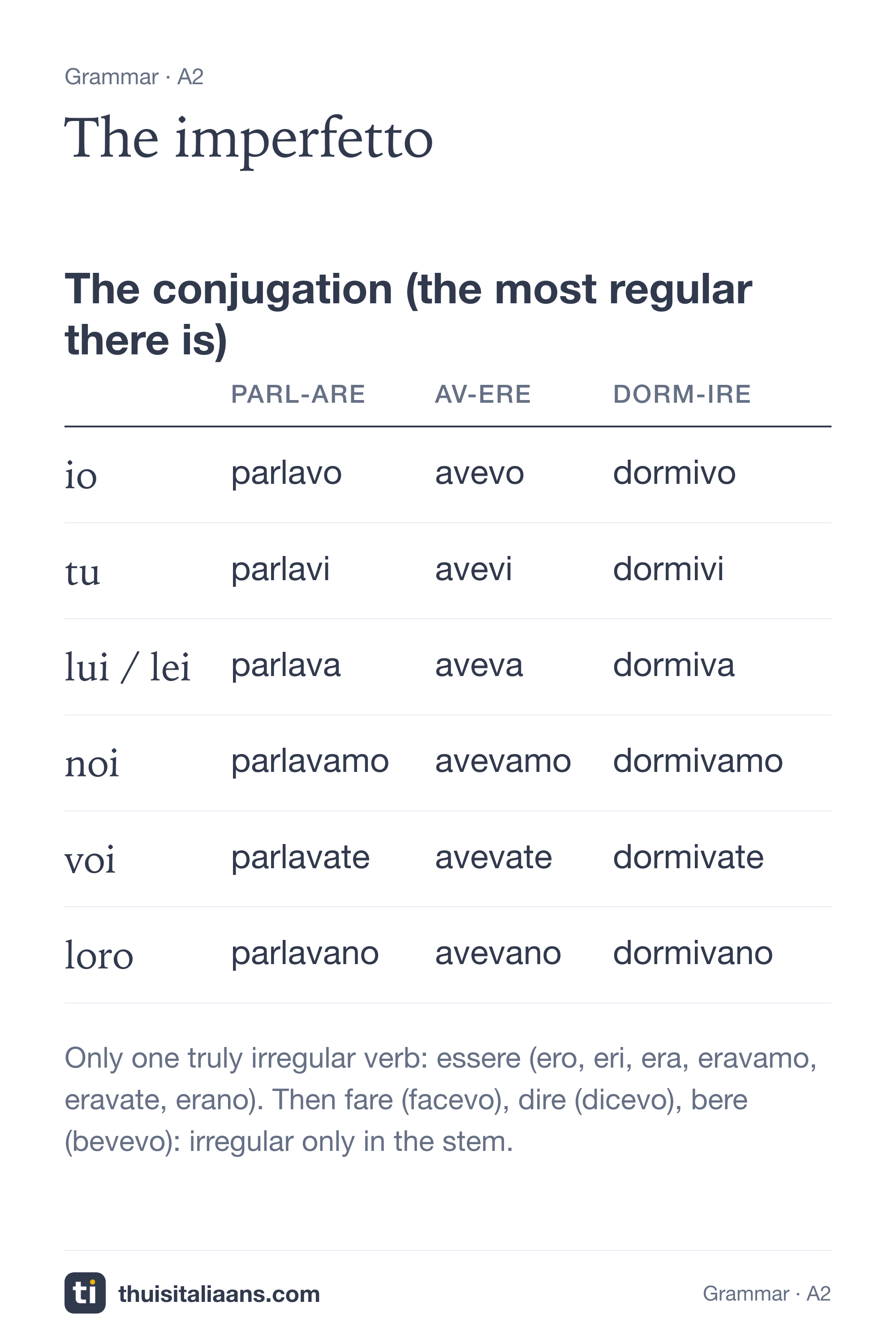
The conjugation (the most regular there is)
| parl-ARE | av-ERE | dorm-IRE | |
|---|---|---|---|
| io | parlavo | avevo | dormivo |
| tu | parlavi | avevi | dormivi |
| lui / lei | parlava | aveva | dormiva |
| noi | parlavamo | avevamo | dormivamo |
| voi | parlavate | avevate | dormivate |
| loro | parlavano | avevano | dormivano |
When to use it
| Use | Family example |
|---|---|
| abitudini nel passato | ogni estate andavamo al paese dei nonni |
| descrizioni | la casa era piccola e profumava di pane |
| età, tempo, stati d’animo | avevo otto anni, faceva caldo, ero felice |
| azione di sfondo | mentre la nonna cucinava, il nonno raccontava |
The most common mistakes
ieri andavo al cinema e ho visto un film→ ieri sono andato al cinema: a completed event, not a habitquando ero piccolo, sono andato ogni estate al mare→ andavo ogni estate: habits take the imperfettola nonna stava cucinando quando arrivavo→ quando sono arrivato: the interrupting event is passato prossimo
Did you know?
Read and understand
This chapter’s grammar. Example: a chat about old memories.
online
Questions
Che cosa regalava la signora Pia?
Che cosa c'è adesso al posto del bar?
«Andavamo», «facevamo», «stavamo»: perché l'imperfetto?
Completa il ricordo: «Da piccolo io ___ moltissimo» (dormire).

Exercises
Five exercises in order of difficulty. The last ones bring back what you have already seen.
01 Le tre coniugazioni
Complete with the imperfetto.
- io (parlare)
- tu (leggere)
- lui (dormire)
- noi (lavorare)
- voi (prendere)
- loro (finire)
02 I pochi irregolari
In the imperfetto almost everything is regular. These are not: complete.
- io (essere)
- tu (fare)
- lei (dire)
- noi (bere)
- voi (essere)
- loro (fare)
03 Com’era, cosa si faceva
The imperfetto describes and tells habits. Complete.
- Da bambino (io / abitare) in campagna.
- La casa (essere) grande e (avere) un giardino.
- Ogni estate (noi / andare) dai nonni.
- Mia nonna (fare) la pasta a mano.
- (esserci) sempre molti bambini.
- (io / essere) felice.
04 Passato prossimo o imperfetto?
The background goes in the imperfetto, the event that happens in the passato prossimo. Choose.
- Mentre (io / dormire) , (suonare) il telefono.
- (essere) le otto quando Marco (arrivare) .
- Ieri (piovere) tutto il giorno, così (noi / restare) a casa.
- Da piccola (lei / avere) i capelli lunghi, poi li (tagliare) .
- (noi / camminare) in centro quando (vedere) Luca.
- Il film (essere) bello: mi (piacere) molto.
05 L’estate di una volta
Complete, choosing between imperfetto and passato prossimo.
Review passato prossimo
- Quando (io / essere) piccolo, (passare) le estati al mare.
- Una volta (io / perdersi) sulla spiaggia e (piangere) per un’ora.
- Mia madre mi (cercare) dappertutto: (essere) molto preoccupata.
- Alla fine un signore che (vendere) gelati mi (aiutare) .
- Da quel giorno (io / stare) sempre vicino all’ombrellone.
- (essere) estati semplici, ma (noi / divertirsi) molto.
These five are a taste. There are over seven hundred on the site, free and with no sign-up. All the exercises →

Every topic, a world
In the  amo Italian app, grammar is practised inside thematic pathways with field-specific vocabulary: il bar, i trasporti, il calcio, la moda, la burocrazia and seventeen more. Choose your world and the grammar comes along by itself, explained in your language too.
Half the path free, no sign-up
★★★★★(11)by Alessio, teacher since 2018
Downloadamo Italian for iPhone ↗︎Search for amo Italian

Read and understand
This chapter’s grammar. Example: an article about the old days.
Il Corriere del Quartiere
giovedì 9 aprile · pagina 5
Memoria
Quando in piazza c'era il cinema
di Anna Foschi
Negli anni Settanta la piazza era il salotto del quartiere. Il sabato sera le famiglie andavano tutte al cinema Astra: il biglietto costava come due caffè.
Davanti all'ingresso un signore vendeva le caldarroste e i ragazzi aspettavano le ragazze sotto l'orologio.
«Non avevamo niente e avevamo tutto», racconta Bruno, 81 anni, che allora faceva la maschera in sala.
Il cinema ha chiuso nel 1994. Oggi al suo posto c'è un supermercato.
Questions
Quanto costava il biglietto del cinema?
Che lavoro faceva Bruno al cinema?
«Il cinema ha chiuso nel 1994»: perché qui NON c'è l'imperfetto?
Completa il ricordo: «Da bambini noi ___ qui ogni estate» (venire).
One more go
Put into the imperfetto:
- Da bambina (io) le estati in Sicilia.
- I nonni una casa in campagna.
- La cucina sempre di caffè.
- Mentre la nonna , noi giocavamo in cortile.
- (Noi) felici e non lo sapevamo.
Frequently asked questions
Why do Italians say volevo un caffè when they still want it?
It is the imperfetto of courtesy: the past softens the request, like English “I wanted to ask”. Volevo un’informazione, volevo chiederti una cosa: pure politeness, no time travel involved.
How do I translate “used to”?
With the plain imperfetto: abitavo a Torino covers “I used to live in Turin”. Italian needs no extra verb: habit is exactly what this tense is for. Add da bambino, una volta, ai tempi if you want to underline it.
What does abitavo lì da due anni mean?
“I had been living there for two years” (at some past moment). Imperfetto + da is the past twin of presente + da: an action already running for some time, seen from inside. English needs a heavy “had been -ing”; Italian does it with one tense and one preposition.
 The conjugation (the most regular there is)