

Grammar · B2
Conditionals: types 1 and 2
by Alessio · teacher of Italian as a foreign language, ITALS master’s

Italian hypotheses have two gears: reality (se segna, vinciamo: indicative) and possibility (se segnasse, vinceremmo: imperfect subjunctive + conditional). Logic before labels: how much do you believe it?
- 6min reading
- 20min exercises
- B2level
What you learn
- 1: realtà, 2: possibilità
- When to use conditionals
- The most common mistakes
- Vocabulary: il calcio
Italian and English side by side
English conditionals map fairly well: type 1 with the present, type 2 with the past + would. Italian does the same with the indicative and with congiuntivo imperfetto + condizionale: se avessi tempo, verrei = if I had time, I would come. The forms differ, the logic does not.
Take this page with you
This chapter’s sheet as a free printable PDF (tables in Italian): rules, typical mistakes and the quiz with answers. A teacher’s tip: grammar sticks by reviewing it often, not by studying it once.
The hypothesis opens a branch: if that branch comes true, the consequence follows on the conditional.


The words on this page
Drag each Italian word onto its definition, or tap a word first, then its box.
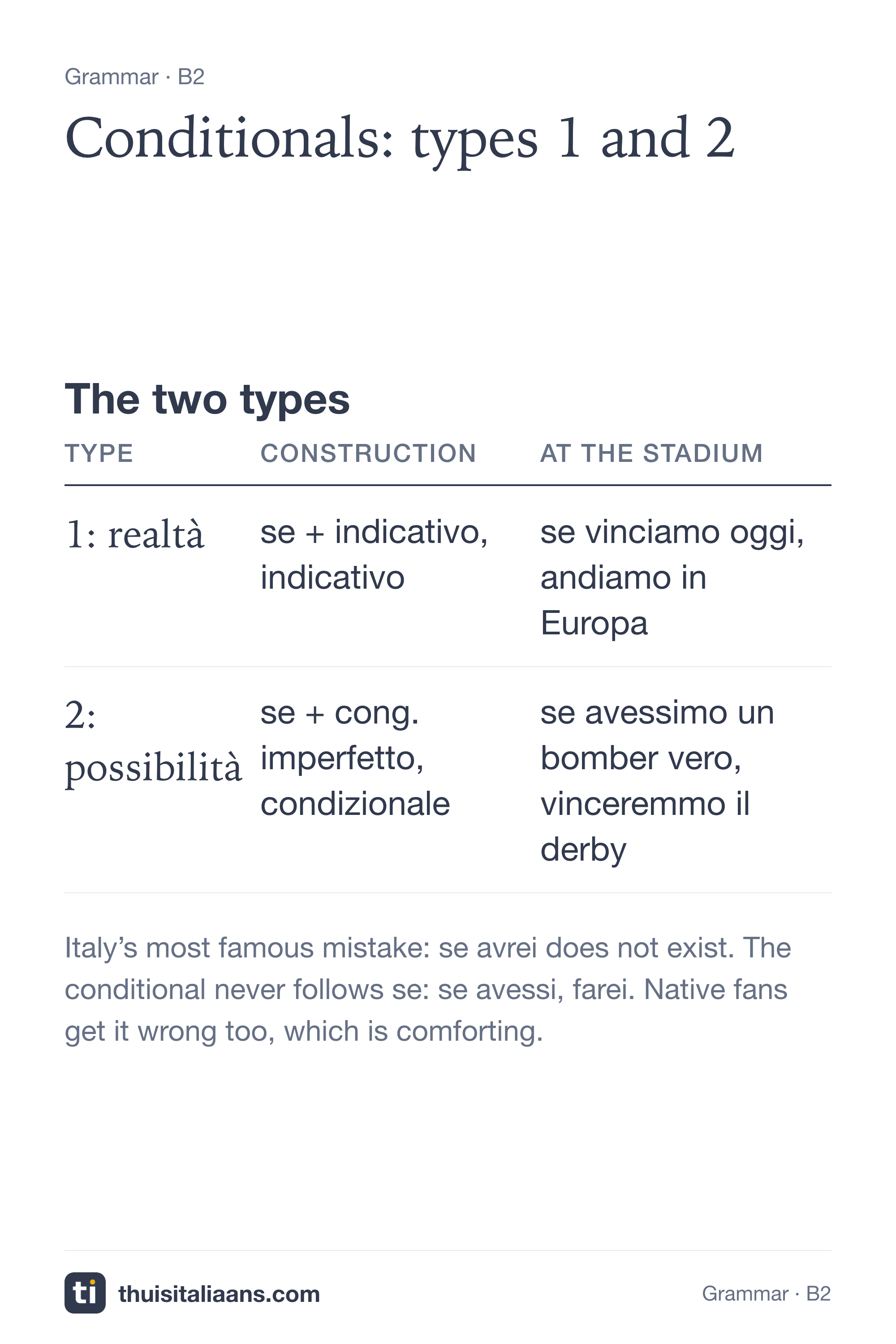
The two types
| Type | Construction | At the stadium |
|---|---|---|
| 1: realtà | se + indicativo, indicativo | se vinciamo oggi, andiamo in Europa |
| 2: possibilità | se + cong. imperfetto, condizionale | se avessimo un bomber vero, vinceremmo il derby |
Sports-bar nuances
| Sentence | Reading |
|---|---|
| se l’arbitro fischia il rigore, è finita | lo considero probabile: tipo 1 |
| se giocasse il capitano, sarebbe un’altra partita | ma è infortunato: tipo 2 |
| se per caso arrivassimo quarti, faremmo festa | possibile ma remoto: tipo 2 |
The most common mistakes
se avrei i soldi, comprerei l’abbonamento→ se avessi i soldi, comprerei l’abbonamento (never the conditional after se)se il mister cambierebbe modulo, vinciamo→ se il mister cambiasse modulo, vinceremmo (full type 2)se segniamo, vinceremmo→ se segniamo, vinciamo (coherent type 1) or se segnassimo, vinceremmo
Did you know?
Read and understand
This chapter’s grammar. Example: a chat about a lake trip.
ultimo accesso 17:40
Questions
Che fine ha fatto il furgone di Paolo?
Dove si possono noleggiare le bici?
«Se il tempo regge, facciamo il giro lungo»: che ipotesi è?
«Se avessi il furgone, porterei le bici»: perché questa coppia di verbi?
Completa: «Se ___ alla lotteria, farei un anno di viaggi» (vincere).
Exercises
Five exercises in order of difficulty. The last ones bring back what you have already seen.
01 La realtà: tipo 1
Se + indicative, then indicative or imperative. Complete.
- Se (piovere) , resto a casa.
- Se (tu / avere) tempo, chiamami.
- Se (noi / partire) presto, arriveremo per pranzo.
- Se lo (tu / vedere) , digli di chiamarmi.
- Se (esserci) sciopero, prendo la macchina.
- Se (voi / volere) , vi accompagno io.
02 La possibilità: tipo 2
Se + imperfect subjunctive, then present conditional. Complete.
- Se (io / avere) tempo, (venire) volentieri.
- Se (tu / studiare) di più, (passare) l’esame.
- Se (noi / vivere) in Italia, (parlare) meglio.
- Se (loro / essere) qui, ci (aiutare) .
- Se (fare) meno caldo, (io / uscire) .
- Che cosa (tu / fare) se (vincere) alla lotteria?
03 Tipo 1 o tipo 2?
Write 1 if the thing is likely, 2 if it is only possible or unreal (where the number is already there, just complete), then complete the verbs.
- Se domani (esserci) il sole, andiamo al mare.
- Se (io / essere) in te, non lo farei.
- Se (tu / finire) presto, ti aspetto.
- [2] Se (noi / avere) una casa più grande, (potere) ospitarti.
- Se il treno (essere) in ritardo, avvisami.
- [2] Se (loro / accettare) , (cambiare) tutto.
04 Come si dice altrimenti
Rewrite the sentence without se, using the expression in brackets.
- Se non piove, esco. (a meno che) →
- Se studi, passi. (basta che) →
- Se avessi tempo, verrei. (magari) →
- Se me lo dici, ti aiuto. (purché) →
- Se fossi ricco, viaggerei. (al posto tuo) →
- Se non parti ora, perdi il treno. (altrimenti) →
05 Il colloquio
Complete with first and second type conditionals.
Review congiuntivo imperfetto · B1: condizionale presente
- Se (voi / assumermi) , (io / cominciare) subito.
- Se (io / avere) più esperienza nel settore, (essere) più tranquillo.
- Se il posto (richiedere) trasferte, non è un problema.
- Se (io / potere) scegliere, (preferire) il part-time.
- Se (voi / avere) altre domande, sono qui.
- Se (io / non ricevere) notizie, (io / richiamare) fra due settimane.
These five are a taste. There are over seven hundred on the site, free and with no sign-up. All the exercises →

Every topic, a world
In the  amo Italian app, grammar is practised inside thematic pathways with field-specific vocabulary: il bar, i trasporti, il calcio, la moda, la burocrazia and seventeen more. Choose your world and the grammar comes along by itself, explained in your language too.
Half the path free, no sign-up
★★★★★(11)by Alessio, teacher since 2018
Downloadamo Italian for iPhone ↗︎Search for amo Italian
Read and understand
This chapter’s grammar. Example: an interview about the pool.
La Gazzetta della Domenica
domenica 15 giugno · pagina 4
L'intervista
«Se i fondi arrivassero, la piscina riaprirebbe entro un anno»
di Elisa Marchetti
La piscina comunale è chiusa da due anni. Ne parliamo con l'assessora Ricci, che non si nasconde.
«Se il bando va bene, i lavori partono in autunno», spiega. «E se tutto procedesse senza sorprese, potremmo riaprire per l'estate».
I costi restano il nodo: «Se dovessimo rifare anche il tetto, la spesa salirebbe parecchio. Ma se i cittadini continuano a scriverci così numerosi, una strada la troviamo».
E chiude con l'immagine a cui tiene: «Se un bambino di oggi imparasse a nuotare qui tra due estati, per me sarebbe il traguardo più bello».
Questions
Da quanto tempo è chiusa la piscina?
Se il bando va bene, quando partono i lavori?
«Se il bando va bene, i lavori partono»: perché qui l'indicativo?
«Se dovessimo rifare il tetto, la spesa salirebbe»: «dovessimo» è…
Completa: «Se non piovesse, ___ a piedi» (noi, andare).
Want another text on this topic? If I won a million
One more go
Build the hypothesis:
- Se stasera, andiamo in finale.
- Se un portiere migliore, meno gol.
- Se il capitano , sarebbe tutta un’altra storia.
- Se l’arbitro il rigore, la partita è chiusa.
Frequently asked questions
Can I use the future after se?
Yes, in type 1: se pioverà, rimanderemo la partita: future in both clauses is correct and common for real future conditions. What can never follow se is the conditional: the future is welcome, se pioverà is fine, se pioverebbe does not exist.
Is type 2 only for impossible things?
No: it covers the unlikely-but-open future too: se domani vincessi alla lotteria, smetterei di lavorare. Tomorrow has not happened yet: the imperfect subjunctive is not saying “impossible”, it is saying “I’m not counting on it”. Type 1 believes; type 2 daydreams.
Are there alternatives to se?
Several, all with the subjunctive: qualora, nel caso in cui, casomai, a patto che: qualora ci fossero problemi, chiamatemi. They raise the register a step: useful in emails and formal writing, where a well-placed qualora quietly announces your level.
 The two types