

Grammar · A2
Essere or avere? Choosing the auxiliary
by Alessio · teacher of Italian as a foreign language, ITALS master’s

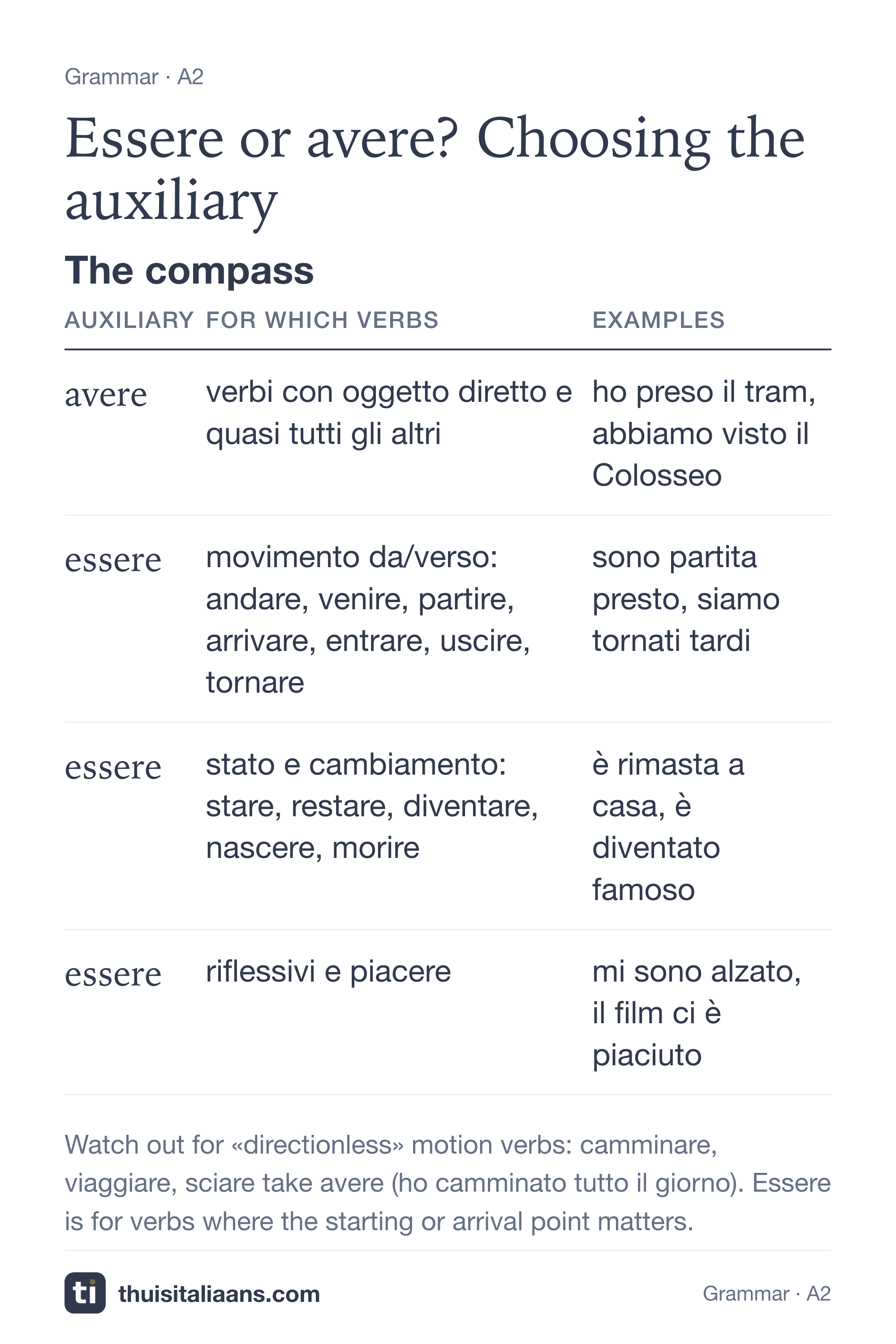
The A2 question: ho or sono? The compass: avere for most verbs; essere for movement and change of state, for reflexives, and for piacere. And with essere, the participle agrees.
- 5min reading
- 16min exercises
- A2level
What you learn
- avere, essere, essere, essere
- Essere or avere? Choosing the auxiliary
- The most common mistakes
- Vocabulary: viaggi e spostamenti
Italian and English side by side
English builds every compound past with have. Italian chooses between avere and essere, and with essere the participle agrees: è andata, not è andato, if the subject is female. Movement and change of state take essere. The closest English echo is the old he is gone.
Take this page with you
This chapter’s sheet as a free printable PDF (tables in Italian): rules, typical mistakes and the quiz with answers. A teacher’s tip: grammar sticks by reviewing it often, not by studying it once.


The words on this page
Drag each Italian word onto its definition, or tap a word first, then its box.
The compass
| Auxiliary | For which verbs | Examples |
|---|---|---|
| avere | verbi con oggetto diretto e quasi tutti gli altri | ho preso il tram, abbiamo visto il Colosseo |
| essere | movimento da/verso: andare, venire, partire, arrivare, entrare, uscire, tornare | sono partita presto, siamo tornati tardi |
| essere | stato e cambiamento: stare, restare, diventare, nascere, morire | è rimasta a casa, è diventato famoso |
| essere | riflessivi e piacere | mi sono alzato, il film ci è piaciuto |
| Agreement with essere | Example |
|---|---|
| maschile singolare: -o | Marco è salito al binario 3 |
| femminile singolare: -a | Anna è salita sul rapido |
| maschile plurale: -i | i turisti sono scesi a Firenze |
| femminile plurale: -e | le ragazze sono partite ieri |
The most common mistakes
ho arrivato in ritardo→ sono arrivato in ritardo (arrivare: motion towards)siamo viaggiato tutta la notte→ abbiamo viaggiato tutta la notte (viaggiare takes avere)Anna è salito sul treno→ Anna è salita sul treno (feminine agreement)
Did you know?
Read and understand
This chapter’s grammar. Example: a postcard from Naples.
Cari tutti,
siamo arrivati a Napoli martedì. Abbiamo mangiato la pizza vera e abbiamo camminato per ore, dal porto fino ai quartieri alti.
Ieri siamo saliti sul Vesuvio: è stata una giornata incredibile. Papà ha comprato un cappello ridicolo.
Il tempo è cambiato solo oggi: piove, così abbiamo visitato il museo. Domani ultimo giorno.
A presto, Emma
ITALIANE
C.P.
Herenstraat 12
3512 KA Utrecht
Questions
Quando sono arrivati a Napoli?
Che cosa hanno fatto oggi, con la pioggia?
Perché «abbiamo mangiato» ma «siamo arrivati»?
Completa: «Il treno ___ in ritardo» (partire).

Exercises
Five exercises in order of difficulty. The last ones bring back what you have already seen.
01 Essere o avere?
Write only the right auxiliary.
- mangiato
- andato
- partito
- letto
- arrivata
- dormito
02 I verbi di movimento e di stato
These take essere. Complete in the passato prossimo.
- Anna (uscire) alle otto.
- (noi / rimanere) a casa.
- I treni (partire) in orario.
- (tu, Sara) (entrare) senza bussare!
- Il pacco (arrivare) ieri.
- (io) (stare) male tutta la notte.
03 Lo stesso verbo, due ausiliari
With an object they take avere, without an object essere. Complete.
- (io) finito il lavoro.
- Il film finito alle dieci.
- (noi) cominciato la lezione.
- La lezione cominciata.
- (io) cambiato casa.
- Il tempo cambiato.
04 Servire, piacere, mancare
These take essere and agree with the thing that pleases or is needed. Complete.
- Mi (piacere) il film.
- Mi (piacere) le canzoni.
- Ci (servire) due biglietti.
- Ti (mancare) l’Italia?
- Gli (piacere) la pizza.
- Vi (bastare) i soldi?
05 La gita
Complete: right auxiliary, participle agreeing where needed.
Review passato prossimo · imperfetto
- Domenica (noi / partire) presto e (prendere) il treno.
- (noi / arrivare) a Siena alle nove: (essere) una bella mattina.
- Le mie amiche (visitare) il duomo, io (restare) in piazza.
- Ci (piacere) molto i vicoli del centro.
- A mezzogiorno (noi / mangiare) e poi (tornare) indietro.
- (essere) una giornata perfetta.
These five are a taste. There are over seven hundred on the site, free and with no sign-up. All the exercises →

Every topic, a world
In the  amo Italian app, grammar is practised inside thematic pathways with field-specific vocabulary: il bar, i trasporti, il calcio, la moda, la burocrazia and seventeen more. Choose your world and the grammar comes along by itself, explained in your language too.
Half the path free, no sign-up
★★★★★(11)by Alessio, teacher since 2018
Downloadamo Italian for iPhone ↗︎Search for amo Italian

Read and understand
This chapter’s grammar. Example: a news report on the storm.
Il Corriere del Quartiere
martedì 18 novembre · pagina 3
Cronaca
Il temporale è passato, i danni restano
di Sergio Valli
Il temporale di domenica è durato venti minuti ma ha lasciato il segno: un albero è caduto sulla pista ciclabile e il torrente è salito di un metro.
«Abbiamo passato la notte a controllare gli argini», racconta un volontario della protezione civile.
I lavori di pulizia sono cominciati ieri e sono costati finora ventimila euro. Il mercato del martedì ha cambiato piazza, ma solo per questa settimana.
Questions
Quanto è durato il temporale?
Che cosa è caduto sulla pista ciclabile?
«Il temporale è passato» ma «abbiamo passato la notte»: perché?
Completa: «Il film ___ alle nove» (cominciare).
Want another text on this topic? Booking a table
One more go
Choose the right auxiliary:
- Il treno partito dal binario 9.
- (Noi) camminato fino alla stazione.
- Le mie amiche con l’autobus.
- (Io) preso un taxi sotto la pioggia.
- Maria a casa: era stanca.
Frequently asked questions
Is it è piovuto or ha piovuto?
Both: with weather verbs (piovere, nevicare) modern grammars and the Accademia della Crusca accept either auxiliary. Ieri è piovuto tutto il giorno and ieri ha piovuto tutto il giorno are equally correct: pick one and do not lose sleep.
Why does cominciare take both auxiliaries?
It depends on the object: with one, avere (ho cominciato il corso); without, essere (il corso è cominciato). Same story for finire and cambiare: when the thing itself starts, ends or changes, it takes essere.
Ho vissuto or sono vissuto?
Both are accepted: vivere is one of the verbs with a double passport. Ho vissuto a Roma per dieci anni is the more common choice today, but sono vissuto is equally grammatical, and the participle then agrees: Anna è vissuta a lungo.
 The compass