

Grammar · B1
The present subjunctive
by Alessio · teacher of Italian as a foreign language, ITALS master’s

The subjunctive is not a monster: it is a signal. It says that what follows passes through a point of view: penso che sia un capolavoro does not state a fact, it states my opinion. It switches on after verbs of opinion, emotion, doubt and will.
- 6min reading
- 15min exercises
- B1level
What you learn
- noi, voi, loro
- When to use the present subjunctive
- The most common mistakes
- Vocabulary: l'opera
Italian and English side by side
English lost the subjunctive except in fossils like if I were you. Italian uses it constantly, after any verb of opinion, doubt or wish: penso che sia, not penso che è. It is not elegance, it is grammar: leaving it out sounds wrong the way he go sounds wrong.
Take this page with you
This chapter’s sheet as a free printable PDF (tables in Italian): rules, typical mistakes and the quiz with answers. A teacher’s tip: grammar sticks by reviewing it often, not by studying it once.
The subjunctive is a bubble floating above the facts: what is thought, feared or hoped, not what is.


The words on this page
Drag each Italian word onto its definition, or tap a word first, then its box.
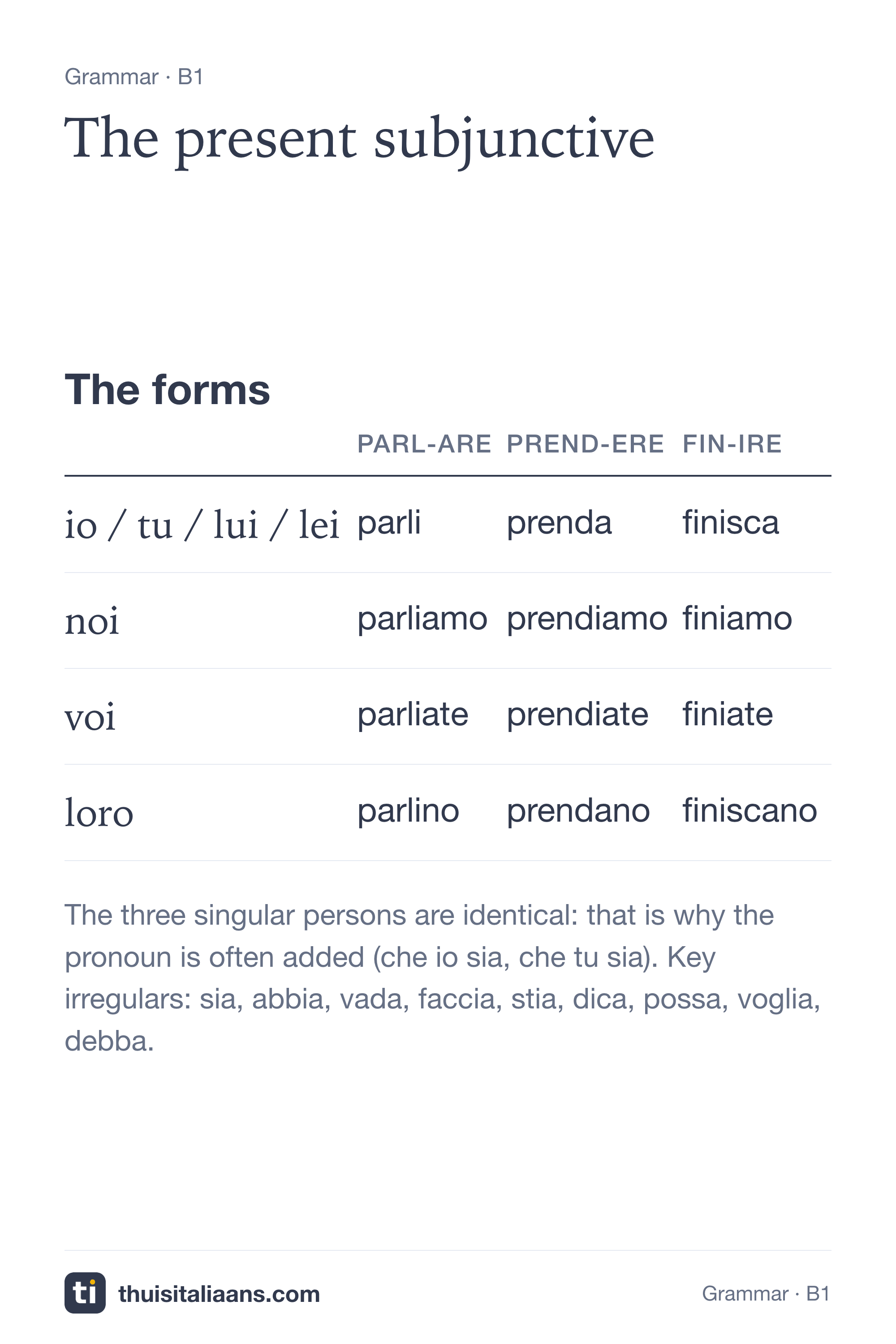
The forms
| parl-ARE | prend-ERE | fin-IRE | |
|---|---|---|---|
| io / tu / lui / lei | parli | prenda | finisca |
| noi | parliamo | prendiamo | finiamo |
| voi | parliate | prendiate | finiate |
| loro | parlino | prendano | finiscano |
The switches
| After | Opera example |
|---|---|
| opinione: penso, credo, mi sembra che | credo che questa Traviata sia straordinaria |
| emozione: sono felice, temo, mi dispiace che | temo che il tenore sia raffreddato |
| volontà: voglio, spero, preferisco che | spero che il bis ci sia |
| dubbio e impersonali: è possibile, bisogna che | è possibile che il loggione fischi |
The most common mistakes
penso che è una bella regia→ penso che sia una bella regia (opinion switches on the subjunctive)credo che io sono in ritardo→ credo di essere in ritardo (same subject: di + infinitive)secondo me sia un capolavoro→ secondo me è un capolavoro (secondo me takes the indicative)
Did you know?
Read and understand
This chapter’s grammar. Example: the teacher's email.
Gita al museo: penso che sia la settimana giusta
daMaestra Elena Corti <e.corti@scuolaverdi.edu.it>
agenitori.3b@scuolaverdi.edu.it
datalun 5 mag, 17:05
Gentili genitori,
credo che la classe sia pronta per la gita al museo della scienza. Penso che i bambini non parlino d'altro da settimane.
È importante che ognuno porti uno zaino leggero e che nessuno dimentichi la borraccia. Non è necessario che compriate il pranzo: c'è la mensa del museo.
Temo che il pullman parta presto, alle 7.30: mi dispiace! E spero che venerdì non piova.
Per qualsiasi dubbio potete scrivermi qui.
Un caro saluto,
Elena
Questions
A che ora parte il pullman?
Perché non serve comprare il pranzo?
«Penso che sia pronta»: perché non «penso che è»?
Completa: «Spero che tu ___ presto» (arrivare).
Exercises
Five exercises in order of difficulty. The last ones bring back what you have already seen.
01 Le forme
Complete with the present subjunctive.
- che io (parlare)
- che tu (prendere)
- che lui (dormire)
- che noi (lavorare)
- che voi (scrivere)
- che loro (finire)
02 Gli irregolari che servono davvero
Complete.
- che io (essere)
- che tu (avere)
- che lei (fare)
- che noi (andare)
- che voi (potere)
- che loro (venire)
- che io (sapere)
- che tu (dare)
03 Chi lo chiama
Opinion, doubt, feeling and will call for the subjunctive. Complete.
- Penso che (lui / avere) ragione.
- Spero che (voi / stare) bene.
- Non credo che (loro / venire) stasera.
- Voglio che (tu / dirmi) la verità.
- Mi dispiace che (lei / non potere) restare.
- È possibile che (esserci) sciopero domani.
04 Congiuntivo o indicativo?
With so che, è vero che, secondo me the indicative stays. Choose.
- So che (lui / essere) a Roma.
- Credo che (lui / essere) a Roma.
- È vero che (loro / avere) ragione.
- Dubito che (loro / avere) ragione.
- Secondo me (tu / sbagliare) .
- Mi sembra che (tu / sbagliare) .
05 Il messaggio al collega
Complete with subjunctive, indicative or conditional, according to what the sentence asks for.
Review condizionale presente · A2: pronomi indiretti
- Ciao, penso che la riunione (essere) alle tre, ma non sono sicuro.
- So che Marta (arrivare) più tardi: me l’ha detto ieri.
- Sarebbe meglio che (noi / cominciare) senza di lei.
- Vuoi che (io / preparare) le slide?
- Spero che (bastare) mezz’ora.
- (tu / potere) confermarmi tu l’orario?
These five are a taste. There are over seven hundred on the site, free and with no sign-up. All the exercises →

Every topic, a world
In the  amo Italian app, grammar is practised inside thematic pathways with field-specific vocabulary: il bar, i trasporti, il calcio, la moda, la burocrazia and seventeen more. Choose your world and the grammar comes along by itself, explained in your language too.
Half the path free, no sign-up
★★★★★(11)by Alessio, teacher since 2018
Downloadamo Italian for iPhone ↗︎Search for amo Italian
Read and understand
This chapter’s grammar. Example: an article on the square debate.
Il Corriere del Quartiere
lunedì 16 febbraio · pagina 1
Il dibattito
Piazza senza auto: sembra che il quartiere sia diviso
di Dario Neri
Da lunedì la piazza è chiusa alle auto, in prova per sei mesi. E il quartiere discute.
I commercianti temono che i clienti vadano altrove: «Non crediamo che una piazza vuota faccia vendere di più».
I genitori della scuola, invece, festeggiano: «Finalmente pare che i bambini possano attraversare da soli».
Il Comune chiede che tutti abbiano pazienza: «È giusto che la prova duri sei mesi; poi decideremo con i numeri sul tavolo».
Comunque vada a finire, una cosa è certa: se ne parlerà a lungo.
Questions
Quanto dura la prova della piazza chiusa?
Che cosa temono i commercianti?
«Sembra che il quartiere sia diviso»: dopo «sembra che» serve…
Completa: «Benché ___ tardi, la piazza è ancora piena» (essere).
Want another text on this topic? The rental contract
One more go
Indicative or subjunctive?
- Credo che la soprano sarda.
- Spero che i biglietti non troppo.
- So che il teatro alle sette.
- Temo che il tenore la voce stanca stasera.
- Penso tornare per il secondo atto.
Frequently asked questions
Is the Italian subjunctive dying out?
No: reports of its death are a recurring myth, and the Accademia della Crusca regularly debunks it. Informal speech sometimes swaps in the indicative, but educated speech, writing, exams and the press all require the subjunctive: mastering it is not optional polish, it is standard Italian.
Can I say penso che arriverà, with the future?
Yes: when the subordinate clearly points forward, the future indicative is accepted even after opinion verbs: penso che arriverà domani, alongside the subjunctive penso che arrivi domani. It is one of the system’s official safety valves, not a mistake.
Do forse and probabilmente trigger the subjunctive?
No: they are adverbs, not che-clauses, so the indicative follows: forse è in ritardo, probabilmente ha perso il treno. The subjunctive needs the full structure verb + che: doubt alone is not enough, the grammar switch must be there.
 The forms