

Grammar · C1
Conditionals: type 3 and mixed
by Alessio · teacher of Italian as a foreign language, ITALS master’s

The third type is the grammar of regret: se avessi accettato quell’offerta, oggi sarei a Milano. Pluperfect subjunctive in the hypothesis, past conditional (or present, in mixed types) in the consequence. It is the tense of career retrospectives.
- 6min reading
- 22min exercises
- C1level
What you learn
- ipotesi, conseguenza passata
- When to use conditionals
- Type 3: past unreality
- Vocabulary: la carriera
Italian and English side by side
The third conditional maps onto English almost exactly: se avessi saputo, sarei venuto = if I had known, I would have come. Mixed conditionals work too (se avessi studiato medicina, ora sarei medico), with the same split between a past cause and a present result.
Take this page with you
This chapter’s sheet as a free printable PDF (tables in Italian): rules, typical mistakes and the quiz with answers. A teacher’s tip: grammar sticks by reviewing it often, not by studying it once.
The hypothesis opens a branch: if that branch comes true, the consequence follows on the conditional.


The words on this page
Drag each Italian word onto its definition, or tap a word first, then its box.
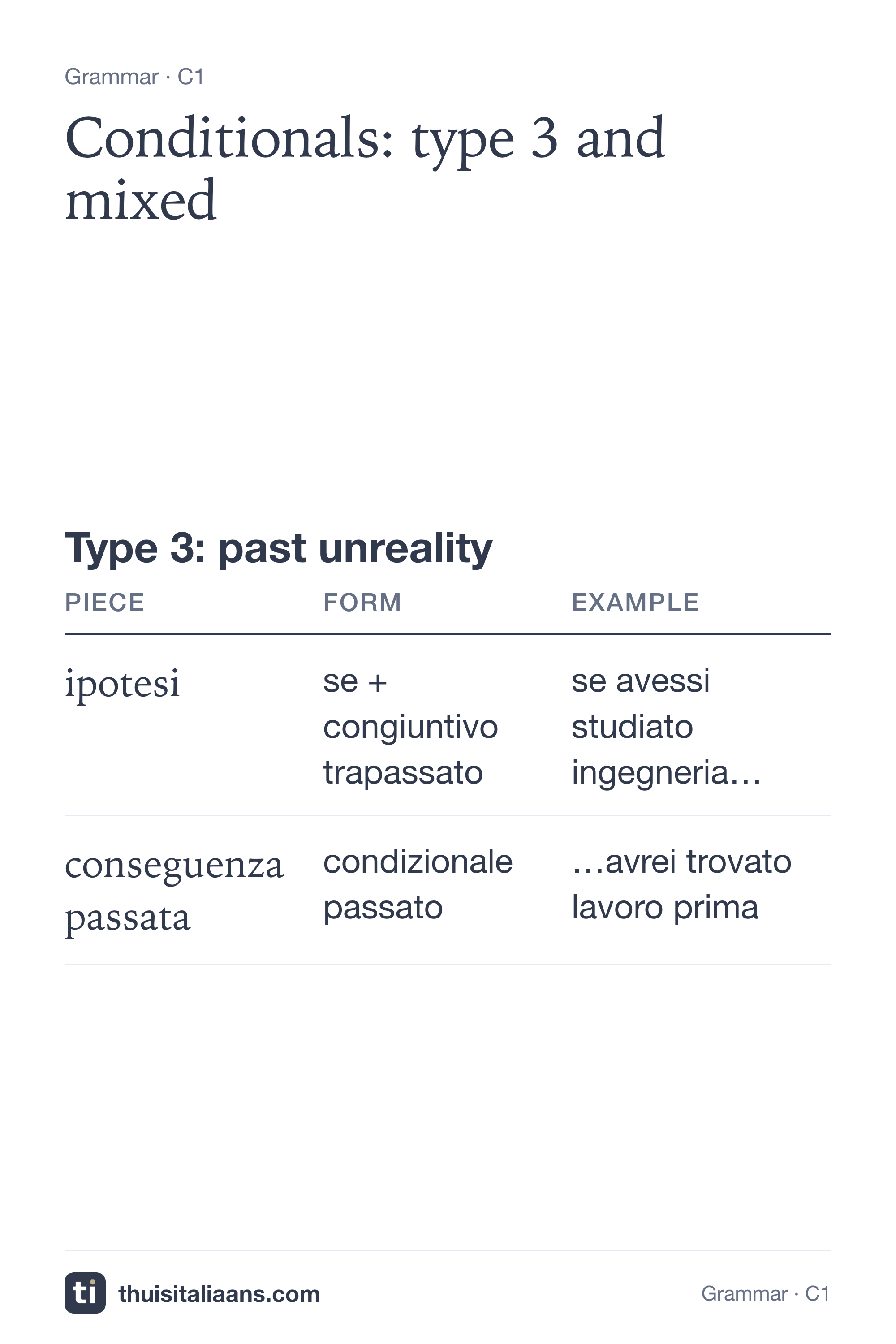
Type 3: past unreality
| Piece | Form | Example |
|---|---|---|
| ipotesi | se + congiuntivo trapassato | se avessi studiato ingegneria… |
| conseguenza passata | condizionale passato | …avrei trovato lavoro prima |
Mixed types: a past that weighs on the present
| Hypothesis | Consequence | Example |
|---|---|---|
| nel passato (trapassato) | nel presente (condizionale presente) | se avessi accettato, ora sarei dirigente |
| permanente (imperfetto) | nel passato (condizionale passato) | se fossi più paziente, non avrei litigato col capo |
The most common mistakes
se avrei saputo del colloquio, mi sarei preparato→ se avessi saputo del colloquio, mi sarei preparato (never the conditional after se)se avessi accettato, oggi sarei stato a Milano→ se avessi accettato, oggi sarei a Milano (present consequence: present conditional)se firmavo quel contratto, ora ero ricco (in una mail formale)→ se avessi firmato quel contratto, ora sarei ricco (written register)
Did you know?
Exercises
Five exercises in order of difficulty. The last ones bring back what you have already seen.
01 L’irrealtà nel passato
Se + congiuntivo trapassato, poi condizionale composto. Completa.
- Se (io / sapere) , (venire) .
- Se (tu / studiare) , (passare) l’esame.
- Se (noi / partire) prima, (arrivare) in tempo.
- Se me lo (loro / dire) , li (io / aiutare) .
- Se (non piovere) , (noi / uscire) .
- Se (lei / accettare) , ora (essere) a Roma.
02 I misti
Passato nell’ipotesi e presente nella conseguenza, o il contrario. Completa.
- Se (io / studiare) medicina, ora (essere) medico.
- Se (tu / essere) più prudente, non (avere) questo problema adesso.
- Se (lui / non essere) così testardo, (accettare) ieri.
- Se (noi / vivere) in città, (potere) venire alla riunione di ieri.
- Se (voi / avvisarmi) in tempo, ora (io / essere) lì.
- Se (lei / non essere) così brava, non l’(assumere) l’anno scorso.
03 Il rimpianto
Riscrivi con il periodo ipotetico del terzo tipo.
- Non ho studiato, quindi non ho passato l’esame. →
- Era tardi, così non siamo usciti. →
- Non me l’ha detto, così non l’ho saputo. →
- Ho perso il treno perché mi sono svegliato tardi. →
- Non avevamo la mappa, quindi ci siamo persi. →
- Pioveva, così la festa è saltata. →
04 Altri modi per dire l’irreale
Riscrivi usando l’espressione indicata.
- Se avessi saputo… (magari) →
- Se non fosse stato per te, non ce l’avrei fatta. (senza) →
- Se avessi potuto, sarei venuto. (volentieri) →
- Se me l’avessero chiesto, avrei detto di sì. (bastava) →
- Se lo avessi visto prima… (avessi) →
- Se non avesse insistito, non sarei andato. (a meno che) →
05 La lettera mai spedita
Completa con ipotetiche del terzo tipo e miste.
Review concordanza dei tempi · B2: periodo ipotetico 1 e 2
- Se te lo (io / dire) allora, forse oggi (noi / essere) ancora amici.
- Se (tu / non partire) così in fretta, ne (noi / parlare) .
- Se (io / essere) meno orgoglioso, ti (cercare) il giorno dopo.
- Se (esserci) ancora tempo, ti (io / chiedere) scusa adesso.
- bastato poco. (essere, condizionale composto)
- Se (tu / leggere) questa lettera, capiresti.
These five are a taste. There are over seven hundred on the site, free and with no sign-up. All the exercises →

Every topic, a world
In the  amo Italian app, grammar is practised inside thematic pathways with field-specific vocabulary: il bar, i trasporti, il calcio, la moda, la burocrazia and seventeen more. Choose your world and the grammar comes along by itself, explained in your language too.
Half the path free, no sign-up
★★★★★(11)by Alessio, teacher since 2018
Downloadamo Italian for iPhone ↗︎Search for amo Italian
One more go
Build regrets and retrospectives:
- Se quell’offerta, carriera più in fretta.
- Se ieri il capo la mia proposta, oggi già operativi.
- Se più diplomatico, quella riunione non male.
Frequently asked questions
Can I drop se altogether?
Yes, in the elegant inverted version: avessi saputo, sarei venuto: the pluperfect subjunctive alone signals the hypothesis. Alone, it becomes pure regret: avessi ascoltato i miei! (if only I had listened). The conjunction is optional; the mood is not.
Can a gerund carry a hypothesis?
Yes: volendo, si potrebbe partire domani (if one wanted), potendo, l’avrei fatto (had I been able). The gerund compresses the whole se-clause into one word: C1 prose uses it for hypotheses too light to deserve a full clause.
How do I say “I should have…”?
Past conditional of dovere: avrei dovuto ascoltarti, avremmo dovuto prenotare. Its siblings: avrei potuto (I could have) and avrei voluto (I would have liked to). The grammar of hindsight: three modals, all in the past conditional.
 Type 3: past unreality