

Grammar · B1
The past perfect
by Alessio · teacher of Italian as a foreign language, ITALS master’s

The past perfect tells what had happened before another past moment: quando Fellini girò La dolce vita, aveva già diretto quattro film. It is the tense that puts history in order.
- 6min reading
- 17min exercises
- B1level
What you learn
- con avere, con essere
- When to use the past perfect
- The most common mistakes
- Vocabulary: le storie di vita
Italian and English side by side
This one maps cleanly: avevo mangiato = I had eaten. Same idea, same construction, one auxiliary difference. Italian may need essere: erano partiti, they had left.
Take this page with you
This chapter’s sheet as a free printable PDF (tables in Italian): rules, typical mistakes and the quiz with answers. A teacher’s tip: grammar sticks by reviewing it often, not by studying it once.
The trapassato says what had already happened before another past event.


The words on this page
Drag each Italian word onto its definition, or tap a word first, then its box.
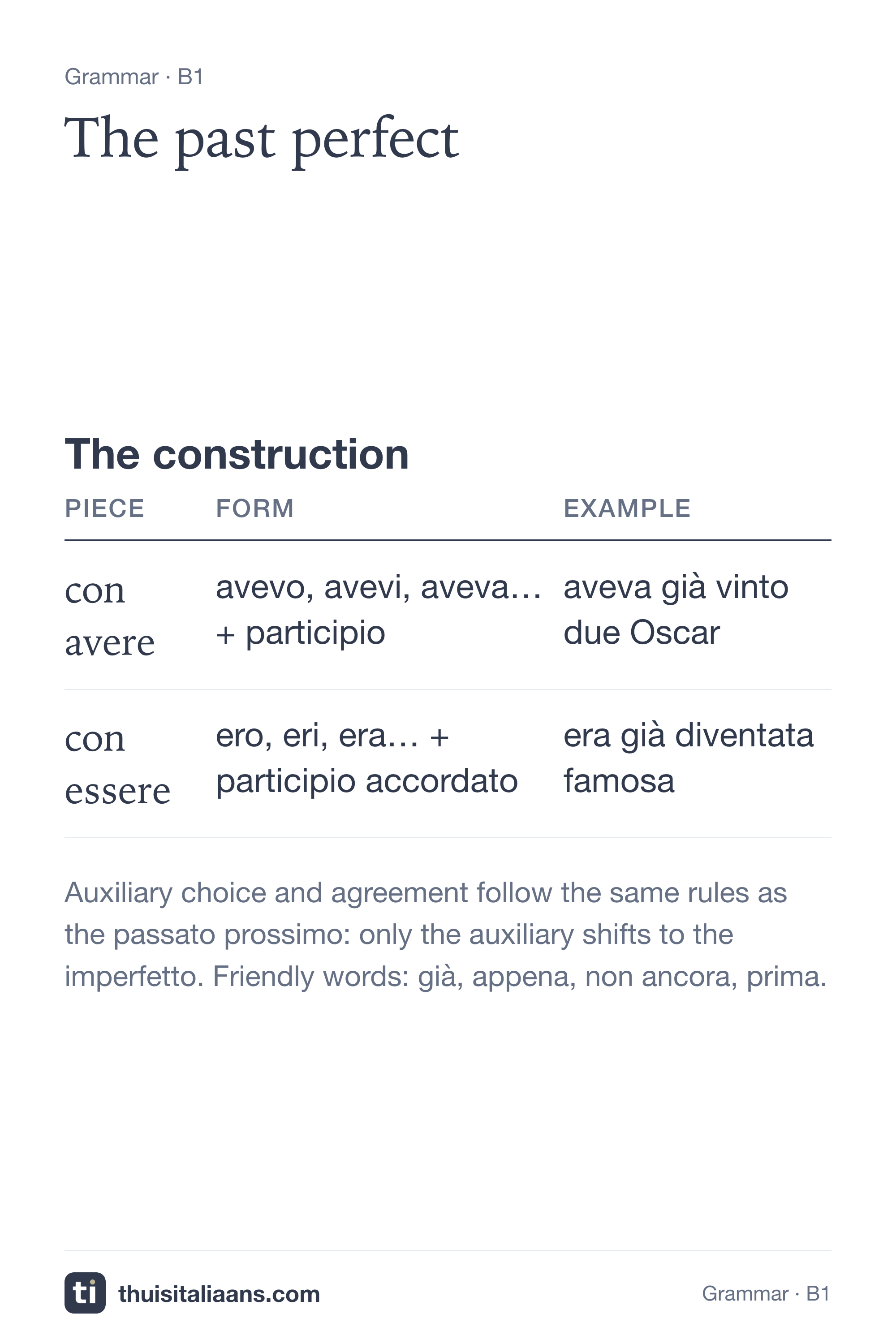
The construction
| Piece | Form | Example |
|---|---|---|
| con avere | avevo, avevi, aveva… + participio | aveva già vinto due Oscar |
| con essere | ero, eri, era… + participio accordato | era già diventata famosa |
Famous lives in order
| Sentence | First → then |
|---|---|
| quando arrivò a Hollywood, aveva già recitato in venti film | recitare → arrivare |
| Marconi aveva appena compiuto ventisette anni quando trasmise oltre l’oceano | compiere → trasmettere |
| non aveva ancora finito il liceo quando scrisse la prima canzone | scrivere prima del diploma |
The most common mistakes
quando è arrivato, il concerto ha cominciato da un’ora→ il concerto era cominciato da un’ora (the before of the past)aveva andata a Roma prima della guerra→ era andata a Roma (andare takes essere, agreed)ho già visto quel film prima che uscisse il seguito, anni fa→ l’avevo già visto (anteriority in the past)
Did you know?
Read and understand
This chapter’s grammar. Example: an email about a lost suitcase.
La storia della valigia (te la devo raccontare)
daLaura Conti <laura.conti@mail.it>
arita.f@mail.it
dataven 21 mar, 19:10
Rita, ascolta questa.
Quando sono arrivata alla stazione, il treno era già partito. Colpa mia: avevo guardato l'orario vecchio, quello invernale.
Alla biglietteria la signora mi ha riconosciuta: le avevo chiesto aiuto anche a Natale, ricordi? Mi ha cambiato il biglietto senza problemi.
Sul treno dopo, la sorpresa: la valigia non c'era. L'avevo lasciata sulla panchina del binario, dove mi ero seduta ad aspettare. Sono tornata di corsa: era ancora lì.
Dentro avevo messo anche il regalo per te. Tutto bene, ma che venerdì.
Laura
Questions
Perché ha perso il treno?
Dove aveva lasciato la valigia?
«Quando sono arrivata, il treno era già partito»: il trapassato indica…
Completa: «Non ho riso alla battuta: la ___ già ___» (sentire).
Exercises
Five exercises in order of difficulty. The last ones bring back what you have already seen.
01 La forma
Imperfetto of essere or avere + participle. Complete.
- io (mangiare)
- tu (partire)
- lei (finire)
- noi (uscire)
- voi (vedere)
- loro (arrivare)
02 Prima del passato
The trapassato says what had already happened. Complete.
- Quando sono arrivato, il film (cominciare) già.
- Non ho mangiato perché (io / mangiare) a casa.
- Marco era stanco: (lavorare) tutto il giorno.
- La casa era sporca: nessuno (pulire) da settimane.
- (loro / uscire) prima che io tornassi.
- Sapevo la notizia: me la (dire) Luca.
03 Metti in ordine i due tempi
The older fact goes in the trapassato, the other in the passato prossimo.
- (io / perdere) il treno / (io / arrivare) tardi →
- (lei / studiare) molto / (lei / passare) l’esame →
- (noi / prenotare) / (noi / trovare) posto →
- (loro / dimenticare) le chiavi / (loro / non entrare) →
- (tu / non dormire) / (tu / essere) stanco →
- (io / vedere) il film / (io / non venire) al cinema →
04 Con già, appena, non ancora
Complete, putting the adverb in the right place.
- Quando ho telefonato, (loro / già uscire) .
- (io / appena finire) di mangiare quando è arrivata.
- Alle otto il negozio (non ancora aprire) .
- (noi / già vedere) quel film due volte.
- (lei / appena tornare) dal lavoro.
- (voi / non ancora capire) il problema.
05 La telefonata mancata
Complete with trapassato, passato prossimo and imperfetto.
Review passato prossimo o imperfetto · pronomi combinati
- Ieri sera (io / provare) a chiamarti tre volte.
- (tu / non rispondere) perché (già andare) a dormire.
- (io / volere) dirti che la riunione (essere) spostata.
- Il capo lo (comunicare) solo alle sette, quando tutti (uscire) .
- Stamattina Marta (arrivare) alle nove e (trovare) la sala vuota.
- Nessuno le (dire) niente: (io / dimenticarsi) di scriverle.
These five are a taste. There are over seven hundred on the site, free and with no sign-up. All the exercises →

Every topic, a world
In the  amo Italian app, grammar is practised inside thematic pathways with field-specific vocabulary: il bar, i trasporti, il calcio, la moda, la burocrazia and seventeen more. Choose your world and the grammar comes along by itself, explained in your language too.
Half the path free, no sign-up
★★★★★(11)by Alessio, teacher since 2018
Downloadamo Italian for iPhone ↗︎Search for amo Italian
Read and understand
This chapter’s grammar. Example: the story of the found wallet.
Il Corriere del Quartiere
sabato 17 gennaio · pagina 3
Storie
Il portafoglio che aveva perso nel 1998 è tornato a casa
di Sergio Valli
Durante i lavori al vecchio teatro, gli operai hanno trovato un portafoglio dietro una poltrona. Il proprietario lo aveva perso una sera di dicembre del 1998: era andato a vedere un concerto e si era accorto del vuoto in tasca solo a casa.
«Avevo cercato dappertutto, ero tornato anche il giorno dopo», racconta oggi il signor Bruni, 63 anni. «Alla fine avevo smesso di pensarci».
Dentro c'era tutto: la patente, due foto e il biglietto del concerto. Il teatro glielo ha riconsegnato ieri, con un invito per il primo spettacolo della nuova stagione.
Questions
Dove hanno trovato il portafoglio?
Che cosa c'era dentro, oltre alla patente e alle foto?
«Era andato a vedere un concerto»: perché il trapassato?
Completa: «Quando siamo arrivati, il film ___ già ___» (cominciare).
Want another text on this topic? News in easy Italian
One more go
Put the past in order:
- Quando vinse l’Oscar, Sophia Loren decine di film.
- Il concerto quando siamo entrati.
- Modugno Volare prima di diventare famoso nel mondo.
- Non il libro quando ho visto il film.
- Quando la incontrai, dall’America.
Frequently asked questions
Is the trapassato ever optional?
When the order of events is already explicit, Italian can relax it: dopo che ha mangiato, è uscito works, because dopo che does the sequencing. But in a flashback with no time markers, the trapassato is what signals the jump backwards: non le ho scritto: avevo perso il suo numero.
Is avevo mangiato the same form I use after se for regrets?
No, careful: avevo mangiato is indicative. Hypotheses and regrets use the subjunctive pluperfect: se avessi mangiato… Same architecture (auxiliary + participle), different mood: the indicative remembers facts, the subjunctive imagines alternatives. That story is in type 3 conditionals.
Does it map onto English “had done”?
Almost perfectly: quando sei arrivato, avevo già cenato = “when you arrived, I had already had dinner”. It is one of the friendliest correspondences between the two languages: if English wants “had + participle”, Italian wants the trapassato.
 The construction